For the New Models module, the concept of hygge in relation to art residencies and installations at the library stood out to me. In particular, when viewing hygge as “[integrating] the life of the community” at the library, art residencies, as demonstrated in the National Library of Singapore video, brings in local artists into a public space where their art is created and displayed for a wider audience (Stephens, 2019, p. 64).
The National Library of Singapore makes sure to choose artists that work in various mediums and provides a space for local artists to work and thrive, while also inspiring the public and having participatory elements that brings in patrons. In particular, Natalia Tan describes how she held accessible and free workshops at the library where community members were able to come in and learn how to weave and tell a story with the pieces they made, which were incorporated into a larger installation at the library@orchard location for everyone to see.
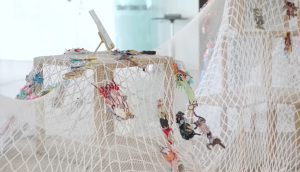
Community Weaving Piece by Natalia Tan and Library Patrons, library@orchard in Singapore
Another aspect of these artist residencies is how it builds community among artists. The Spokane Library has a studio and residency program called The Hive, and it notes how creating art can often be a “solitary activity,” but by having a rotating residency where artists can interact with each other and encourage patrons to participate and talk with the artists, it reduces that solitude (Library Journal, 2025).
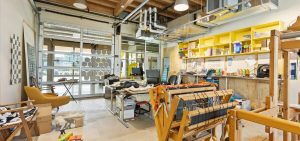
Artist Studio at The Hive in Spokane Public Library, Washington
These aspects of artist residencies at public libraries ties in well with the concept of hygge, along with social infrastructure where community bonds are strengthened along with “collective effervescence” where people create or do something together (Peet, 2018). Natalia Tan also references joy in the participatory aspect of community weaving, referring to a Swedish proverb saying “shared joy is a double joy” in the experience of creating and connecting at the library.
References
Library Journal. (2025, May 5). Eva Silverstone | Movers & shakers 2025 – Community builders. www.libraryjournal.com/story/eva-silverstone-movers-shakers-2025-community-builders
NLB Singapore. (2023, March 23). Beyond books: An art studio in a library | The library report #29 [Video]. YouTube. https://www.youtube.com/watch?v=3VvOGviPic8
Peet, L. (2018, October 3). Eric Klinenberg: Libraries and social infrastructure. Library Journal. https://www.libraryjournal.com/story/181003-Eric-Klinenberg-QA
Public Library Singapore (2023, January 11). On Saori weaving with library@orchard’s resident, Natalia Tan. https://medium.com/publiclibrarysg/on-saori-weaving-with-library-orchards-resident-natalia-tan-6b492ac65e7e
Stephens, M. (2019). Wholehearted librarianship. American Library Association.
Hi, Trisha! I love the Natalia Tan piece, and that the installation itself is like a record of the people who spent time together at the library. I also appreciate your point about solitude at The Hive; residencies seem to serve the artists as much as the public, which is an angle I hadn’t considered.
Hello,
I love discussions around art in the library because they are an amazing way for libraries to partner with local artists and introduce their work to the community.
Thank you for sharing The Hive residency program! What I like about the program is that it not only brings artists together but also includes different types of artwork, such as sculpture, stitchwork, painting, photography, and even sewing! I agree that this type of program really embodies what libraries and hygge are about: connecting and creating with one another.
Thank you for your post!
Hi Trisha!
I enjoyed reading your connection between hygge and artist residencies at the library. Artmaking and art workshops built on the framework of togetherness and conversations is how people develop connections with their creations and the community around them. It is awesome to see more libraries connecting with local artists and offering them spaces to create and share their practice with others. If you are interested in learning about others, the Seattle Public Library currently has a program with four artists-in-residence, and each work in a different area of art (visual, musical, and performing)!
https://www.spl.org/programs-and-services/arts-and-culture/artist-in-residence
Hi Damien! Thanks for sharing the artist residency for Seattle Public Library! I love that they commit to having a diverse group of artists and a variety of mediums. I feel like for younger patrons, it shows a wider world of art in a very accessible way since it’s at a public library.
@tphilip I appreciate the points of inspiration you pulled out of the resources to explore in this post. I think any way we can get art into the library and have art actually being created in the library is such a good thing and could be so inspiring to folks.
Hi Trisha,
I absolutely adored your post especially in connecting art and libraries! Literally two of my favorite subjects, thus it is really neat and special to see the marriage between the two. I particularly enjoyed your points on connecting hygge to these themes as well. I feel like having outlets for art is such an incredible and important vocation we need to have as humans, thus it is delightful to see libraries show up in this way. I also greatly enjoyed the photos you provided within your post. Thanks so much for sharing such neat insights and I hope you have a wondrous weekend ahead!