Category Archives: Uncategorized

Reflection on Hyperlinked Environments & Issues – International Libraries

For this reflection, I decided to focus on International Libraries to tie it back to my previous reflection regarding hyperlinked libraries and English language learners. One thing that came up when I was researching that topic, and something I encounter with patrons while working, is how a lot of new patrons coming in are unfamiliar with how public libraries work, sometimes due to how libraries are perceived or are utilized in the countries they are from. Drawing off of this, seeing how libraries are internationally and what kinds of services are available for patrons seemed like the right direction.

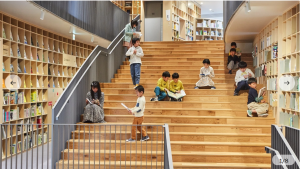
Pezutto (2026) discusses how libraries are perceived in Japan, and right away the first observation is how it is not as common in comparison to public libraries in the United States. There is a disconnect in community engagement and in having accessible services and resources for patrons. However this is combatted through a few approaches, in particular architectural design. Architectural design in the buildings is integral in making a library an open and welcoming space for patrons and having a purpose in mind for who the library is meant for, such as the Nakanoshima Children’s Book Forest.

An image of children browsing books on the stairs inside the Nakanoshima Childrens Book Forest Library.

Photo: Shunsuke Ito

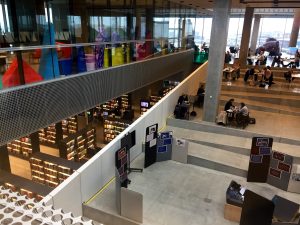
This is an approach that can be seen with the DOKK1 Library in Denmark as well. DOKK1 somehow manages to fit every type of resource or service for any type of patron with quiet spaces, gaming rooms, playgrounds, cafes, reading rooms, and more! Even though it is a thriving community space, it is still a library and has a robust collection with an attentive library staff.

Image of people gathered and settled in at different spots in the DOKK1 Library.

Photo: Ilona Kish

Both of these libraries tie itself to what the community needs and even goes beyond the expectations of what a library should be like. It reflects adaptation and understanding how patrons will use the space beyond what the initial expectations might have been. This can range from the library being a “living room” to a “space of intense work” or the community itself.

References
Morehart, P. (2016, August 17). Moving beyond the “third place”. American Libraries. https://americanlibrariesmagazine.org/blogs/the-scoop/library-design-moving-beyond-third-place/
Pezutto, E. (2026, July 1). Blog #2: Hyperlinked communities: A peek into Japan’s public libraries. https://287.hyperlib.sjsu.edu/wp-content/uploads/2026/07/Pezzuto.pdf
Riain, C. N., & Engberg, J. (2019, February 15). DOKK1 Aarhaus Main Library, Denmark – So good they put it on a stamp. Library Planet. https://libraryplanet.net/2019/02/15/dokk1-aarhus-main-library-denmark-so-good-they-put-in-on-a-stamp/
Time Out. (2025, March 10). Nakanoshima Children’s Book Forest. Time Out. https://www.timeout.com/osaka/things-to-do/nakanoshima-childrens-book-forest


Reflection on Hyperlinked Libraries – English Language Learners

Who are we reaching by different modes of communication and outreach?

This is a part of the idea of the hyperlinked library model, where services are relevant and available to people in the community and allows them to participate or come in, either in-person or virtually. Additionally, this part from Garcia-Febo’s article, “creating institutions that expand minds and open futures,” stood out to me with understanding what the purpose behind libraries are and what they meant to other people. In order to examine this concept further, I wanted to focus on the hyperlinked library model and how it ties into the services libraries offer for English language learners and the connections these services make.

Hwang Lynch (2015) explores how Minnesota’s Hennepin County Library system provides outreach and services outside of the typical expectation for English language learners. This library system serves a diverse community that speaks Spanish, Hmong, and Somali, and they have community outreach liaisons that have an understanding of both the traditions and history of the respective countries the patrons are from. One liaison notes that an important aspect of outreach is explaining what the public library offers besides books and how it can be utilized as a valuable resource.

When looking at this from the perspective of the hyperlinked library model, trust and building relationships is essential. Building trust and relationships can look like many different things, some of which include going to churches, holiday events, having programs aimed at different age ranges such as multilingual Kindergarten readiness or creative writing programs for teens, or items in the collection that are in languages other than English.

As for a more personal example that I see at work, one of the resources offered is “Conversations in English,” where it is an approachable class where English language learners are able to converse in English with others in a more casual setting. One of the perks of this format is that it allows patrons to come in and be familiar with the library and the local community. Even more special, is that patrons can make connections with each other and make friends or acquaintances with people who are also attending weekly.

References
Garcia-Febo, Loida. (2018, November 1). Serving with love. American Libraries. https://americanlibrariesmagazine.org/2018/11/01/serving-with-love/
Hwang Lynch, Grace. (2015, April 1). Libraries and English language learners. School Library Journal. https://www.slj.com/story/libraries-and-english-language-learners

Assignment X – Extended Hours, Participatory Service, & Trust

This week’s module in particular stood out to me because one of the videos this week features one of the services offered by the Gwinnett County Public Library (GCPL) where I work. As a person who grew up in Gwinnett County, I happened to have encountered the buddy branch system a lot while in high school, and it was something that was a source of confusion.

(I actually couldn’t resist tracking down those unusual hours the library had during that time using the Wayback Machine. Check out the screenshot below!)
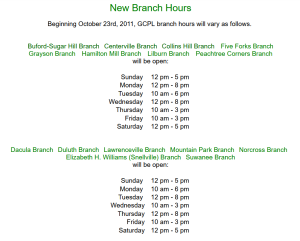
A screenshot of Gwinnett County Public Library's Buddy Branch hours from the Wayback Machine

Hearing the explanation of the extended hours as a solution compared to the previous model of the buddy branch system was interesting particularly how it relates to library transparency, and by extension easier access for patrons. This service, especially for new patrons I sign up for library cards, are sometimes still taken aback by the fact that the library trusts its patrons enough to allow this service without staff readily available. I feel this ties into two important concepts introduced in this week’s module: the user is not broken and building and earning trust.

Two of the concepts brought up in Schneider’s The User is Not Broken (2006) is to “meet people where they are” and to “transform the user experience to meet the user.” An example that Kenney (2014) gives is how a service specifically about e-reader help expanded to offering help for other types of devices. The library was able to recognize that this hyperspecific service offered, although nice in concept, was not what the larger community needed and expanded its goal accordingly.

This also ties into how expanded self service hours at GCPL met what the community needed. They would much rather prefer predictability with the library’s service hours, and the extended hours allows for patrons, who are not normally able to use the library, to do so outside of its regular hours. This service demonstrates building trust with the community, and by extension, helps make people successful, which makes for a great user experience (Schmidt, 2013). There was reoccurring feedback from patrons regarding how this service helped them, including: how it’s useful for patrons with long commutes who normally aren’t able to use the library during regular hours, parents with neurodivergent children use the extended hours since it’s quieter, and patrons that work from home use these hours because it’s a time with minimal distractions (Stamm, 2024a).

This reaction can be seen in other libraries that utilized this service as well, like the Manawatū Community Hub Library, that realized that, although they renovated the library into a beautiful space, they needed to make the library work for the community. Even the way it’s described on their website, reiterates this:

“… it provides our community with more opportunities to use Te Āhuru Mōwai when it works best for them” (Stamm, 2024b).
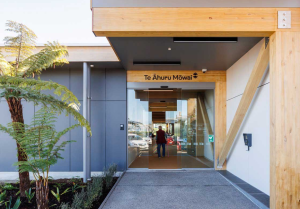
An image of the library entrance of Manawatū Community Hub Libraries in New Zealand.

Extended hours is just one way out of many that demonstrates how participatory service is essential to how libraries adapt and become accessible to the community it serves. Additionally, it shows how technology can provide unique solutions to services that patrons ask for.

References
Kenney, B. (2014, January 27). The user is (still) not broken. Publishers Weekly. https://www.publishersweekly.com/pw/by-topic/industry-news/libraries/article/60780-the-user-is-still-not-broken.html
Schmidt, A. (2013, November 1). The user experience: Earning trust. Library Journal. https://287.hyperlib.sjsu.edu/wp-content/uploads/2018/09/SchmidtEarningTrust.pdf
Schneider, K. G. (2006, June 3). The user is not broken: A meme masquerading as a manifesto. Free Range Librarian. https://freerangelibrarian.com/2006/06/03/the-user-is-not-broken-a-meme-masquerading-as-a-manifesto/
Stamm, L. (2024a, September 10). Where are they now? Gwinnett County Public Library: Magnifying access with open+. Bibliotecha. https://www.bibliotheca.com/library-story-gwinnett-county/
Stamm, L. (2024b, December 16). Groundbreaking access: open+ in Manawatū Community Hub Libraries, New Zealand.
Stephens, M. (2016). The heart of librarianship. ALA Editions. 

Introduction

Hi everyone! It’s nice to be in this class with you all. My name is Trisha, and I live in the metro Atlanta area, where I work as a library associate in the Gwinnett County Public Library System. I’m currently taking this class, along with Project Management (INFO 282), and I’m planning on taking the e-Portfolio course next spring.

For this course, I was really excited to sign up for this because I’ve heard a lot of good things about it. I felt like it would tie in well with my experience working in a public library so far, and refocusing on why I enjoy working in that space. Things I love about working at my library system includes the collaborative and creative aspect of creating programs for the community, having those one-on-one interactions with patrons and building relationships with them, and even the quieter downtime where I shelf read my assigned collection sections.

As for some of my hobbies, they include reading, collecting more stationary than I would use, baking, and watching shows and movies. Lately, I have been re-reading one of my favorite manga series, Blank Canvas by Akiko Higashimura. It’s a memoir that looks back on the creator’s artist journey from high school to where she is now as a manga artist. She’s very straightforward about her memories and perspective, and has a great sense of humor while also being slightly exasperated with her younger self. It’s a great read if anyone’s interested!