
Reflection #1 – 2026 ALA Annual

While combing through this week’s reading materials, I read Loida Garcia-Febo’s article titled “Serving with Love: Embedding equality, diversity, and inclusion in all that we do”. Upon encountering this article, I thought to myself, “Wow, the timing couldn’t be better”. Currently, as I write this reflection post, I am sitting in front of Gate H6 at O’Hare International Airport waiting to board my return flight back to LAX. 

You may be wondering, “That’s so random… why?”
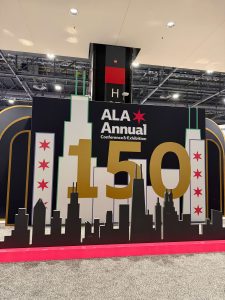
Photo by Ruby Zhu

This week is the ALA 2026 Annual Conference and Exhibition, and I was invited to attend the Spectrum Leadership Institute as one of the scholars in the 2025-2026 cohort. With this opportunity, I met and networked with upcoming librarians and library professionals who are also BIPOC. Many of the stories shared between scholars, panelists, and keynote speakers embraced the values as highlighted in previous ALA President Garcia-Febo’s article, especially fighting for people from vulnerable groups and creating community spaces that reflect the needs of those people (Garcia-Febo, 2018). I was truly moved by the energy in the conference room and felt a sense of solidarity from a bunch of strangers from different parts of the country who share the same heart.

At today’s lunch reception, before I trekked over to the airport, we had our current ALA President-Elect Tamika Barnes speak a little about her hopes for the scholars and her lifelong experience up until her current leadership position at ALA. She reminisced about her days as a reference librarian and her transition to management and leadership. One of the scholars posed a great question regarding leadership and how to be an effective leader. Barnes’ response mirrored what Stephens (@michael) wrote in “The Heart of Librarianship” and the importance of listening. Listen to what people want and what their requests are; at the same time, pay attention to what they are not saying and the services they are not utilizing (Stephens, 2016, p. 43). 

I am incredibly grateful and honored to be a part of the Spectrum family and ALA community. It gives me hope to see more faces that look like mine in this profession. I am looking forward to my journey forward as a hyperlinked librarian and building a foundation where communities can thrive.

References

Garcia-Febo, L. (2018, November 1). Serving with love: Embedding equality, diversity, and inclusion in all that we do. American Libraries Magazine. https://americanlibrariesmagazine.org/2018/11/01/serving-with-love/ 

Stephens, M. (2016). The heart of librarianship: Attentive, positive, and purposeful change. ALA Editions. https://www.dropbox.com/s/gc9ecokb972xgil/HeartofLibrarianship.pdf?dl=0  

Assignment X: If the user is the sun, then we must be the planets!

Photo by Robert Bye on Unsplash

In 2006, Karen Schneider published a post titled “The User Is Not Broken: A meme masquerading as a manifesto” on her blog, the Free Range Librarian. A particular thought from her discussion stood out to me, and that is “the user is the sun”. For this assignment, I want to dig deeper into this notion and reflect on this concept exactly two decades after Schneider’s post. 

How is the user “the sun”?

In “The User Is (Still) Not Broken” written by Bryan Kenney in 2014, the author expands on the idea of the user being the sun as depicted in Schneider’s post. He emphasizes that libraries should focus on the people and how they interact with the systems created; the user is never wrong, but rather, the systems are broken (Kenney, 2014). This idea aligns with the hyperlinked library practice as outlined in “The Heart of Librarianship” where author Michael Stephens (@michael) states that libraries must evolve to meet user preferences even if the journey to accomplishment is inevitably evolutionary and most definitely chaotic (Stephens, 2016). The user should be the center of gravity for library services and resources, and we must be ready to evolve and keep up with interests.

What is holding libraries back?

Like Stephens, I also find myself pondering intensely about this question because, really, what exactly are the factors preventing libraries from moving forward and making executive decisions that may potentially alter entire organizational landscapes? Take my workplace, for instance—the Monterey Park Bruggemeyer Library has over 1,300 ESL and Citizenship learners yearly, but our in-house literacy collection is not only outdated, but also poor in circulation. Regarding this issue, management has yet to implement weeding procedures and give directions to update the catalogs to include newer, more relevant books that reflect the needs of learners wanting more bilingual materials. I have come to the conclusion that there could be many factors barring libraries, including my place of employment, from truly evolving: a lack of intention from management, a lack of budget to purchase new collections and renovate library spaces, and even a fear of hard labor (all the re-cataloging) going in vain. 

Embracing hyperlinked library practices

The San Francisco Public Library’s (SFPL) teen space, “The Mix”, is a great example of user-centered creation where a group of teenagers collaborated with an architect to design a teen exclusive zone with study nooks, white boards and projectors, and chill seating areas that allow eating (O’Brien, 2019). The library simply asked the teens what they wanted in this space, and it delivered in the final outcome. “The Mix” illustrates how dynamic and creative change can be when users are involved in the decision making process and design. Perhaps when users are consulted about library decisions, the fear of the evolution of library services is mitigated because there is a sense of affirmation from target audiences. 

How to be a good planet

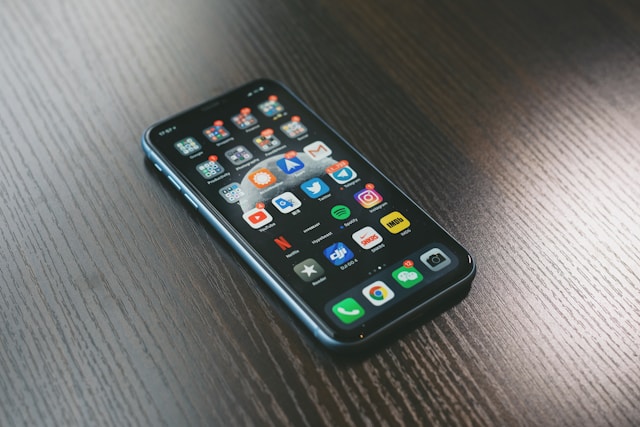
As a LIS student who currently works in a public library, I can see that I have already been implementing Library 2.0 changes to my organization before even realizing the term existed! Through daily interactions with community patrons, I have developed a strong understanding of what programs they want to see in the library. Every year, I make it a priority to lead a 3-week phone technology workshop where I focus on helping ESL learners understand elements of the phone in English. This may only be one instance, but if we, as information professionals, involve users in defining library services, then we are moving in a positive direction that brings us closer to Library 2.0.

Photo by Jonas Lee on Unsplash

In order for a planet to be a successful planet, it must orbit the sun. If the user is the sun, then we need to continuously change and maintain relevancy to stay connected to the sun. 

References

Casey, M. E., & Savastinuk, L. C. (2007). Library 2.0: A guide to participatory library service. Information Today, Inc. https://287.hyperlib.sjsu.edu/wp-content/uploads/2019/07/Library2.0Text.pdf 

Kenney, B. (2014, January 27). The user is (still) not broken. Publishers Weekly. http://www.publishersweekly.com/pw/by-topic/industry-news/libraries/article/60780-the-user-is-still-not-broken.html 

Literacy for All of Monterey Park. (2025). LAMP monthly statistical report 2024-2025 [Internal statistics]. Monterey Park Bruggemeyer Library.

Monterey Park Bruggemeyer Library. (n.d.). Literacy for All of Monterey Park. https://www.montereypark.ca.gov/264/English-Classes-Citizenship 

O’Brien, C. (2019, June 24). How San Francisco’s public libraries are embracing their changing role. Shareable. https://www.shareable.net/how-san-francisco-public-libraries-are-embracing-their-changing-role/ 

Schneider, K. G. (2006, June 3). The user is not broken: A meme masquerading as a manifesto. Free Range Librarian. http://freerangelibrarian.com/2006/06/03/the-user-is-not-broken-a-meme-masquerading-as-a-manifesto/ 

Stephens, M. (2016). The heart of librarianship: Attentive, positive, and purposeful change. ALA Editions. https://www.dropbox.com/s/gc9ecokb972xgil/HeartofLibrarianship.pdf?dl=0  
Introduction

Hello everyone! I’m Ruby (she/her), and I’m from Los Angeles, California. This is my second to last semester in this program, and I am set to graduate in Fall 2026 after I complete my e-Portfolio. I chose this course because I work in a library with older patrons who are not as tech-savvy. Therefore, I am excited to learn more about integrating physical and virtual spaces through technological tools and creating meaningful connections.

Currently, I work as a library assistant in the literacy department of my local public library. At the same time, I also teach ESL classes to our community patrons as part of my job responsibilities. In the future, I hope to be an Asian Services Librarian in the San Gabriel Valley and offer curated information and library resources that assist this underserved population of community members. I am also interested in working in libraries abroad but it is still too early for me to decide on a path. I am a huge history nerd and avid enthusiast of ancient Chinese and medieval European history, so I might want to pursue a career in that field if provided the opportunity. 

During my free time, I like to read, bullet journal, and binge movies and TV shows. After I graduate, I hope to get into gardening and revamp my parents’ garden.

To conclude this introductory post, here is a picture of my cat, Jae!

Gray tabby cat
Name: Jae