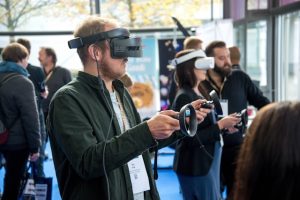
I was fascinated to watch the videos on virtual and augmented reality that were included in Module 6 Hyperlinked Environments and Issues.
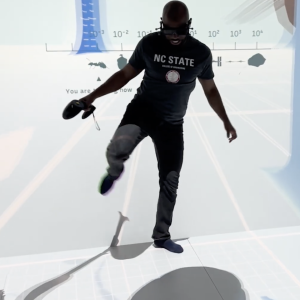
In the video from NC State University, Industrial and Systems Engineer Karen Chen talked about how they have developed a virtual reality experience called Scale World, which allows younger students to be able to visualize different concepts of size and scale. Nehemiah Mabry got to see himself as various sizes compared to other objects, like an ant, a whale, or a bridge. I think this is an amazing way to help students better understand difficult concepts in math and science. It would provide visual and kinesthetic experiences to adapt to various learning styles. One thing that demonstrates the evolution of the technology is that instead of using the bulky VR headsets as seen in the photo above, this program uses lighter 3D glasses.
Colorado State University has a Virtual Reality Anatomy Lab that allows students to better visualize anatomical structures in 3D. I would have loved this when I was completing my occupational therapy degree. I did have a cadaver lab, but that was only once a week. It would have been helpful for me to be able to go into the VR lab to study in between lab classes.
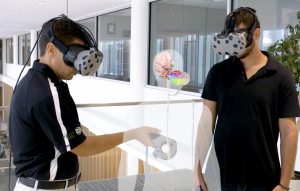
I can see public libraries incorporating this technology into their programs and services. As the American Library Association (2017) states, “Libraries have long served as points for the public’s first exposure to new technologies, and they could again play that role with virtual reality.” Students today are fortunate to be able to experience this in the academic setting. Unfortunately, not all schools have the funding to be able to provide these experiences for the students. And many adults don’t have this opportunity to experience these emerging technologies. I think when most adults think of virtual or augmented reality, they think of games and entertainment, such as the games showcased in the video SJSU King Library Experiential Virtual Reality Lab.
Technology changes so rapidly that it is not always practical or feasible for people to purchase the technology for themselves. It would be wonderful for libraries to be able to provide experiences with virtual and augmented reality. LibLime (2023) shared the following ways that virtual reality can be shared in the library setting:
-
-
-
- Virtual tours and storytelling
- Interactive learning and education
- Access to special collections and archives
- Enhancing library orientation
- Gamification for engagement
-
-
By incorporating virtual reality into programs, services, and resources, libraries can not only continue to provide access to information, but they can also achieve their mission of lifelong learning.
References
American Library Association. (2017, June 16). Virtual reality. Retrieved June 29, 2026, from https://www.ala.org/future/trends/virtualreality
CSU College of Veterinary Medicine and Biomedical Sciences. (2017, August 14). Virtual reality anatomy lab at Colorado State University [Video]. YouTube. https://www.youtube.com/watch?v=zDrLMgYZcac&t=3s
LibLime. (2023, December 10). The impact of virtual reality (VR) and augmented reality (AR) in libraries. https://www.linkedin.com/pulse/impact-virtual-reality-vr-augmented-ar-libraries-liblime-dlb4c/
NC State Engineering. (2023, November 7). Virtual reality at NC State University [Video]. YouTube. https://www.youtube.com/watch?v=NMyunA0Vzsw&t=15s
SJSU Library. (2018, October 2). SJSU King Library Experiential Virtual Reality Lab [Video]. YouTube. https://www.youtube.com/watch?v=YsRNT5U3WxQ&t=24s
@jenfredrick You shared some very practical and useful examples of the technologies you covered in this post. It makes so much sense to read about how VR etc can be used in the library setting. Thanks for the link to the King Library resources as well.