“I trust you will not forget the importance of amusements.”
–Andrew Carnegie
I was surprised to read that the quote above, from one of our Module 4 readings, was delivered at a library dedication in 1889 (Rivenburg, 2022). Libraries have long been thought of as a place for books. A 2010 report indicated that 75% of Americans held this view, up from 69% in 2005 (Kenney, 2014). My experience is consistent with this. When I tell people I work at a library, most respond with a comment about being surrounded by books or the dreaded “You get to read all day!” When I represent the library at community events, people are often surprised that the library is still open since “you can find all the books online.” They are shocked when I tell them what they can do with their library card beyond checking out books.
When you look at mission and vision statements for many libraries, you will see statements like:
-
-
- We inspire lifelong learning, foster creativity and connect you to resources (Fountaindale Public Library, 2026).
- We welcome and support all people in their enjoyment of reading and pursuit of lifelong learning (Chicago Public Library, 2026).
- We nurture curiosity (Evanston Public Library, 2026)
- Madison Public Library sparks literacy, fosters curiosity and supports community (Madison Public Library, 2026)
- Our mission is to inspire, facilitate, and celebrate lifelong learning (Hennepin County Library, 2026)
-
These phrases create an image that goes far beyond an image of a “traditional” library that is dark and stuffy, with floor-to-ceiling bookshelves and dark, heavy furniture, and librarians who “shush” any noise. Libraries today are vibrant, exciting places that play an important role in supporting people to actively engage in lifelong learning, social connections, personal well-being, and more. In other words, libraries are a place for people of all ages to play, experiment, and explore. Looking at the following pictures, you can see that today’s library spaces are bright, open, and designed to encourage reading, collaboration, and learning.
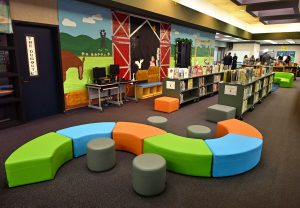
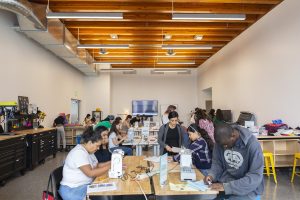
Play and children
Play is absolutely essential for a child’s development. I don’t think anyone would disagree with that statement. If there is one thing most children do well, it’s play! At a surface level, play looks like it’s all about having fun. But if you sit back and really analyze what is happening, play is actually quite complex. Children learn so much about themselves and the world around them through play. In my former career as a certified occupational therapy assistant working with children, most of my therapy sessions looked like we were just playing. There are so many skills that can be targeted by playing. I could use the same activity with 10 children, and have a completely different skill that I was targeting with each child.

My therapeutic experience with play has transferred well into the library world. There are five practices that are essential for early literacy development. These are: singing, talking, reading, writing, and playing. Libraries are in an excellent position to engage in all of these practices with children through the programs and services they provide. When programs are planned with these five things in mind, children will not even realize that they are actually learning and working on crucial developmental skills. They just think they are having fun. Library programs can provide a low-pressure environment where children can play and explore, especially when program planning involves focusing on the process, not the end project (Bateman, 2023).
Play and adults
Play is not just for children! While we have always known that play is beneficial for children, there hasn’t been as much emphasis on the benefits of play for adults. I have also provided occupational therapy services for adults, and often incorporated play into my therapy sessions. I could turn any pastime into therapy to work on standing balance, core strength, fine and gross motor skills, cognitive skills, and much more. When a person is having fun with an activity, it doesn’t seem like hard work. Play serves as a great distraction.
Play can be a great stress reducer. It offers a break from the daily stressors, allowing you to unwind and let loose. Participating in play activities such as games, puzzles, and learning a new hobby, to name a few, is a great way to keep your brain active and help prevent cognitive decline as you age (Hilburn, 2025). Play is a great way to participate in lifelong learning. Just like children, many adults learn through exploration and hands-on activities. In fact, play is important in the learning process because it allows for such experimentation (Thomas and Brown, 2011). This experimentation does not have to lead to a specific end goal. Rather, just as when we talk about play with children, it is about the process, not the product. Libraries plan a variety of programs that allow adults to play and explore, such as crafting workshops, learning how to use maker equipment, board game nights, and more. In addition to the lifelong learning aspect, these programs provide social interaction and community building.
Play is not just something for children, and it is not just for entertainment. Play can open doors for learning, creativity, and connection. Libraries are perfectly positioned to support play throughout the lifespan. By intentionally incorporating play into library programs, spaces, and services, libraries can foster curiosity, strengthen community connections, and create opportunities for exploration and personal growth. Play helps libraries ful their mission and vision statements by creating vibrant, welcoming places where people of all ages can discover, learn, and grow.
References:
Bateman, F. (2023). Libraries as playspaces: A case study from Wyndham City Libraries. InCite, 44(1), 40–41.
Chicago Public Library. (2026). Mission. Retrieved June 18, 2026, from https://www.chicago.gov/city/en/depts/cpl/auto_generated/cpl_mission.html
Evanston Public Library. (2026). Mission, vision and core values. Retrieved June 18, 2026, from https://epl.org/mission-vision/
Fountaindale Public Library. (2026). Mission, vision & strategic plan. Retrieved June 18, 2026, from https://www.fountaindale.org/about-us/mission-vision-and-strategic-plan/
Georges, S. (n.d.). [Oak Grove Elementary School’s new library design]. [Photograph]. CUSD Insider. https://cusdinsider.org/new-oak-grove-elementary-library-unveils-new-collaborative-study-space/
Hennepin County Library. (2026). Who we are. Retrieved June 18, 2026, from https://www.hclib.org/about/who-we-are
Hilburn, J. (2025). Curiosity at every age: The importance of lifelong learning in the library. Information Today, 42(6), 18–20.
Kenney, B. (2014). The User Is (Still) Not Broken. Publishers Weekly, 261(4), 19.
Madison Public Library. (2026). Vision and mission statements. Retrieved June 18, 2026, from http://madisonpubliclibrary.org/about/mission-and-vision
Rivenburg, R. (2022, Aug 03). What can a library card get you? Try a popcorn maker or ukulele. The Christian Science Monitor. Retrieved June 16, 2026, from https://www.csmonitor.com/Arts-Culture/Books/2022/0803/What-can-a-library-card-get-you-Try-a-popcorn-maker-or-ukulele
Thomas, D., & Brown, J.S. (2011). A new culture of learning: Cultivating the imagination for a world of constant change. CreateSpace Independent Publishing Platform.
@jenfredrick
I did not realize how important having a place to play was until I had my daughter. She is 1 years old, and I am constantly trying to find ways to keep her engaged. Most of the time I find myself turning to libraries, not just because I enjoy the library, but because there are few places that offer a free safe space for kids to learn and play. Libraries are perfectly positioned to offer this service that can meet the needs of not only parents, but also adults who want to find a free place to enjoy different entertainments with their friends.
One library that is really leaning into this is the Avon Lake Public Library in Ohio. They have a large section called Discovery Works that offers various interactive exhibits and experiences. Here is a link to their website: https://287.hyperlib.sjsu.edu/frominktohyperlinked/2026/06/20/assignment-x-how-do-we-encourage-participation/. I have not seen something like this before in a library, but I think it is a great idea that demonstrates how libraries are evolving to meet the needs of their communities.
I agree, it’s always difficult to find free things to do as a parent. My kids are 21 and 18, so it’s been a while, but I do remember struggling with that as well. Our library has a great Children’s Department with a lot of great programs for kids of all ages, and play areas sprinkled throughout the department.
And wow! Discovery Works is really cool! It’s awesome that it is free, even for groups who want to reserve it before opening just for them. That is amazing outreach to the community. From their website it looks like people can volunteer for that area. I would be curious to know if it is staffed by library staff, or if they hire for that differently.
My library has STEAMBoxes, which looks very similar to Avon Lake’s Science Kits To Go.