
Reflection Blog #5 – Infinite Learning
Professional Learning Experiences
My first library job was as a part time circulation assistant. I only worked 12 hours a week but I quickly learned that I wanted to pursue a career in librarianship. One of the things I remember very clearly was looking at a job posting for a full time position in another library and a co-worker saying to me “you don’t want to work there, they make everyone do professional development.” Unfortunately, I’ve encountered this attitude from a great number of people in the libraries I’ve worked in. I’ve since seen the error of that way of thinking and this module on Infinite Learning has taught me more about how important it is to continue to seek learning opportunities for myself, the staff I work with, and our patrons.
When looking at the study by Stephens, et al. on the experiences of public library workers in Australia and the different learning “personas” they identified, I would describe myself as the Curious Ad Hoc Learner. I routinely seek out opportunities to learn more about my library, my profession, and my community. As a manager, I would like to learn how to support my staff and encourage them to take part in professional development and professional learning experiences. I think that creating a professional development plan for myself and my staff is a positive first step in showing them that I encourage and support them in their professional endeavors and that I am committed to continuous learning at our library.
I created this infographic of a 4 step professional development plan for small public library staff that I hope to be able to use in my library.
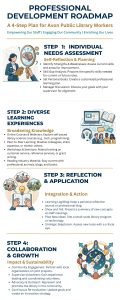
I feel this plan aligns with what we learned from Michael Stephens in Wholehearted Librarianship about what library workers are looking for in their professional development options. They want face-to-face, interactive, real-life learning experiences that challenge them, asks them questions of themselves, and encourages them to branch out and network with others. This plan does all of that and gives staff a chance to learn and grow within the field.
References:
Stephens, M. T. (2019). Wholehearted librarianship : finding hope, inspiration, and balance. ALA Editions.
Stephens, M., Partridge, H., Davis, K., & Snyder, M. (2022). The Strategic, Curious & Skeptical Learner : Australian Public Librarians and Professional Learning Experiences. Public Library Quarterly (New York, N.Y.), 41(3), 257–272. https://doi.org/10.1080/01616846.2021.1893114
Posted in Uncategorized
Leave a comment
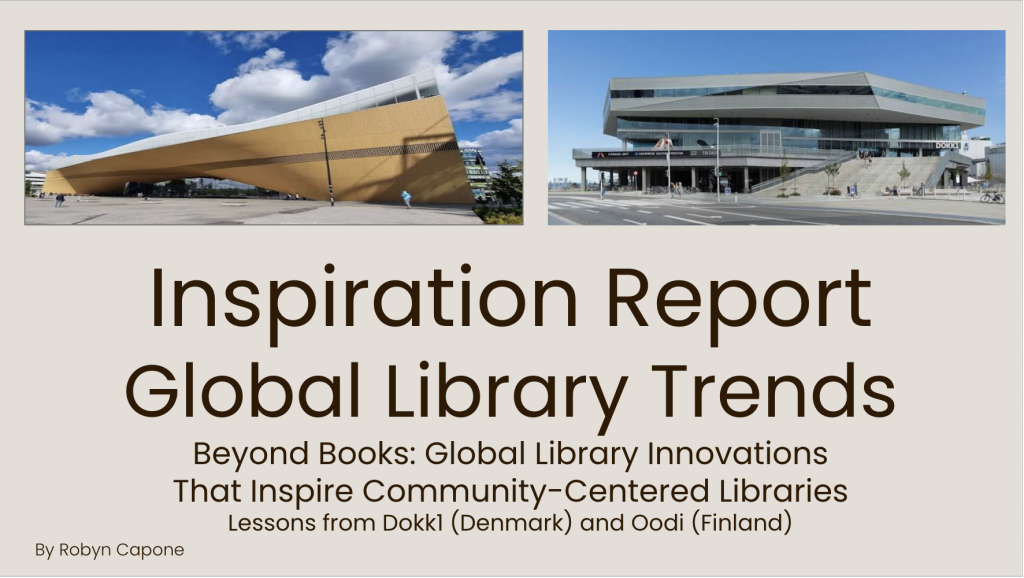
Inspiration Report: Global Library Trends Beyond Books: Global Library Innovations That Inspire Community-Centered Libraries Lessons from Dokk1 (Denmark) and Oodi (Finland)
Posted in Uncategorized
Leave a comment
Reflection Blog #4 – The Power of Stories
“Who lives, who dies, who tells your story”(Miranda, 2015). When I think about storytelling, this line from the musical Hamilton always comes to mind. Stories are not only good for learning to read and understand the human experience, but also serve as our history and point us toward our future. That quote from Hamilton is, fundamentally, a narrative inquiry. Instead of asking “what is your story,” it asks “who will tell your story?” This relates back to what Michael Stephens says in his article “Office Hours: Narrative Inquiry” that instead of asking the common, general question of how can we help you, we should be asking more nuanced questions that will allow us as librarians to uncover different aspects of our patrons’ lives and more personal stories about how they see and use the library.

Getting to know our patrons and their stories can help us to provide better services to the community. As we’ve seen time and again, librarianship is about transparency and participatory service, and stories are also part of that. Learning who our patrons are, where they come from, and what they need, will allow us to create services that will be beneficial and useful to our communities. It will also allow us to preserve our history and look toward our future with an educated eye for what’s on the horizon. Every interaction we have with our patrons is an opportunity to learn about their stories. I love the idea of using a white board or something similar to ask a question of the day or leave an open response. I find this particularly fun and interesting to do with our teen patrons, as their answers are often very surprising. Recording these conversations and organizing them into a book or video could tell the story of a season or school year in the life of the teens in the library. This is something they could look back at and see how they’ve changed (or not!) and what they’ve learned (hopefully!).

One way to record and share these community stories is through StoryCorps. StoryCorps is a nonprofit organization whose mission is “to help us believe in each other by illuminating the humanity and possibility in us all — one story at a time” (StoryCorps, 2026). This is deeply connected to the work we do as librarians by engaging and servicing our community. StoryCorps offers what they call StoryCorps DIY, which is a free course that teaches libraries and other community organizations how to collect and tell the stories of their communities. Their trainings focus on everything from classroom education to dealing with grief and memory loss, reaching across political divides. One common theme throughout is creating connections, and this is something we strive for every day in library work. Connecting with our patrons and our communities is the heart of librarianship.
Telling our stories can happen in many different ways. It can be short interactions or longer conversations. It can be verbal or written. It can sometimes be in a language that isn’t really even a language at all – ☺️♥️📖. It can be recorded by hand or on video. Storytelling takes many forms such as novels and poetry, music and movies, musicals and ballets. The importance of storytelling is that it brings people together, it shows us the power of sharing our experiences, and it preserves our histories for the future.

References:
Getty Images. (n.d.). Everyone has a story [Photograph]. iStock. istockphoto.com
Getty Images. (n.d.). Sticky note on blackboard, Share your story [Photograph]. iStock. istockphoto.com
Getty Images. (n.d.). Student girl writing on whiteboard in classroom [Photograph]. iStock. https://www.istockphoto.com/photos/student-writing-on-whiteboard
Getty Images. (n.d.). What’s your story question [Photograph]. iStock. https://www.istockphoto.com/photos/whats-your-story
Miranda, L. (2015). Hamilton: an American Musical.
Stephens, M. (2020, April, 9). Office hours: narrative inquiry. Tame the Web. https://tametheweb.com/2020/04/09/office-hours-narrative-inquiry/
StoryCorps. (2026). https://storycorps.org/
StoryCorps Do It Yourself. (2026). https://diy.storycorps.org/
Posted in Uncategorized
1 Comment
Reflection Blog #3 – New Models
When thinking about library spaces in the modern world, we are often thinking more about technology and less about books. Libraries today are resources for so many different things: resume writing and job hunting, educational and recreational classes, makerspaces and art production, community services and events. Libraries are working with their communities to offer different services and features based on feedback from residents, and are changing their service models to reflect those needs. The Anythink Nature Library, for example, “invites visitors of all ages to explore their connection to nature” (Anythink, n.d.). Their collection is nature focused and tailored to support their mission of sparking “outdoor learning and adventure” (Anything, n.d.). Innovations like these are happening more and more around the world and are quickly becoming the baseline of what library spaces are shifting towards.
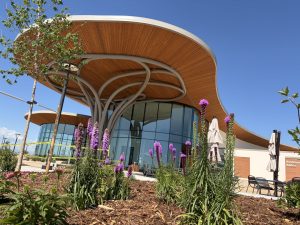 Anythink Nature Library
In Texas, the BiblioTech Public Library is the first all-digital public library. The library opened in 2013 and only lends and offers digital content. They have no physical collection other than e-readers, hotspots, computers, and Launchpads. They are the “library of the future.” Or are they? As Michael Stephens writes in his article “Taming Technolust: Ten Steps for Planning in a 2.0 World,” technology cannot and should not be “the center of your mission as an institution” (Stephens, 2008). While this might refer predominantly to the public library that strives to provide the newest technology along with its traditional physical collection, the question becomes how long can an all-digital library last? BiblioTech has been around and expanding for over 10 years now, so there is definitely something there. But I wonder how many of their patrons have to visit multiple libraries to find what they’re looking for. A 2019 article on the San Antonio Report website highlights the positive aspects of the digital library on the community, including increased access, digital equity, and the collaborative relationship between BiblioTech and the San Antonio Public Library. However, there are financial and operational challenges to such a space. Bexar County, Texas continues to invest more in BiblioTech and gradually reduce its contribution to the San Antonio Public Library, while its residents still extensively use the city’s physical library. At the time the article was written, country resident use accounted for 23% of circulation but the country’s financial contribution only accounted for about 6% of the library’s general fund (Wang, 2019). This is a significant imbalance and raises questions about whether digital libraries should replace or supplement traditional physical libraries.
This is an example of how BiblioTech’s digital-first model addresses a specific community need by bridging the digital divide, but also continuing to value ideas such as collaboration, lifelong learning, and equitable access. The partnership between BiblioTech and the San Antonio Public Library reinforces the argument that libraries strengthen communities when they work together to remove barriers to access which is highlighted in Mike Gaetani’s (2018) interview with Eric Klinenberg. In that interview the focus is on libraries as critical community infrastructures that provide equal access to information, technology, and public services. BiblioTech’s all digital model serves as a core component of social infrastructure by promoting access and equity. While this addresses a community want and need, it cannot fully replace the traditional library space. Leaders of the San Antonio Public Library note that physical libraries are necessary and continue to provide needed services such as story times, community programs, in-person assistance, and meeting spaces. And let’s not forget about the books, magazines, newspapers, DVDs, and video games that patrons are still looking for in physical form. While BiblioTech can bridge that divide, it cannot fully replace the physical collection.
This brings me to my current library. In recent years we have shrunk our physical collections to make room for meeting space, work space, and a study pod. All of these changes were made to accommodate what we thought patrons wanted. However, in 2025 the library started work on its updated Strategic Plan, and we received responses to our survey that we didn’t expect: 23% of respondents (the majority) stated that the physical collection should be the library’s top priority.
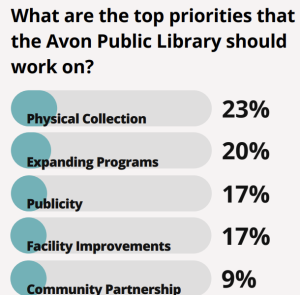 Avon Public Library Strategic Plan, 2025
Whether that was backlash due to the excessive weeding and shifting of the collection that patrons took note of, or if it was something they always wanted but we failed to see, I don’t know. I do know that it surprised us all and we are still struggling to keep up with the demand. We consistently receive comments from patrons that we don’t have enough large print books or that we don’t have enough older adult fiction. So, while library patrons are looking for innovative ways to use the physical library space, they do still want traditional library collections like books. Due to the space limitations of the library, having a big enough print collection is something that we will always find difficult to manage. We even have a consultant from the state library board coming to the library to evaluate the space and work with us on reimagining it. The best thing to come out of the strategic planning process was input from the community. Their valuable responses will shape what direction the library goes in the future both physically and digitally, this is participatory service in action.
References:
Anythink Nature Library. (n.d.). Anythink nature library. https://www.anythinklibraries.org/anythink-nature-library/?fbclid=IwAR2DgO-k8nU6kNUODo7vTlRXKiEiYSoSeQMC8Aq0QnoLMZoT3d-QKpbSl5M
Avon Public Library. (2025, October 17). Avon public library strategic plan. https://www.avon-ma.gov/DocumentCenter/View/7515/Avon-Public-Library-Strategic-Plan-FY-26-31?bidId=
BiblioTech. (n.d.). About bibliotech. https://bibliotech.org/about-us/
Gaetani, M. (2018, November 11). Q&A with Eric Klinenberg. Center for Advanced Study in the Behavioral Sciences. https://casbs.stanford.edu/news/qa-eric-klinenberg
Stephens, M. (2008). Taming technolust: Ten steps for planning in a 2.0 world. Reference and User Services Quarterly, 47, 4, 314-317.
Wang, J. (2019, July 31). City, county work to renew deal for all county residents to use SA libraries. San Antonio Report. https://sanantonioreport.org/city-county-work-to-renew-deal-for-county-residents-to-use-sa-libraries/
Posted in Uncategorized
1 Comment
Innovation Roadmap: Bringing Stories Outside: A StoryWalk® at DeMarco Park Avon Public Library
Posted in Uncategorized
1 Comment
Reflection Blog #2 – Hyperlinked Environments and Global Libraries
While reading about hyperlinked environments in global libraries for this blog post, I came across an initiative that was developed in Brazil called Feito na Biblioteca (made in the library). This program is a partnership between public libraries in Brazil and Caravan Studios, a company that helps communities find solutions to local problems. This program invited community members into the library to “discuss issues and share their experiences” (Feito na Biblioteca, n.d.). They then worked together to find solutions to these problems, create paper mockups of those solutions which were made into posters, and then the community voted on which solution they liked the most. Caravan Studios developed technology solutions for the problems, whether that be safety issues and timing at local bus stops, or where to find trash disposal options.
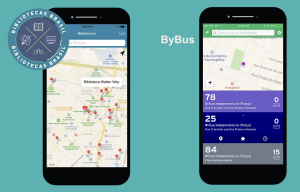
This program is important because it focuses on the community and invites them to use the library to find solutions. It allows library patrons to be active participants who shape library services rather than just passive information seekers who are receiving services. It also encourages libraries to be that place where residents can come together to create and collaborate, to learn from each other, and to improve their communities. This initiative recognizes that every community is different by encouraging each library to find the unique strengths and needs of its own community and work with its users to build programming and services around that. It gets to the heart of the hyperlinked library philosophy by putting people first and instead of asking “what should the library offer,” it asks “what can we create together?”
Brazil is not alone in its collaborative efforts. The Dokk1 library in Denmark is another example of a hyperlinked library environment that invites the community in and gives them authority to shape its services and spaces. Library staff spent years asking residents what they wanted the library to offer, what they wanted the space to become, before they even designed the building. The results of this is a space that is about so much more than just borrowing books. Dokk1 functions as a place for the community to gather, with a makerspace, meeting rooms, children’s play areas, and flexible spaces that fulfill the needs the community identifies. Dokk1 demonstrates that successful library services begin with listening to the community, rather than assuming only librarians have the answers, just like the Feito na Biblioteca project.
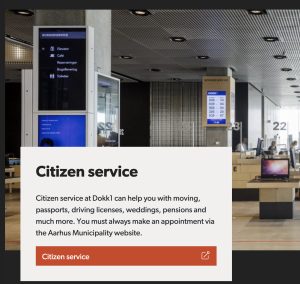
The Idea Stores in London also follow this model. The Idea Stores are built in busy shopping districts where people already spend a lot of time. They combine library services with community programs like job training, adult education, and even health services, in spaces that are welcoming and accessible. Thinking back to my first blog, this ties in to what the library director meant when she said “meet them where they are.” Hyperlinked library environments are about community and about bringing library services to the community where they live their everyday lives, rather than waiting for them to find the library. This is also reminiscent of what happened in the Library Takeover Project at the Madison Public Library.
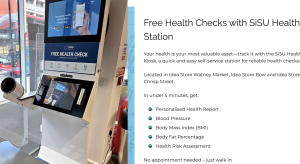
What strikes me about all of these initiatives is the library’s willingness to trust the community and let them lead the way. Each of these libraries gave the residents the opportunity to lead events and programs that reflected what was needed in the community and their lives, rather than assuming the librarians knew best. Feito na Biblioteca encouraged communities to create with their librarians. Dokk1 showed what can be accomplished when an entire library is designed around community input. Idea Stores removed barriers to access by placing libraries where the community already gathers. Madison empowered its residents to develop and lead programming. All of these libraries embrace the meaning and vision of the hyperlinked environment by recognizing that libraries are strongest when they invite the community in and work alongside them to shape services.
Another notable aspect of all of these initiatives is that none of them depended heavily on technology or artificial intelligence. Innovation is not only about makerspaces, computers, virtual reality, or AI, but about building relationships and creating environments that strengthen community connections. Trusting their communities and creating opportunities for participation were more important and transformative than investing in new technologies and equipment.

These examples are encouraging for the future of libraries and even for the small public library where I work. While we don’t have the space or budget that a large urban library has, initiatives like these remind me that change and innovation aren’t always just about money. Small efforts such as partnering with local schools during their free lunch program or offering free printing and faxing services after recognizing a community need, are also about building relationships and creating a welcoming and accessible environment for our patrons. Meeting people where they are is just the beginning, the next step is inviting them in and asking them to become our partners in order to shape the future of library services. It is clear that libraries remain the most relevant when they are shaped by their communities.
References:
Abisla, R. (2018, August 6). Caravan Studios boosts access to transit through open data. Tech Soup. https://blog.techsoup.org/en-us/posts/caravan-studios-boosts-access-to-transit-through-open-data
Dokk1. (n.d.). https://dokk1.dk/english
Feito na Biblioteca. (n.d.) https://www.feitonabiblioteca.org/
Idea Store. (2026). The idea story. https://www.ideastore.co.uk/about-us/the-idea-story
Zorthian, J. (2016, August 19). Look inside the most cutting-edge public library in the world. Time. https://time.com/4458185/denmark-library-cutting-edge-dokk1/
Posted in Uncategorized
1 Comment
Reflection Blog #1 – Hyperlinked Communities
In May of 2025 I attended my first library conference, the Massachusetts Library Association’s annual conference. One topic in particular interested me and left me with an interaction that I won’t soon forget. The title of the presentation was “Indigenizing the Library,” and the speaker talked about her culture and the history of indigenous cultures in America. She then related that to libraries and library work, and the need for libraries to consider indigenous culture in their collections, programs, and services. When it came time for questions, one member of the audience asked about how to reach people who don’t know the library is available to them. A local library director answered the question by saying “meet them where they are.” That phrase really stuck with me. I think part of her point was that librarians and libraries are so focused on bringing people through the doors and into the library that they forget to go out to the community and meet those who they serve in their own spaces. She was also saying that there might be some members of the community who don’t feel comfortable walking into the library for various reasons, whether it’s a language barrier, old overdue fines that they can’t pay, negative experiences with the staff in the past, or any other reason. It’s our job, our responsibility, to let the entire community know that they are not only welcome, but belong, in the library.

My library is small and has very limited space for things like noisy programs or classes. As a result, we tend to offer fewer programs and services than neighboring libraries. This is something that I would like to see change; and I believe it can be changed by going out into the community and offering programs and services in other spaces. Laura Warner writes in her article “Revolutionizing Public Libraries: Three Ways that Alternative Service Delivery Strategies Can Meet the Challenges of a Booming Population” that as municipalities grow, infrastructure struggles to keep up with the demand. Many libraries are now seeking alternative ways to deliver services including things like holds pick-up lockers, kiosks, book vending machines, and pop-up libraries.
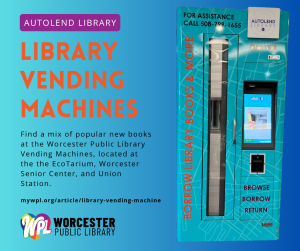
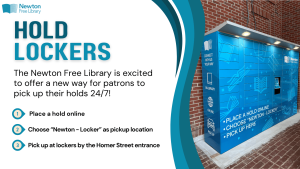
(Worcester Public Library, 2026) (Newton Free Library, 2026)
(Osterville Village Library, 2024)
All of these strategies are about making access easier and more equitable for the community. I think it is important to think about what the community needs and how we can make it easy for them to access services. And it’s not just about physical collections, either. Bringing storytime to the local elementary schools and computer classes to the council on aging in the town will show the community what the library can offer outside of the physical building and bring awareness to the changing landscape of library services.
This summer our small town is offering free lunch to all children up to age 18 at the elementary school. The school reached out to the library and asked if we would like to partner with them and have our children’s librarian come to the lunch and read stories and lead activities for the kids while they eat. This is a perfect example of a hyperlinked community idea. Meeting the kids and parents where they are and offering them something fun to do while having a meal is the kind of holistic approach modern libraries are looking for as a way to connect with patrons. As Dr. Stephens says in the lecture for the Hyperlinked Communities module, “hyperlinks are people,too.” Having the children’s librarian, or even the teen and programming librarian, at the summer lunch program is a great way to connect with and support the community. It shows them that we are willing to branch out and maybe even step outside of our comfort zones to engage with a group of people we might not normally interact with. Just that physical presence will make people stop and think about the library and its importance in the community, as well as what it can offer to the community.
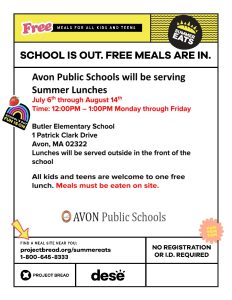 (Avon, MA, 2026)
An example of community involvement that I really love and feel connected to is the Madison Public Library’s “Library Takeover Project” (Smith, 2017). The city of Madison worked with its community partners to analyze the community’s needs, secure grant funding, plan programming, and educate and train patron-led groups to facilitate those programs. Giving community members “an opportunity to host their own events” (Smith, 2017) empowers them and acknowledges their role in shaping services that their tax dollars are paying for. It ties in to the idea of radically trusting your community that Michael Stephens writes about in his article “Beyond Buzzwords Ten Invitations to Build Library Connections and Community” (Stephens, 2025). It sounds scary, but asking for input and allowing the community to have a hand in developing and shaping the library is the true definition of a hyperlinked community.
This is similar to something we did in my library when we decided to change the way we charge for printing services. As I’ve mentioned, we’re a small library in a small town that is surrounded by bigger libraries and bigger towns. A few years ago we decided to offer 25 pages of free printing and 10 pages of free faxing a day. This is available to anyone who walks through our doors, they don’t have to live in the town or have a library card. This was done after we realized that we were seeing a lot of people who liked to use our public computers but when it came time to print or fax many patrons were unable to pay for the few things they needed and would leave. Making the change was a no-brainer after we surveyed the patrons and found that they like the library and the staff, but couldn’t afford the service. It was a small step the library could take to show the community that we value their input and respect their situations. It has paid off enormously by bringing more patrons through the door who might not otherwise think of our small library. We have seen an increase in library card sign-ups, circulation, and program attendance by people who said they only came in to use the computers but found something else they didn’t even realize they were looking for. I think that sums up the mission of the hyperlinked library and hyperlinked communities: offer the community what they need and what they don’t yet know they need. If we manage to accomplish those two things, the library will have served its purpose.
 (Created by ChatGPT)
References:
Newton Free Library. (2026). Holds pickup lockers. https://newtonfreelibrary.net/services/services/lockers/
Osterville Village Library. (2024). Osterville village library introduces 24/7 access to library materials. https://www.youtube.com/watch?v=dO2bStB328o
Stephens, M. (2025). Beyond buzzwords ten invitations to build library connection and community. https://www.dropbox.com/scl/fi/f05u6l0d50k8js28vgokz/Beyond-Buzzwords-Ten-Invitations-to-Build-Library-Connection-and-Community.pdf?rlkey=2i1b76g18h9t2qxmq3s1y7q90&st=of4tisuf&e=1&dl=0
Warner, L. (2024, January 17). Revolutionizing public libraries: Three way that alternative service delivery strategies can meet the challenges of a booming population. Medium. https://medium.com/@lauracwarner/revolutionizing-public-libraries-ff7fed3d12c5
Worcester Public Library. (2026). Library vending machine. https://mywpl.org/?q=article/library-vending-machine
Posted in Uncategorized
1 Comment
Assignment X: Transparency in the Small Public Library
As I’ve been working my way through the Hyperlinked Library course site and reading, I can feel myself becoming overwhelmed with all the information. And while I know that @michael said “do not feel overwhelmed,” sometimes I just can’t turn it off. Overwhelmed is my default. The interesting thing about this feeling, however, is that it’s not about the workload or the class itself, as daunting and challenging as those do seem at times, it’s about all the thoughts and ideas I’m getting about the “what’s” and “how’s” and “why’s” of librarianship. I see so many ideas and want to get started implementing them all right away. I’m learning that change is necessary and powerful, but it also takes time.
A Little Background to Set the Stage
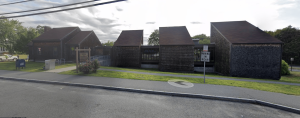 Avon Public Library, Avon, MA
I’ve been working in public libraries for a little over 11 years now, and while that isn’t a considerably long time, I’ve seen quite a few changes and faced some very interesting challenges over those years. I’m currently working as a technical services librarian in a small public library in a town of around 4700 people. Last month our library director decided to move on to a new library and her departure has prompted me to consider applying to be her replacement, a career path I never would have thought myself interested in before.

My reasoning for considering this change in my career trajectory is that I want to have more involvement in creating a transparent and participatory atmosphere in the library. Over the past four years or so, I’ve seen the staff at my library suffer from boredom and an intense need to get away from the public facing areas. As it is right now, we have three circulation staff members (remember we’re a very small library) and each one of them seems to count down the minutes until the part of their shift when they’re “off desk.” I see this as an administrative failure when library staff don’t want to spend their time assisting and interacting with our patrons. As Casey and Stephens write, transparency can be simple but it “requires commitment from administrators and staff,” (2007) and I haven’t seen that commitment in my library at all.
How to Bring About Transparency and Staff Buy-In
In his book Wholehearted Librarianship: Finding Hope, Inspiration, and Balance, @michael encourages us to dream at our library jobs. He says: “we have the potential to be the leaders as we all move towards a seamless information and knowledge environment” (Stephens, 2019). This is something that I would hope to foster in the staff at my library: that desire to dream about what we can do and how we can connect with our community. I know people have thoughts and ideas and I know we all talk about those things with each other, with the hope that someday we could implement different services and programs. We need to work on how to get from talking about it to doing it. Casey and Stephens offer a “to do” list of transparency in their article “A Road Map to Transparency,” that includes things such as cross-training staff, encouraging new ideas, and getting all departments to work together when planning projects (2007). I believe that these tools would give our staff who see their library work as just a job, and not a career or a service to the community, new meaning to their daily routine. We can change the culture of the library by giving each staff member something more to focus on and a reason to interact with the people who walk through our doors.
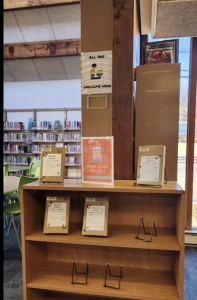 Inclusion is small but powerful aspect of transparency.
There are so many different aspects to transparency and so many different ideas that I see that could be immensely beneficial to my small library and its community. Things like adopting a “user-driven policy” to get a better feel for not only what our users actually want, but what they might not know they need, getting all staff out into the front lines to see how the daily interactions with the patrons really work, and being more open to change by saying “yes” more often than saying “no.” All of these ideas will work to bring the staff into a more cohesive and unified group that is not working against each other, but towards a common goal of creating a transparent and participatory library space.
 The Avon Public Library went fine free in 2022
My Focus
For this class, I hope to focus my study on transparency and how that can benefit small public libraries. Our daily operations might be significantly different than that of a bustling, dynamic, city library, but we are just as vital. I might argue that in some ways we are even more vital in a small community than a library in a big city, where there are a multitude of different resources for the community. In a small suburban community the library can become a hub for information and learning outside of the more structured classroom setting; it might be the only place the community has to discover resources. This is why it’s vital that we connect with our users and foster an environment from within that encourages open communication and a willingness to work with our patrons and town leaders to bring about change.
References:
Avon Public Library. https://www.facebook.com/avonpubliclibrary
Baldwin Public Library. (n.d.). Career path graphic. https://baldwinpl.org/career-path-graphic/
Casey, M. and Stephens, M. (2007, December 15). Check your ego at the door. Tame the Web. https://tametheweb.com/2008/07/01/check-your-ego-at-the-door/
Casey, M. and Stephens, M. (2007, December 15). Going to the field. Tame the Web. https://tametheweb.com/2007/09/15/going-to-the-field/
Casey, M. and Stephens, M. (2007, December 15). A road map to transparency. Tame the Web. https://tametheweb.com/2007/12/15/a-road-map-to-transparency/
Casey, M. and Stephens, M. (2007, December 15). Six more signposts. Tame the Web. https://tametheweb.com/2007/09/15/going-to-the-field/
Casey, M. and Stephens, M. (2007, December 15). Six signposts on the way. Tame the Web. https://tametheweb.com/2008/11/15/six-signposts-on-the-way/
Casey, M. and Stephens, M. (2007, December 15). Turning “no” into “yes”. Tame the Web. https://tametheweb.com/2008/11/15/six-signposts-on-the-way/
Stephens, M. T. (2020). Wholehearted librarianship : finding hope, inspiration, and balance. ALA Editions.
Posted in Uncategorized
1 Comment
Introduction
Hi everyone! My name is Robyn and I live on the east coast, in Quincy, MA, which is about 15 minutes south of Boston. I’ve been enrolled at SJSU since the fall of 2024 and only have 4 more classes to take, 2 this summer and 2 in the fall, before taking the e-portfolio class and (hopefully!) graduating next spring.
Right now I work full time at a small public library as a technical services librarian. I purchase and catalog new materials along with maintaining our serials collection. I love selecting new titles to add to our collection but opening the boxes of books when they’re delivered is one of my favorite parts of my job! I’ve always loved the smell of books, it never gets old.
Since I started the MLIS program my priorities have shifted a little. I started out wanting to remain in the technical services realm, but the more classes I take, the more I’ve become interested in library administration. Who knows where I’ll end up!
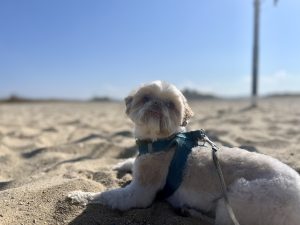
Here’s a picture of my dog, Benny, at his favorite beach just down the street from my house.
Posted in Uncategorized
4 Comments