Reflection: New Models 

Social Work in the Library

The concept of social work in the library brings together two tremendous, transformative services.

Living in the Silicon Valley, I see both wealth and poverty on a daily basis. In my residential neighborhood, there are often unhoused people who sleep in front of homes, on benches, or even in the outdoor common electrical rooms (I am unsure of the precise name or description of these). At the end of last school year, one of my twelfth grade students – one that I also taught when they were in sixth grade – shared with me that they were living in their car for the last few months. When volunteering as a court-appointed special advocate for children in foster care over the past eight years, I had many interactions with loving parents who were unhoused as they strived for reunification with their children. I think about the well-being of young and older adults – especially those unhoused – constantly and wonder about short and long-term solutions. 

The Salt Lake City downtown library’s social worker “provided 2, 144 services to people” since her hire to meet patron needs related to unhousing and psychosocial as well as staff needs (Harkins, 2023, p. 1). This number of services provided nearly doubled compared to before the social worker, Nicole Campolucci, was hired.  She was able to provide an immense amount of services due to her work in partnering with eight other providers – the “Asian Association of Utah, The Road Home, Odyssey House, Valley Behavioral Health, and the Department of Workforce Services” (Harkins, 2023, p. 3). It is incredible that in just three months, Campolucci was able to not just establish these partnerships, but coordinate and get them running.

Upon further research, I learned that the San Francisco Public Library also has a social worker – they were the first in the nation to hire one back in 2014 (Shafer, 2014). The social worker, Leah Esguerra, not only helped the unhoused, but ended up hiring them for an outreach program that she supervised. Similarly, San Jose Public Library hosted job fairs for the unhoused by partnering with a local nonprofit (City of San Jose, 2023).
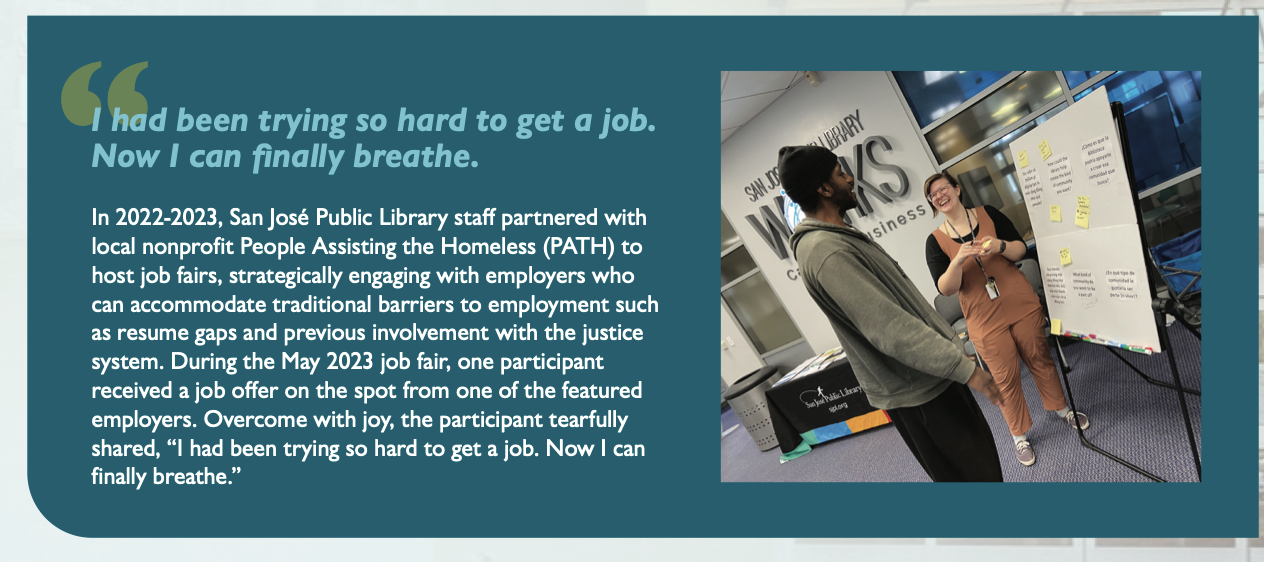
(City of San Jose, 2023, p. 12)

These are salient examples of how the public library can provide both short and long-term solutions for the unhoused. These services transform and empower those belonging to a population that is marginalized and dehumanized by society – while chipping away at the stigmas held by patrons with more privilege and power. The human, community, and justice-centered direction that libraries are taking inspires so much hope and possibility. 
Reflection: Hyperlinked Environments

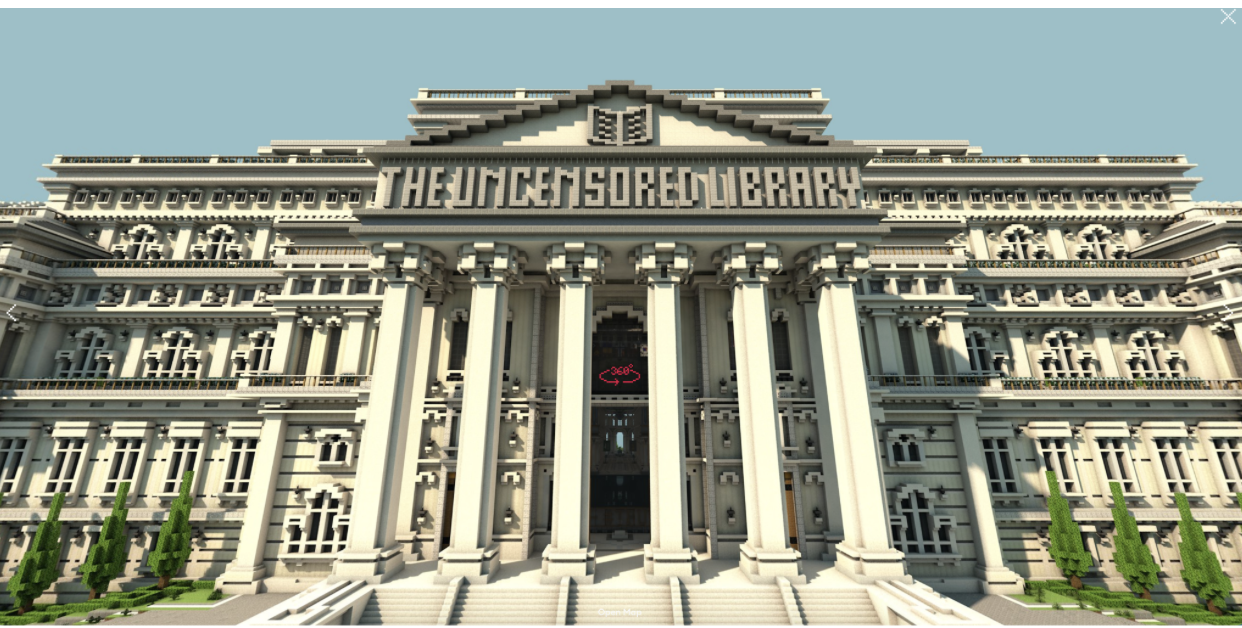
 The Uncensored Library 

The Uncensored Library server/map on Minecraft has a powerful purpose in fighting against internet censorship by publishing articles by writers who have been banned, imprisoned, exiled, or killed. Specifically, this library honors the voices and perspectives of Jamal Khashoggi from Saudi Arabia, Nguyen Van Dai from Vietnam, Javier Valdez from Mexico, MadaMasr and Al-Manassa from Egypt, and exiled journalists from Russia. Their library honors the voices and legacy on an extremely popular gaming platform – this opens up the many possibilities to what librarianship in terms of information sharing and retrieval can look like. 

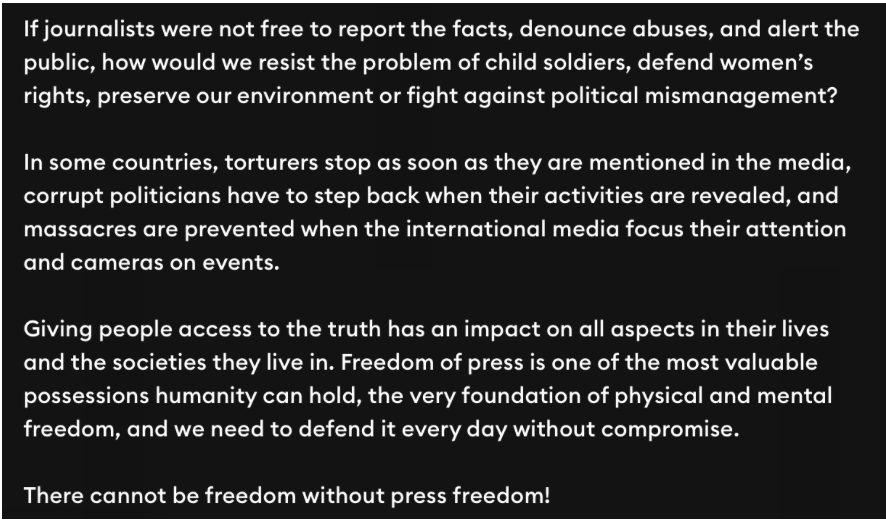
This text under the Reporters without Borders section of the map underscores the importance of press freedom. 

Questions

  • Can this truly be called a library with only five articles being published? 
  • Why does the main page talk about having articles from the United States, Iran, Brazil, and Belize but I cannot find them on the map? Were these removed? Are they accessible from a different map that is not on their official website?
  • Why is this library not updated frequently – what are the barriers? 
  • How often is this library frequented and to what degree do users engage with the articles published? 
  • How could this actually act as a library, where there is an abundance of articles and texts? 
  • What might social engagement look like in an uncensored library on a gaming platform?
  • How could participatory service allow for more frequency in updates?
  • What are the risks and dangers involved in maintaining such a library?

Real-World Applications

Censorship is something many public school teachers, librarians, and other industries are facing in America. Book bans are discussed in PBS News Hour’s documentary, The Librarians.  The Minecraft Uncensored Library sparks the possibility of using digital, non-traditional spaces to host information in the face of book bans.

Reflection on Hyperlinked Communities

Wash & Learn Pop-Up Library Program in the Bronx 

I am super moved and inspired by the library program covered in this 3:49 minute video. The partnership between Libraries without Borders (BSF), The DreamYard Project, and the LaundryCares Foundation transcends traditional library boundaries to meet the needs of their community. Through this program, the participants build community, connection, cultural capital, and knowledge. 

In the video, one of the speakers mentioned the importance of having students from the community to “go out and figure out what it is that we could offer that would actually be helpful.”

In this way, the “Wash & Learn” program will also give local youth the opportunity to develop skills that are essential for future success — from hard skills like creating a project timeline or securing an MOU, to soft skills like problem-solving, adaptive thinking and interpersonal communication (BSF, 2017).

The reciprocal and intergenerational nature of the Wash & Learn Pop-up Library program stands out to me. The community and their young leaders both gain from the interactions and benefits are exchanged. Gratitude, information, and skill are exchanged, leading to building of community and disruption of inequitable access to information and opportunity. Robin Wall Kimmerer argues for a gift economy based on reciprocity in her latest book, The Serviceberry. In an interview about her book, she shares:

And here we go back to Indigenous science and to Indigenous knowledge because there are wonderful antecedents to our contemporary economic models in Indigenous economies. And for the most part, they are based on circular economies, they’re based on a kind of biomimicry from the natural world. They’re based on reciprocity. The currency of an economy is not money. The currency of those gift economies is gratitude. And there’s trust that when you have more than you need, you will share it with me because we have this currency of reciprocal relationship. That’s how the natural world works (Kimmerer & Tucker, 2025). 

The Wash & Learn Library program disrupts supremacy culture and barriers to information, leading to transformation and hope. The program challenges my previous understanding of libraries as information organizations in physical buildings and their virtual websites. The act of transcending library walls in a way that builds and serves communities in spaces vital and consistently frequented by community members opens my mind to a world of possibilities.

In addition to the internal challenge I encountered, external challenges to this concept also exist. Upon exploration of the pop-up library program and its partnerships’ websites, I was unable to find more information online and did not see new publishings. Why did such an important program to the Morrisania neighborhood cease to exist? Was it unsustainable? What could we learn from the program and apply to future ones to promote its longevity? 

Library as the Community’s Heart: Ponderings and Possibilities


Thinking Like a Start-Up

In his white paper, then associate dean for Learning and Outreach at Virginia Tech Brian Mathews (2012) challenged libraries to “think like a start-up” to meet our primary goal in answering the question: “How do we help the individuals at our institutions become more successful?” As technology continues to evolve and transform society, adopting a start-up mindset allows information organizations to keep up and even move ahead of the curve. By evolving and staying informed, information organizations can help their communities build resilience and adapt.

Immediately, a recent CodeSignal article came to mind. In the article, CodeSignal discussed their 2026 Report of data-based university rankings which measured both general and industry coding skills of their graduates. CodeSignal’s assessment results revealed that the graduates of San Jose State University (SJSU) Computer Science (CS) program scored in the 66th percentile, ranking them number two compared to graduates from over 594 other universities throughout the nation. How did the SJSU CS program climb 49 spots from last year’s report? The department’s thinking and acting like a start-up may play a crucial role in effectively helping their students become successful coders.  Dean Kaufman attributes the success to the program’s alignment with current industries based on faculty experiences and network, emphasizing the importance of the college’s proximity to Silicon Valley’s technology hub (Team CodeSignal, 2026).

“Our academic programs have industry advisory councils which provide direct input to departments regarding industry needs,” Dean Ehrman explains. “Most of our lecturer faculty are part time and hold day jobs in the tech industry, so they’re able to include real-world perspectives in our courses. Many of our full-time tenure-line faculty also have industry experience and current collaborations with industry partners” (Team CodeSignal, 2026).

(CodeSignal, 2026).

Seizing the White Space

Thinking like a start-up includes “seizing the white space” – the white space consisting of everything that has not yet been done or considered (Mathews, 2012).  I wonder: what would it look like to transcend traditional library boundaries?

  • What would a partnership between SJSU’s academic library and its CS program look like?
  • Could libraries facilitate programming where CS faculty provide workshops for faculty of other departments?
  • Could SJSU’s academic library partner with industries to support the university’s other departments in preparing their students for future employment?

Encouraging the Heart

A distinct difference between thinking like a start-up and being one is that information organizations put humans first. I believe that every library should strive to be the heart of its community as discussed in the Hyperlinked Library, Participatory Services & Transparency lecture (Stephens, 2025). To be the community’s heart means to encourage it: “satisfying the needs and wants of our users”  and providing “a space where users connect, collaborate, create, and care” (Stephens, 2011). A wonderful example of a library being its community’s heart is Fayette County Public Library’s program where teens connect, collaborate, and create comics with published comic artists. This accessible program is rooted in care.

https://www.instagram.com/p/DYmnHkoDZuu/

I am reminded of two other relevant examples that are not necessarily rooted in information science but absolutely could be applicable to the hyperlinked library due to its richness in community, connection, collaboration, and care. Last Spring, Continue reading Library as the Community’s Heart: Ponderings and Possibilities

“There is nothing new under the sun, but there are new suns.” -Octavia E. Butler

Hello!

I am excited to continue my journey towards a librarianship in the Bay Area, California. I am working on both the MLIS and teacher librarian credential programs. I am eager to dive into my coursework this summer semester as I will not have to manage my capacity and additional responsibilities as a public school teacher.

While working on my first semester of the MLIS program, I found that information science is absolutely critical to public education. This particular course’s focus on the future of librariansip is necessary and urgent in this time of unprecedented advancements of technology and societal changes.

My goal for the class is to cultivate curiosity, creation, connection, courage, compassion, and community in order to better serve those who seek information as an educator and future librarian.