
Reading the history of the Four Space Model’s development sparked my interest. I’ve always enjoyed brainstorming ideas, sketching, collaborating with others, and seeing the final “product” come to life. The Four Space Model was developed by Dorte Skot-Hansen and her colleagues, associate professors Casper Hvenegaard Rasmussen and Henrik Jochumsen. This committee was formed to explore new roles for public libraries and lifelong learning, and to help integrate new and emerging digital technologies. To give some context, according to Jochumsen et al., during that time, many library branches in Denmark closed due to municipal reform and reductions in the number of municipalities and public spending. This framework helped discuss the value of the public library at the beginning of a new digital era and served as a tool for redesigning and developing the library.
The Four Space Model has four main goals:
- Experience
- Involvement
- Empowerment
- Innovation
This also includes four other overlapping “rooms” that can be viewed as either physical or virtual spaces. They are:
- Inspiration Space
- Learning Space
- Meeting Space
- Performative Space
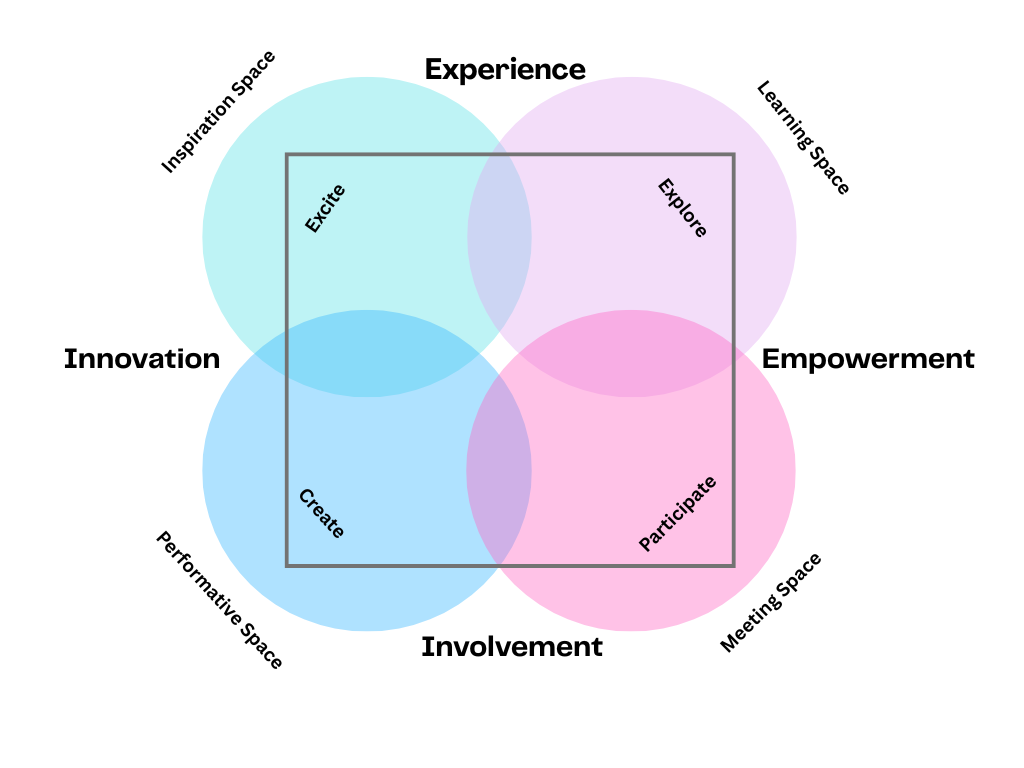
Four Space Model recreated using Canva.
Experience and Involvement center on one’s journey as they integrate into their community. As for Empowerment, it centers on individuals to solve everyday problems. Innovation helps create new concepts and methods that can boost artistic expression. These four goals can assist libraries in creating opportunities for the overlapping areas. These areas invite patrons to engage with one another by learning new things and heightening their creativity.
As explained by Jochumsen et al., these things cannot be considered in isolation; they must be seen as overlapping functions that interact in the library space, both physically and virtually. The model indicates possibilities for experiencing, discovering, participating, and creating that a new library must offer its users.
After learning more about this model, I can understand why it’s still a relevant tool for public libraries and for anyone involved in this type of environment to use as a foundation. This model continues to help Libraries structure their physical spaces and digital elements, making them more accessible and inclusive as times change. I know this model focuses on the environment and the space, but I think it can be a helpful tool that librarians can refer to when feeling “stuck.” What I mean is that if they notice an area in the library that needs to be rearranged because it is no longer serving its “purpose,” this diagram can help them reevaluate the space. What the new space can offer and how it can better serve the community. I feel like this can also be used when deciding whether to create and host workshops, how we would like the community to engage with each other, and how we can use the space to create a fun, interactive environment that encourages community participation.
Jochumsen, H., Hvenegaard Rasmussen, C., & Skot‐Hansen, D. (2012). The four spaces – a new model for the public library. New Library World, 113(11/12), 586–597. https://doi.org/10.1108/03074801211282948