Reflection Blog: Hyperlinked Environments International Libraries

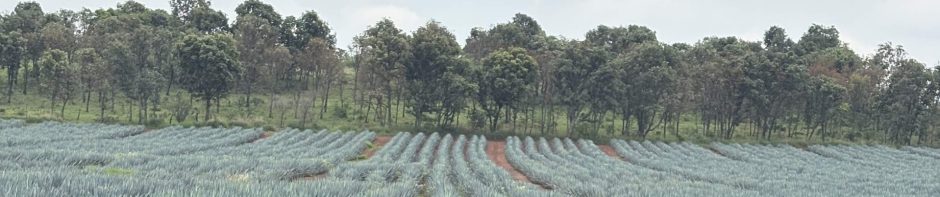
I learned to read in Spanish in my early teens, and ever since then I’ve challenged myself to read books in my native language. Growing up, it was always hard to find books in Spanish, especially ones you were interested in reading. On our yearly trip to Mexico, we would visit local libraries to read books while visiting and go to bookstores in hopes of finding books to bring back to the US. On my last trip to Mexico, one of my goals was to bring back books in Spanish. To my surprise, my hometown didn’t have a single bookstore; sadly, all were closed during COVID. The community now relies on its public libraries and local museum to gain access to books.

Looking at international libraries in a different light after realizing that some rural towns in Mexico rely solely on libraries for books and related materials. In my home state of Jalisco, there are 282 public libraries (“Red Nacional De Bibliotcas – DGB – Secretaría De Cultura”). One of the most well-known libraries is the Juan José Arreola Library. This library was integrated into the University of Guadalajara in 1925; its main goal is to provide users with a space to engage with culture and knowledge, encouraging reading and research. After researching a few libraries in Mexico, one thing they all have in common is their mission to preserve the area’s history and culture through artifacts and documentation, which often cross into the museum realm.

The Juan José Arreola Library’s structure has two buildings connected by a bridge; one building houses a historical collection, and the other a contemporary collection. Their visual and sound archives house film, audiovisual, photographic, iconographic, sound, technological, bibliographic, and documentary collections. It comprises approximately 150,000 documentary items primarily related to the cinematic, musical, and iconographic culture of Mexico and Jalisco (Archivo Visual Y Sonoro (AVS) | Biblioteca Pública Del Estado De Jalisco, n.d.).

Given how many international libraries incorporate their cultures into creating spaces for people to engage, the Juan José Arreola Library has something special in its collections. They have what they call the Shanghai Window. Shanghai Window is a collection of books brought by a project called “China’s International Book”; it aims to raise awareness of Chinese culture and history in other countries. This library is the only institution in the entire country that safeguards this collection, forming part of the more than 55 countries that make up the “International Book of China” project (5.4 Ventana De Shangai | Biblioteca Pública Del Estado De Jalisco, n.d.).

The library centers on engaging with its community; it offers a variety of workshops, cultural and academic activities. Juan José Arreola Library is one of the top libraries to visit if you’re in Mexico. If you want to take a virtual trip, you can head over here!

“Red Nacioanal De Bibliotcas – DGB – Secretaría De Cultura.” Cultura.Gob.Mx, 2024, https://dgb.cultura.gob.mx/directorio/bibliotecas.php?op=1&id_estado=14&id_municipio=0&id_localidad=0. Accessed 1 July 2026.

“Archivo Visual Y Sonoro (AVS) | Biblioteca Pública Del Estado De Jalisco.” Bpej.Udg.Mx, 2016, https://bpej.udg.mx/index.php/acervo-historico/piso-5/archivo-visual-y-sonoro-avs. Accessed 3 July 2026.

“5.4 Ventana De Shangai | Biblioteca Pública Del Estado De Jalisco.” Bpej.Udg.Mx, 2025, https://bpej.udg.mx/index.php/acervo-contemporaneo/piso-5/54-ventana-de-shangai. Accessed 3 July 2026.
 

Posted in Uncategorized | Leave a comment

Reflection Blog: Hyperlinked Communities

Healing power of books

Social media apps like Instagram and TikTok have popularized hashtags like #booktalk, #bookstagram , and #bookish over the last couple of years. Not sure how it became popular, but in my opinion, many people finally realized it’s okay to enjoy reading and share their passion for books with one another. I know there have been stigmas in the past about readers, readers being “uncool” or having a negative connotation. I’m confident when I say that many people don’t see readers in that type of light anymore.

Now more than ever, we have access to books; many go to a public library, visit a community Little Free Library, or purchase them. I find myself doing all of these for many reasons. I find new books I probably would not normally read by walking the aisles of my local public library. I purchase books to support authors and indie bookstores. I share books I no longer have room for with my community by dropping some off at a Little Free Library.

I’m also a participant in book clubs, many through Discord groups. One of my favorite Discords groups is called Thron Grove, which is Adalyn Grace’s book community. My point is that books unite us; we share books that resonate with us, annotate, analyze, and connect with the characters. Books have the power to heal. They help you escape reality, bring you peace, provide encouragement, and, at times, a whole wave of emotions. Certain book stays with you for a long time.

As Jessica Klinker states, “Books can also serve as lenses, opening readers up to different insights, cultures, and experiences they may not otherwise experience, deepening their empathy for others. They provide a critical foundation for conversations that extend into political and social contexts and that focus on unity and healing rather than division and destruction”.

I completely agree with this statement. I’m slowly branching out of my comfort zone with book genres. One of my book clubs is focused on diversity and inclusivity. We try to select a book of the month by a BIPOC or Queer author. Although some of these stories might not connect with everyone, they remain just as impactful. I’ve challenged myself to read three books in my native language this year, which may be easy for many, but I’m not as fluent as I thought.

In the end, the important takeaway, as Professor Stephens states, Hyperlinks are people too. By reading books, we can connect, converse, and share experiences with others, allowing us to engage with our community.

Klinker, Jessica. “The Healing Power of Books: Using Reading to Address Social and Emotional Needs.” Gale Blog: Library & Educator News | K12, Academic & Public, 24 July 2020, blog.gale.com/the-healing-power-of-books/.

Posted in Uncategorized | 7 Comments

Assignment X: Four Spaces of the Public Library

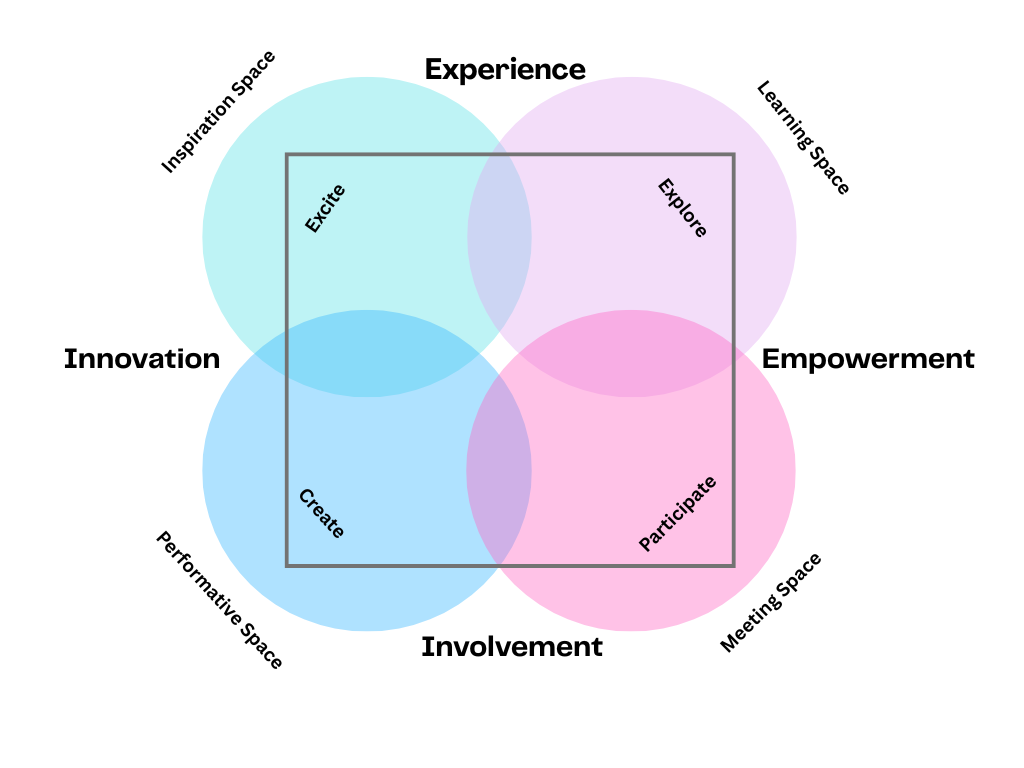
          Reading the history of the Four Space Model’s development sparked my interest. I’ve always enjoyed brainstorming ideas, sketching, collaborating with others, and seeing the final “product” come to life. The Four Space Model was developed by Dorte Skot-Hansen and her colleagues, associate professors Casper Hvenegaard Rasmussen and Henrik Jochumsen. This committee was formed to explore new roles for public libraries and lifelong learning, and to help integrate new and emerging digital technologies. To give some context, according to Jochumsen et al., during that time, many library branches in Denmark closed due to municipal reform and reductions in the number of municipalities and public spending. This framework helped discuss the value of the public library at the beginning of a new digital era and served as a tool for redesigning and developing the library.
The Four Space Model has four main goals:
  • Experience
  • Involvement
  • Empowerment
  • Innovation 
This also includes four other overlapping “rooms” that can be viewed as either physical or virtual spaces. They are: 
  • Inspiration Space
  • Learning Space
  • Meeting Space
  • Performative Space

Four Space Model recreated using Canva.

          Experience and Involvement center on one’s journey as they integrate into their community. As for Empowerment, it centers on individuals to solve everyday problems. Innovation helps create new concepts and methods that can boost artistic expression. These four goals can assist libraries in creating opportunities for the overlapping areas. These areas invite patrons to engage with one another by learning new things and heightening their creativity. 
          As explained by Jochumsen et al., these things cannot be considered in isolation; they must be seen as overlapping functions that interact in the library space, both physically and virtually. The model indicates possibilities for experiencing, discovering, participating, and creating that a new library must offer its users.
          After learning more about this model, I can understand why it’s still a relevant tool for public libraries and for anyone involved in this type of environment to use as a foundation. This model continues to help Libraries structure their physical spaces and digital elements, making them more accessible and inclusive as times change. I know this model focuses on the environment and the space, but I think it can be a helpful tool that librarians can refer to when feeling “stuck.” What I mean is that if they notice an area in the library that needs to be rearranged because it is no longer serving its “purpose,” this diagram can help them reevaluate the space. What the new space can offer and how it can better serve the community. I feel like this can also be used when deciding whether to create and host workshops, how we would like the community to engage with each other, and how we can use the space to create a fun, interactive environment that encourages community participation. 
Jochumsen, H., Hvenegaard Rasmussen, C., & Skot‐Hansen, D. (2012). The four spaces – a new model for the public library. New Library World, 113(11/12), 586–597. https://doi.org/10.1108/03074801211282948
Posted in Uncategorized | Leave a comment

Get to know me!

Hi everyone, I’m Karla (she/her), and I’m from central CA. I just started my MLIS journey in the spring. During my undergrad, I worked as a student assistant at the Reference desk at the campus Library and loved it. After many years of contemplating starting this journey, I finally decided to apply, and here I am. I’ve found that the Public Librarianship pathway combines a few of the things I enjoy: reading books, technology, the arts, and giving back to our community, just to name a few.

For the last 15 years, I’ve worked in tech, and I currently work in the IT department for the local hospitals in my city. Very different from a library setting, but still giving back to our community in a very different way.

In my free time, I like to play video games, read, and build LEGO sets.

Currently playing: Pokopia

Reading: The Bewitching by: Silvia Moreno-Garcia

Posted in Uncategorized | 4 Comments