“One of the biggest business battles of our time is between Microsoft and Google” (Loertscher, 2008). Well, today in 2026, I would say that battle rages between the different AI platforms. “Microsoft believes that if they build it, we will come -and buy their product. Google’s approach is different: if they built it, we will integrate it into our lives”. Now, we can say that Google has remained consistent because that is indeed exactly what has happened with its AI approach. When we search for anything in Google nowadays, we are first presented with an AI overview of the response, and invited to ask follow-up questions. Only if we scroll down, we can get actual sources that would answer our question. And that is the thing: more and more often, many people will not scroll down any further. AI Gemini has been integrated into the Google Suite. A debate has been sparked at my school about Gemini and Notebook LM being added to Google Classroom students’ accounts. We stop mid-task in the kitchen to ask Alexa a quick question. We call our health insurance and are kept on an AI bot until we impatiently repeat “Human agent! Human agent!” into our phone.
These are all examples of how AI has infiltrated and integrated into our environments and thus our lives. AI has sometimes made itself almost indispensable for some people, or at least a go-to without a second thought. It has become instinctive, and very rapidly so (in just a couple of years). It is very interesting (but I could really think of several other adjectives) how fast this habit has taken. Some people find it fascinating and amazing, some others find it worrying.
I would personally argue that while AI has hyperlinked us to information (and even here, we need to be very careful because of the numerous AI issues such as hallucination, incomplete or irrelevant information, etc), it has not hyperlinked us with each other. On the contrary, in many ways, I reckon it can easily make us less linked to each other. We read and hear about people using AI engines as their therapist (and it has now become a new market: Therapeak, TalkSpace,…), their friend or even their lover (remember the visionary movie “Her”?). The Russian series “Better Than Us” and many BlackMirror episodes are really too close for comfort when displaying how intertwined AI has become with our environments and actually made us more isolated. According to a recent Pew research (2026), 10% of Americans use AI for emotional support.
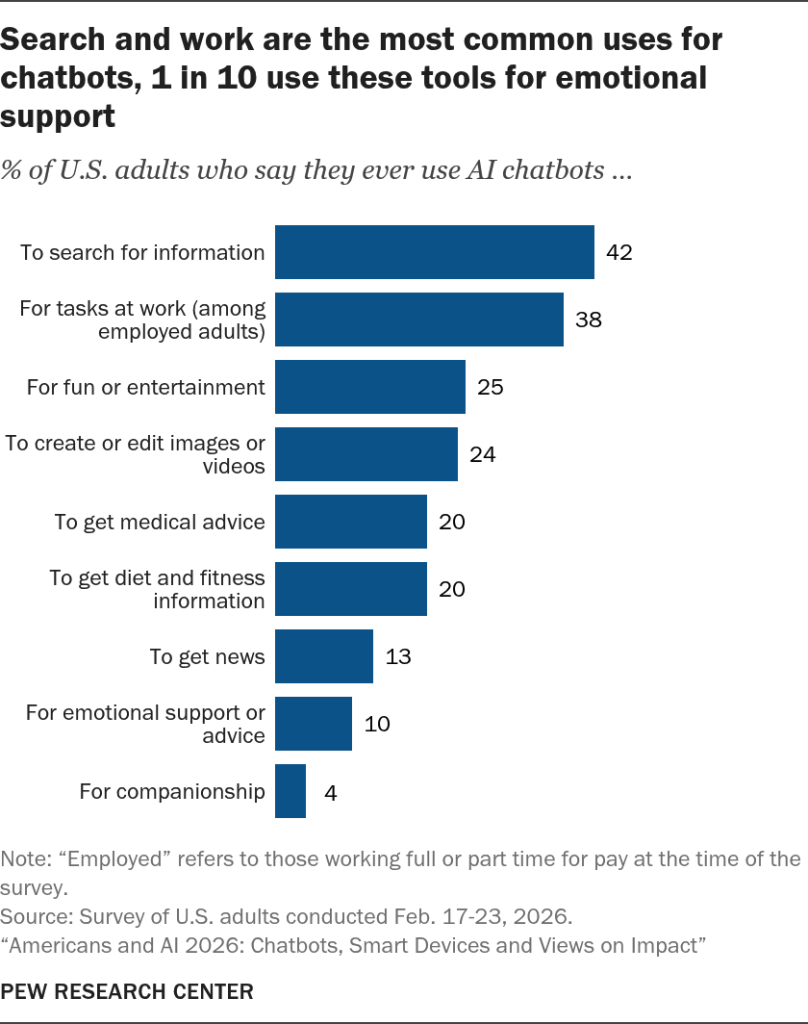
Regardless of our opinions about it, AI is here to stay so we need to ensure that, just like with any other emerging technology, we use it as a tool to navigate our new modern complex environment, and that it remains only a part of it. Information ultimately comes from humans and any new tool, whatever it is, should enhance our human bonds and what we learn from each other.
References
Gottfried, J., Bishop, W., Anderson, M., Faverio, M., Park, E., & McClain, C. (2026, June 17). Americans and AI 2026: Chatbots, smart devices and views on impact. Pew Research Center. https://www.pewresearch.org/internet/2026/06/17/americans-and-ai-2026-chatbots-smart-devices-and-views-on-impact/
Loertscher, D. (2008). Flip this library: School libraries need a revolution, not evolution. School Library Journal (New York, N.Y.), 54(11), 46. https://link-gale-com.libaccess.sjlibrary.org/apps/doc/A189870491/AONE?u=csusj&sid=bookmark-AONE&xid=c9cf8a02
Thrill de Novo – Shorts. (2025, October 4). Black Mirror: Can AI Bring Back Loved Ones? [Video]. YouTube. https://www.youtube.com/shorts/iUAML4ufD4E
This was such an intriguing thought! I’ve always though of technology as something that connects us more than ever before. I mean, we can all pick up our small electronic devices to immediately connect with someone on the other side of the world. But, your point about AI disconnecting us is also very true. I personally know of a few acquaintances who use Chat GPT as some sort of “therapist” (AKA to affirm their opinions and decisions). While the power of AI is impressive, it’s also quite scary. You and I both can agree that AI should exclusively be a tool to enhance information dissemination and human bonds; unfortunately, the real challenge is making the masses believe that too.
Thank you for stopping by @tinazhen ! I agree that technology has -often- connected us. My entire family lives on the other side of the world and I can’t imagine not being able to send my mom a picture about the new recipe that I’ve tried or message my best friend to ask her how her job interview went. However, in my opinion, AI is different (than mere technology). More often than not, it substitutes itself for the other person and therefore the opportunity for human connection is lost. There are certainly cases when it is appropriate for the context and/or the user, but it is my observation so far.
Indeed, it is a tool and as with all tools, the real value is knowing how to use it.
Hi again @jenniferw! I enjoy your coining of the term “hypolink,” and you raise great points about how AI affects human connection. Your mention of Black Mirror actually reminds me of how various companies are creating AI products that let you speak to loved ones who have passed away. One such tool, Seeking Immortality (though I think it’s called WeTales now?), was actually set to debut at the ALA Conference last month, though it’s marketed more as a method of “digital storytelling.” But when the stories and conversations it would provide are AI-generated (according to their website), what are we truly connecting with, and what is the value of “connecting” through that artifice rather than simply having and documenting real conversations? I imagine any inevitable discrepancies between the AI representation and the real thing would also potentially be uncanny or upsetting to the people who actually knew them, and it makes me wonder if the purpose of such tools is truly connection through storytelling, or if it’s more of a self-serving thing (as suggested by the product’s original name) and the promise to leave a “legacy.” After all, you yourself would have to opt in to be “preserved” in that manner, and I imagine that anyone who has the means to find such a product and submit all their data also has the means to simply take regular photos/videos and talk to their loved ones more directly, whether it’s in person or through letters, voice calls, video calls, etc. While technology can certainly reduce distances between people, I think we should be careful not to let it replace who we are.