While working through the materials for this module, two organizations stood out to me the most, The Human Library and StoryCorps. Both organizations focus on speaking directly to people and encouraging them to share their stories to build connections and uplift voices that may otherwise go unheard. It can be easy to stay engulfed in our own little world, speaking to the same people every day, moving within our own social circle, and listening to similar viewpoints. There are not many opportunities to speak with someone you would not normally interact with, which is why I was excited to read about these two organizations.
The Human Library features “human books,” which are people that volunteer to share their unique stories and perspectives with “readers,” opening themselves up to questions and sharing their experiences (Wentz, 2013). While this program originated in Denmark, it has expanded to several other countries and now even has an online video platform available (Human Library, n.d.; Wentz, 2013). In a recent study, Aarne-Skidmore (2021) found there is an overall positive impact from these programs, and many readers reported they began to reflect on their own biases and behaviors after attending a program. I believe this shows how important it is to listen to other people’s stories. By taking the time to have these open conversations, we can become more empathetic and reevaluate our own perceptions and biases.
StoryCorps is another organization that encourages people to share their stories. One difference is that instead of having “human books” available for checkout, stories are recorded as an interview between an individual and a loved one (Eberhart, 2018). Recordings are then posted online, archived in the Library of Congress, and played on NPR’s “Morning Edition,” making these stories widely available (Eberhart, 2018). While The Human Library makes it possible to have a one-on-one conversation with a new person, I appreciate that StoryCorps makes it easy for more people to share their stories. With their DIY tools and StoryCorps App, people can record a conversation and share it at any time (StoryCorps, n.d.-b). Additionally, if someone does want to meet someone new, StoryCorps has a new program called “Connect250” that matches people together to have a conversation and share their experiences as part of a time capsule for America’s 250th anniversary (StoryCorps, n.d.-a).
Both organizations make it possible for people to share their stories and build connections, which can help broaden viewpoints and lead to more empathetic communities. Within a library setting, I can see both models being used as a way to encourage communication between the many different people that come into the library. Not only can these types of programs help facilitate conversations between patrons, but they can also help librarians build better relationships with people they interact with every day.
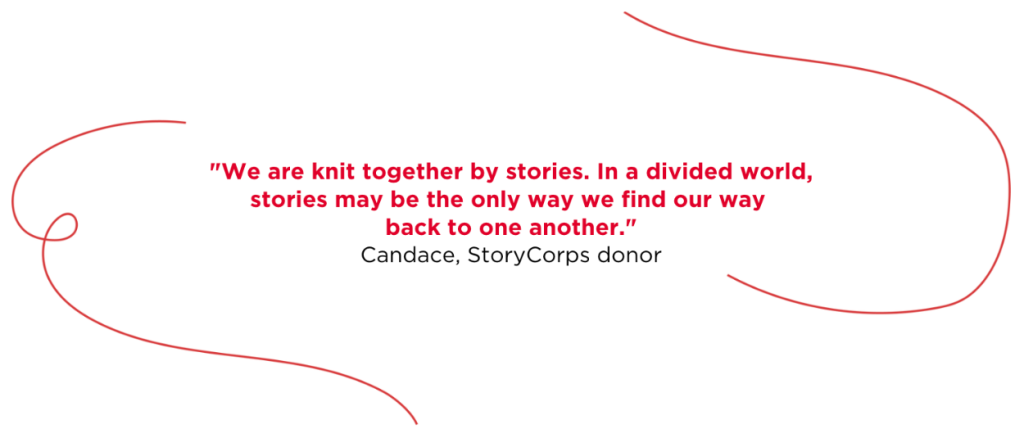
Quote from Impact page on StoryCorps website. https://storycorps.org/impact/
References
Arne-Skidmore, E. (2021, April 8). New study on the impact of the human library. Human Library. https://humanlibrary.org/new-study-on-the-impact-of-the-human-library/
Eberhart, G. M. (2018, February 10). Sharing people’s stories. American Libraries Magazine. https://americanlibrariesmagazine.org/blogs/the-scoop/sharing-peoples-stories/
Human Library. (n.d.). Human library online. https://online.humanlibrary.org/
StoryCorps. (n.d.-b). Participate. https://storycorps.org/participate/
Wentz, E. (2013, April 26). The human library: Sharing the community with itself. Public Libraries Online. https://publiclibrariesonline.org/2013/04/human_librar/
When I was reading your post, I was struck with the thought that the earliest forms of learning was through stories. We are told bedtime stories, family stories, Bible stories, and the list goes on and on. These stories help us to learn about the world around us, the people around us and help us to learn about ourselves. Stories have the power to move people to action, to change, to emotion. This notion of story telling is as old as time.
I love the idea of the human library and the story corp. Both organizations have a fantastic way for “readers” to get to know their “books” in ways that open up dialog and conversations about many things including those topics that are hard to talk about. I know that a while ago, we had an English instructor that had a smaller version of the Human Library on our campus for one of her classes and it was well attended. She did it a few times over the years before she left and it always left people talking about the experience. I would love to bring that back to our library. I think now more than ever, it is important to tell our stories. The stories we have now versus the stories from back then bring a vibrance to our knowledge base that can’t be had any other way.