A question I often hear when I tell people I am pursuing my MLIS and that I currently work in libraries is, “Who still goes to the library?” I wish the people that ask that question could step into a school or public library and witness the range of activties and interactions taking place. There is exploration, learning, curiousity being satisfied, and humans of all ages connecting in different ways. A glimpse into the space may show school students participating in a book tasting, a group of adult learners in a study room, poring over their textbooks and supporting each other on their educational journeys, or the adult patron looking for classes for seniors. They would get to experience the magic that is the the learning laboratory also known as the library. The library is a more digitally connected space than ever before. So many things are accessible online through various platforms. From Libby to Driver’s Education, there are many digital programs in addition to all of the in person programming available. We have more ways than ever to be connected, but there is still a chasm between those who are able to navigate these digital learning spaces and those who are somewhat sidelined for a variety of reasons.
“In the networked society, learning is everywhere and everywhere is here”. Nygren (2014)
There are two disconnects I see happening. The first is those who have an outdated perception of what is happening in the library. Bookey (2017), exemplifies this disconnect between the the perception of libraries past versus the libraries of today. “Kiss your image of a library as a book warehouse goodbye, and say hello to community spaces and gathering places for the 21st century”. The second disconnect are those being left out or behind because they do not have the digital literacy skills required to get “connected”, which Nygren (2014) discusses as well as opportunities to address this gap. Libraries to me are a school for lifelong learners. The library is a place of structured and fluid learning ranging from food preservation to learning to play bocce ball. They are truly the centers of our communities and the endless learning opportunities prove their importance in our society time and time again. The library is not the quiet, stuffy space that acts as a museum for books that people don’t read anymore. The stacks are alive with well curated titles. There are classes for all ages and exhibits that engage and inspire. There are community groups practicing other languages and playing games. I would be remiss if I did not mention tool libraries and the worlds those open up for patrons. The library is the epitomy of community connection and learning. I hope word gets out that the best school in town is your local library.
“In the ‘connected learning’ approach, learning is accelerated when it is powered by an individual’s interests and passions, supported by peers, and in spaces where an individual feels valued and safe”. Nygren (2014)
References:
Bookey, J. L. (2017, December 6). 8 awesome ways libraries are making learning fun. HuffPost. https://www.huffpost.com/entry/8-awesome-ways-libraries_b_7157462
Nygren, Å. (2014). The public library as a community hub for connected learning [Paper presentation]. IFLA World Library and Information Congress, Lyon, France. ifla.org
San Francisco Public Library. (2026, July 28). Activity: Bocce Ball. https://sfpl.org/events/2026/07/28/activity-bocce-ball
Solano County Library. (n.d.). Special collections. https://solanolibrary.gov/catalog/special-collections/
Sonoma County Library. (n.d.). UC Master Food Preservers: Making refrigerator pickles. https://events.sonomalibrary.org/event/uc-master-food-preservers-making-refrigerator-pickles-110166
This might be my favorite topic of the semester! I am a huge fan of StoryCorps and Maria Popova’s writing. I find hearing other people’s stories so moving and also challenging to some of my staunchest beliefs about the world. This module had a lot of meaning for me because I think about our own stories and how they shape who we are. In high school I was assigned to interview someone in my family about their childhood story. This was in the mid 90’s, so I remember using a tape recorder (very high tech!) to interview my paternal grandmother. We sat in her house, and looked out at the garden at her house in San Francisco. The garden my sisters and I often helped her with, which had a true greenhouse my grandfather had built. This house had been in my grandfather’s family for generations and it was very special to her. I always knew the house was important to her, but it took sharing her story for me to truly understand who she was.
I asked her about her childhood in Butte, Montana. She candidly shared heartbreaking as well as humorous insights into her younger years. As the daughter of immigrants living in extreme poverty, she revealed a side of her that I never knew. It was not until after the interview that I began to understand my grandmother’s deep love for her home and garden. I began to understand her unending gratitude for having an operational refrigerator, a washing machine, and heat. Even now, in my late 40’s, I can clearly recall listening to her tell the story of her sister stealing coal from a train coming through town so they would have heat that night in their home. Or her widowed mother scrubbing floors at the church in town so she could afford food to feed her family that night. Sadly, I lost the tape on which I recorded her interview. I wish we had the technology then that is now ubiquitous. What I would give to have that recording of a teenager and her long-widowed grandmother traveling back in time to a desolate mining town and the subsequent years in Portland, then finally settling in San Francisco. Her story is part of my story.
The power of our stories cannot be measured. I think about the impact my grandmother’s story has on me, decades later. She has long since passed, but the power of her story will remain with me for the rest of my life. I often think about the differences between our childhoods. Witnessing her story made me appreciate my own and understand her in a new way. “Story-based experiences of all kinds can increase listeners’ understanding of diverse groups, demonstrate the value of everyone’s experience, and remind listeners of their shared humanity” (Stephens, 2019). I felt compelled to include this video. I thought of this after reading Storm Reyes’ story. Stories change lives as do libraries. By their mere existence and all of the ways they champion stories.
References:
PBS. (2011). Biblioburro. POV. https://www.pbs.org/pov/films/biblioburro/
Popova, M. (2016, October 6). How libraries save lives. The Marginalian. https://www.themarginalian.org/2016/10/06/libraries-storycorps-bookmobile/
Stephens, M. (2019, September 4). With a little twist. Library Journal. https://www.libraryjournal.com/story/With-a-Little-Twist-Office-Hours
I am fascinated by the Anythink Nature Library. As a lover of the outdoors, gardening, and nature in general, this sparked some interesting ideas. My first inclination was to explore the concept of bringing nature into libraries, especially in areas lacking green spaces, such as city centers. Whether adding exterior gardens (culinary, native plants, etc.) or holding classes with a local Master Gardener goup, I think there is something special about connecting people with nature in some form. As I explored this idea, the issue of loneliness kept coming up. Specifically, isolation and the impact technology has had on our very human experience of connection. I was recently at a deli with a friend, where I observed two tween girls come in to get smoothies. They were huddled around their cell phones at their table, yet they were interacting with each other, chatting and giggling. They had arrived on their bikes together, out on a summer day. Despite their phones being always at hand, they were spending time together, IRL. It felt like an anomoly to see two kids out on bikes unsupervised. Awesome! Why did that seem outside the norm to me? I see so many adults and kids glued to their phones, distracted, and disconnected. I think nature and being outdoors can support more awareness and possibly foster connection. This can be self-awareness and also the noticing of others. When we look up and around, it can be amazing what we may have been missing, IRL.
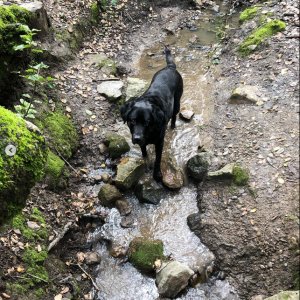
My late dog, Boston. A master at enjoying nature.
In Trend Towards IRL Events With More Authenticity. What’s Behind It, Lee (2026) discusses the desire to be more connected in real life, with real connections. He raises the idea of “digital fatigue”, which is interesting and somewhat ironic. Our whole world operates using technology. We do so much living “online”, but at what cost to our mental and emotional health? Libraries have (and I think some are seizing) a real opportunity to create these IRL experiences that are authentic and can connect people. Bonus if you can incorporate a natural element either by experience or environment. The Anything Nature Library references the Environmental Kinship Model as a foundational element in the creation and fostering of experiences in the natural world, while also incorporating learning and exploration.
The Environmental Kinship Model has three important attributes which are helpful to think of as a framework for planning programming and space. They are Practical, Inclusive, and Community. The Anythink Nature Library (Anythink Libraries, n.d.) is incorporating these simple, yet quite “deep” elements . From indoor/outdoor programmings areas to a cafe for gathering and relaxing, this library will offer such a variety of spaces for patrons to truly be immersed. I wish I could be there for their grand opening next month!
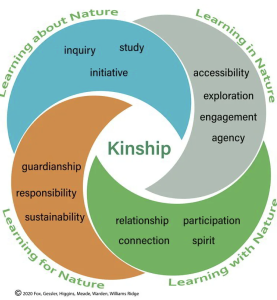
Image Source: https://mindstretchers.academy/pages/environmentalkinship
References:
Anythink Libraries. (n.d.). Anythink Nature Library. https://www.anythinklibraries.org/anythink-nature-library/
Environmental Kinship International. (n.d.). Environmental Kinship. Mindstretchers Academy. https://mindstretchers.academy/pages/environmentalkinship
Lee, B. Y. (2026, January 25). Trend towards IRL events with more authenticity. What’s behind it. Forbes. https://www.forbes.com/sites/brucelee/2026/01/25/trend-towards-irl-events-with-more-authenticity-whats-behind-it/
What if the school library could be an energetic, dynamic space with students teaching alongside the adults? Book bedazzling at lunchtime? Peer tutoring? This is my vision for reimagining the school library, starting with middle school. I hope you enjoy it!
“It’s not schools themselves, obviously, that stand in the way of progress. It’s our nostalgia for what schools are supposed to be. It’s our lack of a modern context for developing a vision for what schools might become” (Richardson, 2014).
So often it seems that we resist change in our schools and libraries, lament how we “used to learn”, and all the while fail to enact meaningful and scalable change that can invigorate these spaces for our learning community. As a child of the 1980’s I did not have an iPad, Chromebook, or chat with my teachers via email and Google Classroom. My first experience with “modern” technology was with the Apple IIe! It was a pretty magical moment when I was in the computer lab for the first time and got to play Where in the World is Carmen San Diego. Technology has changed so many aspects of my life. Mostly for the better, sometimes not. However, it is not going anywhere. Today, our students live in a fully digital world. They have not known a before or after, so why are we so slow to modernize aspects of education? Why are we stuck when it comes to school libraries?
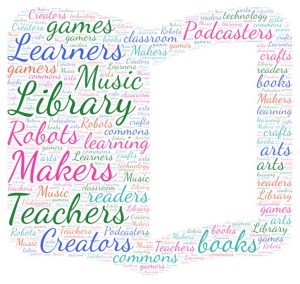
Humankind and technology will continue to evolve, yet somehow we have become entrenched in a vision of school libraries that does not meet the moment. The school library environment is long overdue for a makeover. Loertscher (2008), describes a new vision for the school library. The goal of this new vision in centered around the learning commons. He explains, “The main objective of the open commons is to showcase the school’s best teaching and learning practices.” His idea of creating a dynamic space that is physical, virtual, and is operated and used by teachers, teacher librarians, specialists, and other specialized staff is a far cry from the historical model. This model invites all members to participate, which in turn creates a dynamic synergy across all channels, versus the school library remaining in a silo, continuing to mothball.
“The middleman is vanishing as peer to peer interactions flourish. Teachers no longer stand between the content and the student” (Richardson, 2016). We need a more holistic approach when imagining our school libraries and the role they will play in our educational system. What would it look like to have school libraries that are more of a lively and active commons? What would the experience be like for our students and staff? I would hope engaging, maybe even invigorating, and above all, meaningful. Not just teaching to the test, following dry and standardized curriculum, but a more interconnected and interpersonal experience.
References:
Cord, D. J. (2018, December). Helsinki invests in its people with a library that reinvents the genre. This is Finland. https://finland.fi/life-society/helsinki-invests-in-its-people-with-a-library-that-reinvents-the-genre/
Loertscher, D. V. (2008, November 2). Flip this library: School libraries need a revolution. School Library Journal. https://www.slj.com/story/flip-this-library-school-libraries-need-a-revolution
Jenkins, H. (2013, May 7). Henry Jenkins on participatory culture: Big thinkers [Video]. Youtube https://www.youtube.com/watch?v=1gPm-c1wRsQ
Richardson, W. (2016, May 14). 16 Modern realities schools (and parents) need to accept. Now. Medium. https://medium.com/modern-learning/16-modern-realities-schools-and-parents-need-to-accept-now-64b98710e4e9
Richardson, W. (2014, July 7). Schools at the crossroads. Will Richardson. http://willrichardson.com/schools-at-the-crossroads/
I really enjoyed this module as it gave me a lot of avenues to explore. As I continue to focus my explorations on the school library, I keep thinking about who am I reaching and who is actually reachable? This has become somewhat of a struggle for me. Our mantra is that “the library is for everyone”, but is it? Can we be all things to all students?
In A Beautiful Obsession, Pewhairangi (2014) discusses what libraries should be doing, which is to “…focus its resources on its most valuable members and become obsessed with capturing their attention, surprising them and delighting them” (p.8). In a school setting who are our most valuable members? The “library kids” or the ones who come into the library to hang out with their friends, but do not want to engage with anything else the library has to offer. Which brings me to my next quandary…cell phones. This is our current signage, which now strikes me as the opposite of welcoming and community. The sign on the bottom delivers a completely different message.
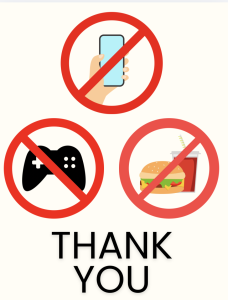
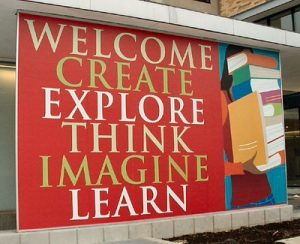 https://www.flickr.com/photos/davidking/
We have a strict no cell phone policy in the library, which is self-imposed. There are a few reasons, but first and foremost is privacy. It is not feasible to gate-keep students filming or recording others in the space. However, I wonder if we are missing an opportunity for engagement and instead are creating a barrier.
After reading Jensen’s (2022) article about #BookTok, I am intrigued! Is this is a missed opportunity? In Assignment X, I lamented that I do not want to just be the library lady who enforces rules and basically tells kids to “get off my lawn” or in this case “put away your phone”. I want to be an ambassador and collaborator to a space that is fun, engaging, and truly a community space.
Last year my colleague, who is our library technician, built a display 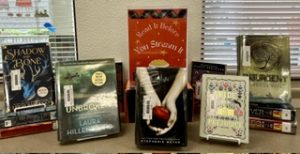 highlighting books that were currently “streaming”. We jumped on the Netflix and Amazon bandwagon, and it worked! The power of connecting to something students engage with daily should not be underestimated. Will we reverse the cell phone ban? That warrants a larger discussion with the team. How could we employ the device that is basically an appendage for most middle schoolers? That remains to be seen. I think we would have to have a structured, intentional use, which requires more nuance. This could be a #BookTok activity or maybe QR codes for activities, challenges, or games. I do know that I want this coming school year to be different for my students. In A Beautiful Obsession, Pewhairangi (2014), ends with The Philosophy of Love. The “e” in love stands for experimentation, “A willingness to experiment, free from orthodoxy and convention because this is when magic happens” (p.50). Maybe this is the year we invite the students onto our proverbial lawn with phones in hand. Let’s see what magic we can make together.
References:
Jensen, K. (2022, February 10). As seen on #BookTok: Inspiring young readers, TikTok is a boon for books. School Library Journal. https://www.slj.com/story/as-seen-on-booktok-inspiring-young-readers-tiktok-is-a-boon-for-books-libraries
Pewhairangi, S. (2014, May). A beautiful obsession. WEVE, 7–10.
Hello All,
My name is Cara and I am in my second to last semester at SJSU. I just completed my coursework for my Teacher Librarian Credential in the Spring semester and will be tackling e-port in the fall. I am really excited about this class and my other class, which is Adult Literacy. I am a teacher librarian and I spent this school year in three different middle schools. Teacher Librarianship is a wild ride, but also rewarding. I do work very part time as an extra help Library Assistant in the Solano County Public Library system, mostly in my local branch, which is Vallejo, California. I look forward to getting to know all of you this summer.