Author: Iris
I love the response of Oak Park Public Library’s (OPPL) Spark Team when it was suggested they repurpose a small area into an art space. In the article, Embracing the Long Game, Greenwalt (2013) writes, “They said, ‘OK, we’ll call it Idea Box, we’ll put things in there, we’re not entirely sure what’s happening with it yet, but I think it sounds really good’” (“Inside the Idea Box” section, para. 2). I’m sure Greenwalt intended it to sound amusingly half-baked, but it also reminded me that being playful and experimental are important elements of hyperlinked librarianship. Stephens (2016) states that “playfully approaching opportunities to create learning experiences and engaging information-based services” (p. 34) is an informed practice of hyperlinked librarians.
Since then, the Idea Box has developed into a participatory space that invites visitors to interact with the displays and each other. From the article, it was difficult for me to picture what the space looked like, but the OPPL website has photos of some past exhibits. The Idea Box is versatile—it has been transformed month-to-month as a bulletin board, diorama, display case, or interactive space. It’s on hold for now while the OPPL evaluates its continued use but it’s impressive the exhibit has lasted for as long as it has.
I enjoyed reading about OPPL’s Idea Box but, really, it was the end of the article that left an impression on me. The Idea Box helped OPPL create opportunities for community interaction in a way that was also budget-friendly, something libraries must often consider. Libraries may not have the funds to equip state-of-the-art makerspaces but that should not hold them back from doing what they can. OPPL’s customer service manager Monica Harris stated, “We’re really interested in creating some of those things too, but this [Idea Box] was a way for us to jump in and get our hands dirty right away” (as cited in Greenwalt, 2013, “Inside the Idea Box” section). It illustrates the way such a simple idea could spark a chain reaction in fostering participatory culture that can have long-lasting effects for future ventures.

References
Greenwalt, R. T. (2013, February 21). Embracing the long game. Public Libraries Online. https://publiclibrariesonline.org/2013/02/embracing/
Stephens, M. (2016). The heart of librarianship: Attentive, positive, and purposeful change. ALA Editions.
Revisiting Module 8: New Models
A few weeks ago, at a family get-together, as is what usually happens, someone asked me how library school is going. My response is typically along the lines of “slowly, but surely.” My cousin then proceeded to tell me about the library of things she happened upon at her local public library in Irvine. She did not call it that specifically but was pleasantly surprised and amused to find she could check out so many other items besides books at the library. There was even a ukulele.
And then, in Module 8, from the Going Beyond Books section, I read about the Chicago Tool Library and how it saves its members much in terms of purchasing tools, appliances, and equipment (Free, 2022) and perused the Traverse Area District Library’s Library of Things. For the Innovation Strategy & Roadmap, I dove deep into how libraries can implement culinary literacy into their programming. I am intrigued by these libraries that provide unconventional services, meet their communities where they are at, and find opportunities and tools to help patrons explore and learn something new—and often, for free.
A Library of Things
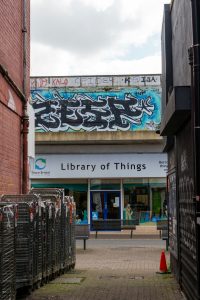
Photo by Lucy Davis on Unsplash
For many libraries, a Library of Things is a vehicle for participatory service whose collections are as result of input from staff members, library committees, or patron request (Bromiel & Towers, 2024).
We started hearing about the projects people were working on, what tools they needed, and what items they had lying around their homes that they wanted to donate to us for other people to use. While circulation numbers can tell part of a collection’s story, what really informs the success of a Library of Things and the impact it has on a community is how much the people we serve embrace it and make it their own. (Lax, 2020, para. 1)
Not far from me, the Altadena Library maintains a Library of Things. Interestingly, it developed from a partnership with NASA’s Jet Propulsion Laboratory who provided the library with a telescope and would be performing its calibration (Hogg, 2020). When the library reopened following the Eaton Fire, the telescope (with JPL’s continued calibration assistance), and the Library of Things were still available (KNX News 97.1 FM, 2025).
Libraries of Things are gaining in popularity as are other innovative and unorthodox library services. They are one way libraries can support their communities while also inviting participation in developing and maintaining collections and deciding what services customers value. Though libraries are starting to look and feel different, providing access to information and educational opportunities remains the same.
References
Bromiel, L., & Towers, A. (2024, March). Beyond books: Exploring the Library of Things movement. ILA Reporter, 42(1), 52-55.
Free, C. (2022, January 5). Tools are costly and take up space. Tool libraries are popping up so people can share. The Washington Post. https://www.washingtonpost.com/lifestyle/2022/01/05/tool-library-gift-economy/
Hogg, D. (2020, November 19). Library of things. Pasadena Weekly. https://www.pasadenaweekly.com/news/feature-stories/library-of-things/article_22880c2c-2ea6-58bc-a243-ecdc347f090b.html
KNX News 97.1 FM. (2025, March 4). Altadena Library reopens following closure prompted by Eaton Fire. Audacity, Inc.
Lax, B. What are these things doing in the library? How a library of things can engage and delight a community. Oregon Library Association, 26(1), 54-61. https://doi-org.libaccess.sjlibrary.org/10.5399/osu/1093-7374.26.01.11
Created using Word Art (https://wordart.com)
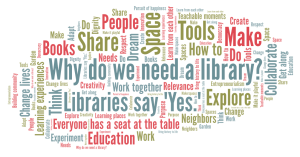
I was quite moved by Pam Sandlian-Smith’s TEDx Talk and the story she told about the young boy who asked if he could hold a puppet show at her library. She later discovered that he and his father were unhoused but would be moving for a new job, a new apartment, and away from her library. Sandlian-Smith stated:
Little did I know that when he asked that question how important it was for him to have that space to create, to think, to fulfill some dreams. He needed someone to have the instinct to say “yes,” and I’m so grateful that I did. He needed somebody to be on his side. Isn’t that what we all need? (TEDx Talks, 2013)
As we move through the course, each module has been about ways hyperlinked libraries can say “yes” and why these new models of librarianship should say “yes.” In doing so, they innovate and adapt in clever and inspiring ways to meet the needs of their communities. Equally heartening are the communities that continue to invest in their libraries, optimizing existing structures, renovating old ones, and building new facilities that welcome and offer comfort as well as opportunity. It is a public acknowledgement that the library is valuable, relevant, and necessary.
The Anythink Nature Library looks to be a prime example of one of the new models of librarianship; it is an unconventional concept whose purpose is to fulfill a community need. What caught my attention as I explored the Nature Library’s website was, oddly, the Frequently Asked Questions section. It reads mostly like a series of yes-answers: “Will there be non-traditional items available for checkout (such as camping gear)? Yes! … Will there be indoor and outdoor gathering spaces? Yes! … Will there be nature-based programs such as plant walks, foraging or outdoor education? Absolutely!” (Anythink Library, 2025).
As remarkable as the Anythink Nature Library will be, many libraries still manage to say “yes” while also working with fewer resources; there are numerous examples of libraries adapting in smaller, yet arguably essential ways. Klinenberg (2018) describes several libraries that provide safe places for social connection. With programming as unorthodox as a videogame bowling league held in the basement, a library says “yes” to building relationships, even with a modest budget.
Sandlian-Smith closes her TED Talk urging the audience that the next time someone asks, “Why do we need a library?” to reflect with, “Who else is going to do this?” But I think the answer is also, “Because, as much as they can, libraries say ‘yes.’”
References
Anythink Library. (2025). Anythink Nature Library. Retrieved July 17, 2026, from https://www.anythinklibraries.org/anythink-nature-library/
Klinenberg, E. (2018). Palaces for the people: How social infrastructure can help fight inequality, polarization, and the decline of civic life. Crown.
TEDx Talks. (2013, December 16). What to expect from libraries in the 21st century: Pam Sandlian Smith at TEDxMileHigh [Video]. YouTube. https://www.youtube.com/watch?v=fa6ERdxyYdo

Photo by Jamie Taylor on Unsplash
For the “Choose Your Own Adventure” theme, I gravitated toward the readings about Hyperlinked School Libraries. Let me start with one takeaway—school libraries and teacher-librarians can be critical to the success in preparing students as 21st century learners. Not a profound or new thought, just one I kept returning to as I moved through the readings.
In Future Ready Librarians View Innovative Libraries First Hand in Baltimore County, Glick (n.d.) described how Baltimore County Public Schools (BCPS), in collaboration with Future Ready Librarians (part of the Future Ready Schools initiative), were working together to transform their school libraries into creative places or “learning commons” for student inquiry and collaboration. One aspect of this was a commitment to staff all their schools with a “full-time certified school library media specialist,” creating an essential partnership with colleagues in the design and implementation of inquiry-driven lessons. In the NEA Today article, Reinvented School Libraries Unleash Student Creativity, Luster (2018) describes similar evolutions of other school libraries (including a BCPS high school) into places for learning, creation, invention, and exploration. Both readings highlighted the importance of certified teacher-librarians in facilitating these changes.
Photo by Hung Nguyen Phi on Unsplash
As we progress further into the digital age, we need to equip children with the skills they need to navigate the intricacies of life online and help them understand that their online activities have far-reaching consequences (good and bad) just like real life life in person. Ní Bhroin (2019) states that the term “naïve experts” is more appropriate than “digital natives.” This distinction is important; adults often assume children can navigate technology much more easily; this is partly true, however Ní Bhroin finds there is a disconnect between knowing how to use the technology and being informed users of it (e.g., understanding the concept of protecting privacy when uploading content; interpretations of permissions/restrictions).
Park (2016) outlines eight digital intelligence skills parents and educators need to teach children to prepare them for the digital age. They include digital identity, digital use, digital safety, digital security, digital emotional intelligence, digital communication, digital literacy, and digital rights. Park states that children “spend an average of seven hours a day in front of screens—from televisions and computers, to mobile phones and various digital devices.” In 2020 with the scramble to move K-12 learning online, school districts equipped students with individual devices, and many schools continue this practice today. Ten years ago, when Park’s article was published, only a few of my junior high students had cellphones. Now, the majority of them are connected. Additionally, in the last few years, curriculum across content areas has moved online; it is not a huge leap to assume this seven-hour average has increased.
Richardson (2016) stresses that technology “is no longer an option when it comes to learning at mastery levels.” He goes on to say, “The skills, literacies, and dispositions required to navigate this increasingly complex and change filled world are much different from those stressed in the current school curriculum.”
For a lot of California schools, the school library is an untapped resource and ranks at the bottom, 48th, in terms of the student to teacher-librarian ratio at 8,579 students for every one teacher-librarian (there was no data for North Carolina or Tennessee). For comparison, in 47th place is Indiana with a ratio of 4,246 to one. The state with the lowest ratio of students to teacher-librarians is Vermont at 407 to one (National Center for Education Statistics, n.d.). An important note—the Model School Library Standards for California Public Schools: Kindergarten Through Grade Twelve recommends a ratio of 785 students for every credentialed teacher librarian (Ong, 2011).
On a positive note, however, is that California’s ratio has shown improvement in the last few school years:
- 2021-2022: 9,964 to 1
- 2022-2023: 9,173 to 1
- 2023-2024: 9,054 to 1
- 2024-2025: 8,579 to 1
I am curious as to the reason for this increase as, in general, it seems that California school enrollment is declining (or perhaps the lower ratio is due to declining enrollment; in any case, we need to keep our teacher-librarians). My hope is that this trend continues and I found this week’s CYOA readings to be a clarion call for this. While many teachers are computer literate, in conversations with colleagues, digital literacy/citizenship is an area in need of improvement, both in its instructional delivery and need for meaningful, engaging professional development. Working in partnership with a teacher-librarian would be a huge benefit for both teachers and students and contribute toward a more hyperlinked school community.
References
Glick, F. (n.d.). Future Ready Librarians view innovative libraries first hand in Baltimore County. All4Ed. https://all4ed.org/blog/future-ready-librarians-view-innovative-libraries-first-hand-baltimore-county/
Luster, S. (2018, July 29). Reinvented school libraries unleash student creativity. NEA Today. https://www.nea.org/nea-today/all-news-articles/reinvented-school-libraries-unleash-student-creativity
National Center for Education Statistics. (n.d.). Elementary/Secondary Information System (ELSi). Institute of Education Sciences, U.S. Department of Education. Retrieved July 3, 2026, from https://nces.ed.gov/ccd/elsi/
Ní Bhroin, N. (2019, February 13). Digital natives or naïve experts? Exploring how Norwegian children understand the internet. LSE Blogs. https://blogs.lse.ac.uk/parenting4digitalfuture/2019/02/13/digital-natives-or-naive-experts/
Ong, F. (Ed.). (2011). Model school library standards for California public schools: Kindergarten through grade twelve. California Department of Education. https://www.cde.ca.gov/be/st/ss/documents/librarystandards.pdf
Park, Y. (2016, June 14). 8 digital skills we must teach our children. Medium. https://medium.com/world-economic-forum/8-digital-skills-we-must-teach-our-children-f37853d7221e
Richardson, W. (2016, May 14). 16 modern realities schools (and parents) need to accept. Now. Medium. https://medium.com/@willrich45/16-modern-realities-schools-and-parents-need-to-accept-now-64b98710e4e9
I really enjoyed reading Ingle and Pewhairangi’s Weve publication. Though I do not currently work in a library, I found that much of what they wrote about struck a chord. In it, they write about how libraries can engage with their communities . In explaining how libraries must roll with the times, Pewhairangi (2014) writes, “The principal currency today is no longer information, products or services; it is human attention” (p. 8).
With hyperlinked libraries, human connection and relationships are crucial. Pewhairangi makes a suggestion that librarians ask if they can shadow patrons for a day to gain a deeper understanding of them. What a scary and intriguing thought! But it is one I can see strengthening relationships and improving library service albeit in an unconventional way. It could help to answer some of the questions Pewhairangi poses in learning more about a library’s most valuable members.
I have been a public-school teacher for over 20 years and in 2020, like other schools, we made the move to virtual classrooms when COVID-19 closed our campus. With all the stresses of being on lockdown, it was even more imperative to make connections with and support students. I got to know more about their personalities, families, interests, favorite games, collections and keepsakes in a different way, a different context than was possible in school, giving me a more nuanced understanding of them as people and not just as students. So, while Pewhairangi probably wasn’t suggesting librarians follow their patrons home, the conversations and experiences that can be had outside of the library can be incredibly enriching and help us learn more about our communities, who our customers are, and how we can better serve them.
I really did find Weve an informative read. As I learn more about hyperlinked libraries, my definitions are changing. Previously, I used words like user-centered or user-based synonymously with user-driven. I like the explanation for customer-focused versus customer-driven libraries provided by Ingle and Pewhairangi (2014) in the essay Design, Deliver, and Decisions. The authors explain that a customer-focused library values its users but, in a customer-driven library, its users are also decision-makers. As we have learned thus far, in participatory library culture, the user is an actively involved stakeholder. With terms like user-centered and user-based, it sounds as though the patron takes on a more passive role. This engaged role is a component of the hyperlinked library where institutions are less hierarchical and more team-based (Stephens, 2016). Additionally, Ingle and Pewhairangi also state, “Rather than learn about their customers, customer-driven libraries think like their customers and use this information to change the way their library is run” (p. 33). Collaborating with the community and adjusting services to meet those needs is a critical element of participatory librarianship.
Though the Weve essays I referenced are from 2014, they remain relevant over 10 years later. The authors describe providing service steeped in an intimate understanding of the community’s and its patrons’ needs and wants. In this way, libraries can truly be community centers for their patrons.
References
Ingle, M., & Pewhairangi, S. (Eds.). (2014, May). Design, deliver, and decisions. Weve, 33. https://heroesmingle.wordpress.com
Pewhairangi, S. (2014, May). A beautiful obsession. Weve, 7-10. https://heroesmingle.wordpress.com
Stephens, M. (2016). The heart of librarianship: Attentive, positive and purposeful change. ALA Editions.
 (Canva, 2026)
When I was in middle school, dismissal was at noon on Thursdays, too early for many parents to pick up their children. Thankfully, the library was just a 10-minute walk away (30 minutes, if you count the clandestine pit stop at the liquor store for Sour Punch candy). And so, every Thursday, a small group of friends and I eventually made our way to the library. These afternoons were always packed with kids in similar need of a safe place to park while they awaited pick-up. The library was a fun place to gather as long as you were early enough to grab a table in the kids’ section. If not, you had to brave the mean, steely-haired librarian in adult reference who was known to boot kids out for talking and other crimes; there, you actually had to do your homework.
A few days ago, I looked up the library I frequented as a kid. It is very different from how I remember it and has been renovated into a huge structure that now includes two stories. There are computer stations, a quiet area, meeting rooms, Chromebook and hotspot lending, and digital tools for creation. Late fees have been eliminated. The children’s section now dominates the second floor and even includes a play area.
I shared this walk down memory lane with my parents yesterday morning over dim sum. Mom made the mom face when I told her about how my friends and I would ditch our backpacks and then head back out to get taquitos. Dad is from the old school and scoffed at the idea of a play area; libraries are quiet places, not a playground.
But this library is not a playground. This library looks like it is working to meet the needs of its patrons. The space appears to be an inviting place to study, read, play, or create. The renovation looks great and seems to be a positive example of movement toward Library 2.0. What is not visible is the work, planning, and collaboration behind the beautiful architecture, space design, and services. As with any large project, there had to be a lot of blood, sweat, and tears that went into its planning and implementation.
As I read and learn about Library 2.0 and Hyperlinked Libraries, there are two core pillars that stand out—trust and relationships. What is Library 2.0? In short (and how I understand it), it is a dynamic, user-centered approach to librarianship, a different way of thinking and operating where libraries are better able to serve their communities with services that meet users’ needs. How this occurs is where the difference lies in the fact that it is more collaborative, more participatory in nature and requires the working partnership of all stakeholders.
Casey and Savastinuk (2007) provide a roadmap to Library 2.0 which involves a shift in thinking where library service includes purposeful and ongoing change, is participatory in nature, and reaches out to all users. Implementing Library 2.0 may require a dramatic overhaul in practice so trust is key among all players involved—administrators, staff, and patrons. While Casey and Savastinuk do not explicitly mention it, I found transparency to be deeply embedded in their approach.
Moving toward Library 2.0 may be challenging. Change is often difficult, especially when it involves this type of paradigm shift. When introducing change, employees may feel anxious, fearful, or resistant. They may fear the unknown, they may have had previous bad experiences, or they may perceive change as a threat. Transparency can help to address these fears and is embedded throughout the processes of implementation and integration. Casey and Savastinuk (2007) explain how these feelings can be managed: make expectations clear, explain the motivation behind the changes being made, and involve the stakeholders in the change process. “Change can be scary, but when staff and customers are well informed about an impending change, the reasons behind it, and the benefits stemming from it, you will see a more positive reaction” (Casey & Savastinuk, 2007, p. 108).
Transparency is an important part of new librarianship where teamwork and collaboration are integral. Casey and Stephens (2007a) outline how transparency helps foster communication among library employees. By making clear what frontline staff deal with on a day-to-day basis, other sectors gain understanding of the distinct roles, responsibilities, and concerns their colleagues must oversee.
Despite the turbulence implementing Library 2.0 may cause, particularly at the start, transparency can be invaluable in cultivating trust among all stakeholders, staff in particular, who are often manning the front lines. They are a valuable source of input and can provide suggestions and feedback or report issues but must be able to trust their administrators. Casey and Stephens (2008) state, “Encourage trust, respect, and a willingness to be open. Remember, no one should be punished for speaking up or speaking out. And use that feedback from staff and library users for planning.” This is a crucial point when moving toward Library 2.0. Alleviating fear of failure may lessen resistance to change as does providing encouragement and support. “The ‘To Do’ list for transparency is simple but requires commitment from administrators and staff and a willingness to learn from failure” (Casey & Stephens, 2007b).
Transparency has the potential to strengthen relationships and keep stakeholders motivated. I have seen first-hand the way transparency improves morale and encourages productivity; buy-in occurs when employees are valued and respected as professionals. When competent leaders embody the true spirit of teamwork and collaboration, they empower their staff to facilitate change.
References
Canva. (2026). Canva AI 2.0. https://www.canva.com
Casey, M. E., & Savastinuk, L. C. (2007). Library 2.0: A guide to participatory library service. Information Today, Inc.
Casey, M., & Stephens, M. (2007a, September 15). Going to the field. Tame the Web. https://tametheweb.com/2007/09/15/going-to-the-field/
Casey, M., & Stephens, M. (2007b, December 15). A road map to transparency. Tame the Web. https://tametheweb.com/2007/12/15/a-road-map-to-transparency/
Casey, M., & Stephens, M. (2008, November 15). Six signposts on the way. Tame the Web. https://tametheweb.com/2008/11/15/six-signposts-on-the-way/
Hello! My name is Iris and I am nearing the end of my SJSU MLIS journey. I still have another year left to go but, having taken just one class each semester, it’s been a long road!
I just finished my 22nd year of teaching. I work with junior high students, teaching English and science. Like in LIS, education is a field undergoing transition at what feels like an accelerated pace. I have found much of what I have learned in the MLIS program can be applied to my own classroom. Technology has changed the way my students interact with information and I look forward to learning about the participatory aspect of hyperlinked libraries.
Outside of work and school, I enjoy travel and reading. I’ve recently discovered science fiction, which is a new genre for me. I’ve read most of John Scalzi’s books, a couple of Andy Weir’s, and am halfway through Dungeon Crawler Carl. If you have any recommendations, let me know! =)