Revisiting Module 8: New Models
A few weeks ago, at a family get-together, as is what usually happens, someone asked me how library school is going. My response is typically along the lines of “slowly, but surely.” My cousin then proceeded to tell me about the library of things she happened upon at her local public library in Irvine. She did not call it that specifically but was pleasantly surprised and amused to find she could check out so many other items besides books at the library. There was even a ukulele.
And then, in Module 8, from the Going Beyond Books section, I read about the Chicago Tool Library and how it saves its members much in terms of purchasing tools, appliances, and equipment (Free, 2022) and perused the Traverse Area District Library’s Library of Things. For the Innovation Strategy & Roadmap, I dove deep into how libraries can implement culinary literacy into their programming. I am intrigued by these libraries that provide unconventional services, meet their communities where they are at, and find opportunities and tools to help patrons explore and learn something new—and often, for free.
A Library of Things
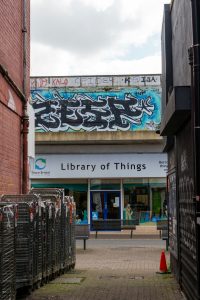
Photo by Lucy Davis on Unsplash
For many libraries, a Library of Things is a vehicle for participatory service whose collections are as result of input from staff members, library committees, or patron request (Bromiel & Towers, 2024).
We started hearing about the projects people were working on, what tools they needed, and what items they had lying around their homes that they wanted to donate to us for other people to use. While circulation numbers can tell part of a collection’s story, what really informs the success of a Library of Things and the impact it has on a community is how much the people we serve embrace it and make it their own. (Lax, 2020, para. 1)
Not far from me, the Altadena Library maintains a Library of Things. Interestingly, it developed from a partnership with NASA’s Jet Propulsion Laboratory who provided the library with a telescope and would be performing its calibration (Hogg, 2020). When the library reopened following the Eaton Fire, the telescope (with JPL’s continued calibration assistance), and the Library of Things were still available (KNX News 97.1 FM, 2025).
Libraries of Things are gaining in popularity as are other innovative and unorthodox library services. They are one way libraries can support their communities while also inviting participation in developing and maintaining collections and deciding what services customers value. Though libraries are starting to look and feel different, providing access to information and educational opportunities remains the same.
References
Bromiel, L., & Towers, A. (2024, March). Beyond books: Exploring the Library of Things movement. ILA Reporter, 42(1), 52-55.
Free, C. (2022, January 5). Tools are costly and take up space. Tool libraries are popping up so people can share. The Washington Post. https://www.washingtonpost.com/lifestyle/2022/01/05/tool-library-gift-economy/
Hogg, D. (2020, November 19). Library of things. Pasadena Weekly. https://www.pasadenaweekly.com/news/feature-stories/library-of-things/article_22880c2c-2ea6-58bc-a243-ecdc347f090b.html
KNX News 97.1 FM. (2025, March 4). Altadena Library reopens following closure prompted by Eaton Fire. Audacity, Inc.
Lax, B. What are these things doing in the library? How a library of things can engage and delight a community. Oregon Library Association, 26(1), 54-61. https://doi-org.libaccess.sjlibrary.org/10.5399/osu/1093-7374.26.01.11
Hi Iris, thank you for sharing! In my area, several library systems now offer a “library of things,” lending out everything from power tools and sewing machines to gardening equipment. These collections have become so popular that there are often long waitlists for many of the items.
I was inspired by your Innovation Strategy & Roadmap, especially your focus on integrating culinary literacy into library programming. One of our staff members, a former chef, is very passionate about this idea, and we’re eager to introduce a similar initiative at our library in the near future.
Returning to the library of things, our library collaborates with a local clean power provider to lend out induction cooktops to members (https://acterra.org/2023-4-17-borrow-an-induction-cooktop-for-free/). I believe this offering could complement future culinary literacy programs, not only by providing cooking instructions and promoting food security, but also by making essential equipment more accessible to our community. 🙂
Thank you so much! Awesome how your library has formed such a partnership.
Learning about Charlie Carts (https://charliecart.org/our-network/libraries/) was really interesting and they come equipped with appliances and utensils. It also includes a setup for water, in case your library doesn’t have a sink nearby. I think teaching culinary literacy classes would be a blast!
@iris I loved reading your post. Your story about your cousin finding a ukulele in the Library of Things made me smile. It reminded me of the unconventional services we offer patrons at my own library. One of our branches (Toronto Public Library, Parkdale Branch) has a musical instrument lending program, and it’s incredibly popular and always in high demand. It’s so true how these unconventional services end up being some of the most meaningful ways libraries meet people where they are.
Thank you! I have really enjoyed delving into Libraries of Things and was surprised to find how widespread they are becoming among public libraries.