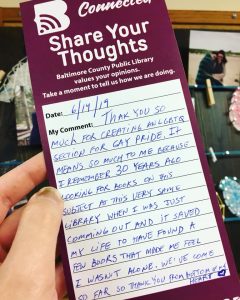
Picture of feedback card shared in the Power of Stories Module
I wanted to expand on the ideas expressed from the picture shared in the Power of Stories Module from a Baltimore County Public Library feedback card. The patron expressed gratitude for the creation of an LGBTQ section in the library. They reminisced about how 30 years prior, the few books the library had on the topic saved their life and told them that they weren’t alone. That’s the power of stories. They are powerful tools for connection and breaking down barriers.
Libraries are centered on storytelling. The most traditional ways this manifests is through the books on a library’s shelves or through library storytimes for young children. However, libraries also tell stories in ways that aren’t so obvious. Yes, each individual book on the shelf tells a story, but all of the books together tell a collective story.
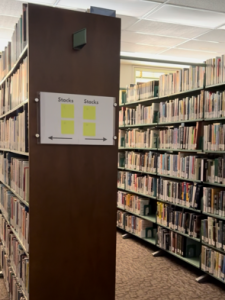
temporary shelving in workspace
When I first started working at the community college library, the collection was very limited. The library was undergoing extensive renovations (the whole building was gutted and redone top to bottom), so the vast majority of the collection was packed into boxes in a secondary storage location. The library operated out of two spaces: one shared space with a handful of small bookcases and one classroom converted into a temporary workspace with a few aisles of shelves and some desks for book processing. Because shelf space was so scarce, new acquisitions were extremely limited. When we finally moved into the newly renovated space and unpacked all of the boxes, we were greeted by an extremely old collection.

books in temporary storage location during the renovation
The story being told by the collection on the shelves was not representative of what we wanted the library to be. Before the move and renovation, the library had started to develop a small fiction and graphic novel section. However, since the move, acquisitions were mainly limited to academic books. This told students that at one point the library was more than just an academic resource, but now, the library wasn’t there to provide anything more than academic support. We wanted the library to be a place where students felt supported academically, emotionally, and socially, but that wasn’t the story told by the books on the shelves.
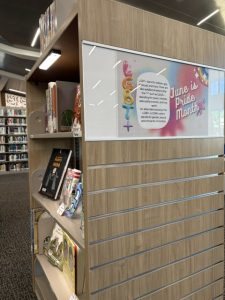 picture of Pride Month Display |
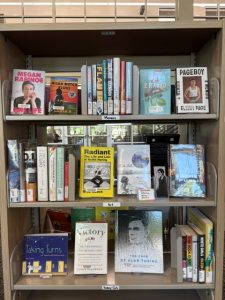 picture of memoirs, art books, and history books centered on LGBTQ+ history |
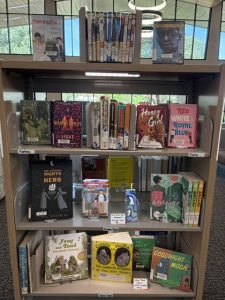 picture of Pride Month display |
Our new acquisition budget was very limited. However, our supervisor gave us access to a separate budget with the intent to expand our collection with more diverse and engaging titles. We purchased fiction and nonfiction books that told the stories of people like our students. We purchased books featuring lgbtq+ stories, Black stories, Native American stories, Hispanic stories, and more. These books celebrated the achievements and stories of a diverse group of people. They communicated to the students that the library was there to celebrate and support their joy, not just their academic pursuits.
Where before our displays for Black History Month, Pride Month, etc. focused on books that discussed their stories through a purely academic lens, now, our displays feature books that celebrate diverse stories of joy. These displays and the books on our shelves tell a story about community, inclusion, and joy.
Hi Adalie!
As a queer person of color, I LOVE the notion of highlighting joy in representative stories. Yes, there is absolutely a place for academic books on said topics at an academic library, but there is also space for the range of experiences and emotions that our diverse stories hold. As someone that studied history in undergrad, I was always so sad to only see myself represented in really terrible historical events. I love the very intentional space you are helping to create. Great work!
Thank you @gabbyj That really means a lot to me to hear