 I became interested in manga for a pretty practical reason: my son was reading a lot of One Piece, and I wanted to understand what he was so absorbed in. I also took a graphic novels class this past summer. I personally did not read manga for the class (it feels like manga could be its own course!), but I learned a lot about graphic novels as a medium, especially how images, text, pacing, and visual sequencing work together. I also learned about the deep history and tradition that encompass manga. That made me even more curious about manga as its own form of storytelling.
I recently had the chance to visit the Kyoto International Manga Museum. I was interested in how the museum would present manga. What stood out to me most was that it did not feel like a traditional museum where everything is placed behind glass. It felt much more like a library and a community space because it was warm, inviting, encouraging of exploration and curiosity.
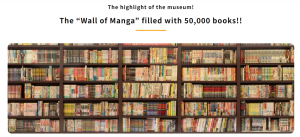
One of the museum’s highlights is its “Wall of Manga,” a 200-meter-long open-access library containing approximately 50,000 manga publications, primarily from the 1970s through 2005 (Kyoto International Manga Museum, n.d.). The books are organized by category and then shelved by the author’s name. The first floor features shōnen manga, the second floor features shōjo manga, and the third floor features seinen manga. Visitors can simply take a book from the shelf and find a place to read (Kyoto International Manga Museum, n.d.). I’ve never been to a museum that is more like a library. Usually museums that are more for exploration are geared towards children, but this was not (although they of course have a lovely children’s reading area).
That freedom was what I loved about the museum; I felt like I could wander and slowly soak things in. The museum also includes a Manga Expo section with translated manga and comics from around the world, a children’s library, a research reference room, and a searchable database. It is simultaneously a museum, a library, a research center, and a community space. That combination connects to Jaqueline Berndt’s discussion of how visitors may approach the museum less as a conventional museum and more as a place to browse and read (Berndt, 2012).
I also appreciated the relatively low admission cost and the building itself, which is a former elementary school, emphasizing the positioning of the visitor as a child with a big imagination and appetite for creative content. The setting made the museum feel approachable rather than intimidating. Last winter, my kids and I visited the Art of Manga exhibition at San Francisco’s de Young Museum, which was also fascinating. But the Kyoto museum stayed with me because it emphasized access and approachability; the goal of this museum is preserving and amplifying a national art form. I could hold manga copies, see them serialized across a shelf, and take in the scope of the art form in its actual format. While Art of Manga was beautiful and flashy (read: slick curation! expensive entry!), I preferred the Kyoto museum’s presentation and experience, mainly due to its focus on physical artifacts.
The Kyoto International Manga Museum embodies a hyperlinked environment where books, people, history, popular culture, research, and community all connect.