Reflection on Infinite Learning

I am drawn to libraries for many reasons, and being able to foster and celebrate lifelong learning is one of them. Infinite learning is a gift, and the public library is the one of the most, and sometimes only, accessible avenue for folks. As outlined in YLibrary Infinite Learning, the library is the “‘people’s university’, an open education resource or commons”. Because I grew up to a parent who was born in a different country in which even primary education is so inaccessible that she could not afford to attend more than middle school, I believe it is incredibly important to have a space that anyone can visit to learn and play in.

Moreover, I think learning and play go hand in hand so much so that sometimes learning does not take place unless there is play. Before working in libraries, I was a middle school special education teacher. I quickly learned that feeling safe is essential for learning to take place. This is where play, curiosity, and inclusion are key. The Marsden Library sensory space is a great example of making intentional space for all patrons to play and explore, demonstrating how learning can be both everywhere and how the library can be a classroom. The Marsden Library has a sensory space with play-based equipment curated for both children and adults, with an emphasis on “feeling comfortable in the space” (Logan CityCouncil, 2018). It is created to promote engagement and communication between children and families. What I really like about their sensory space is that it is not created solely for children, it is created for adults as well. As Crosby Kemper from the Kansas City Public Library states, “the most important thing is the creation of an imaginative world for children and adults that opens their mind to the world”. Ultimately, that is what learning is all about. Learning is expanding the ways you see things and maybe even dreaming new possibilities. It can be even better when it’s done alongside others.

To further touch upon inclusion in learning for folks of all ages and demographics, I admire Rockslide Library’s initiative for lifelong learning that goes as far as to include it as a strategic key area, noting, “learning should not only be reserved for those in education or in jobs, but should be an opportunity you can grab all your life no matter how your life situation looks like.” I think about this so much as a new mom. Each baby that is born has absolutely no control over what world, environment, or situation they are born into. It’s really a roulette of what access looks like for each person when their life begins, and there is no guarantee of support systems available throughout their life. The library is the one place in the world, that no matter what, you are welcome to. From birth to old age, there is something for every walk of life. It is everyone’s birth right to learn, play, and grow alongside their community. Librarians have the incredibly special role of facilitating new and continuous ways of learning and connecting to one another.
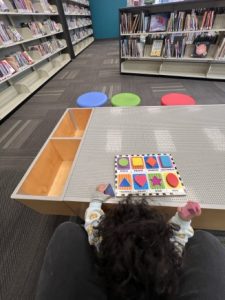
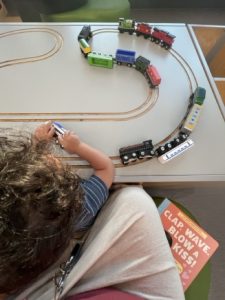
A picture of my baby “infinitely learning” at the Looby Nashville Library this week. We checked out the children’s area after attending a crawl-to-walk class.

References:

Institute of Museum and Library Services. (2015). IMLS focus: Learning in libraries. https://www.imls.gov/sites/default/files/publications/documents/imlsfocuslearninginlibrariesfinalreport.pdf

Lauersen, C. (2020, June 23). Learning, culture, community and diversity: New library strategy for Roskilde Libraries 2020. The Library Lab. https://christianlauersen.net/2020/06/23/learning-culture-community-and-diversity-new-library-strategy-for-roskilde-libraries-2020/

Logan City Council. (2018). Sensory space at Marsden Library [Video]. YouTube. https://www.youtube.com/watch?v=eDp-VBYtd7g

Public Libraries Connect. (n.d.). Check out Marsden Library’s sensory space. State Library of Queensland.https://plconnect.slq.qld.gov.au/blog/check-out-marsden-librarys-sensory-space

Stephens, M. (2014). YLibrary? Making the case for the library as space for infinite learning. https://www.dropbox.com/scl/fi/4zt1yliwb2ffzr8euix2p/YLibraryInfiniteLearning.pdf?rlkey=m0v6lkd43ufilkp5aktawhlpr&e=1&dl=0
 

Reflection on The Power of Stories

Living most of my life in Tennessee, I was surprised to learn about the International Storytelling Festival that has been held here since 1973. I had never heard of either the festival or the International Storytelling Center that puts it on each year. Located in the eastern part of Tennessee closer to the Appalachian Mountains, the festival brings together thousands of people from all over the world. Their homepage features a few short videos introducing the festival, one of which highlights a festival attendee stating, “everyone has a story”. As cheesy as that sounds, I think that is what storytelling is all about. At its core, the power of stories lies in seeing the humanity of others through a shared laugh, admiration through an act of perseverance, resonating with heartbreak, and all the messy, yet beautiful aspects of life. I remember when I had my baby almost a year ago, I could not consume enough stories told by mothers. Whether through a documentary, TikTok, book, or Instagram reel, I needed to know that I was not alone and that being a parent, especially a single working parent, is as hard as it felt. I was able to get validation but also learned how other parents managed certain things like introducing solid foods, navigating a tongue tie, and even how common postpartum depression is through the stories of others. At my most raw and human, after laboring for 72 hours ending in hemorrhaging and my baby not breathing for the first thirty minutes of his life, stories from other mothers made me feel like I was eventually going to be okay.

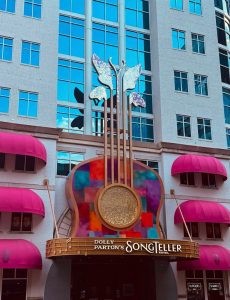
I also found it interesting that the International Storytelling festival takes place in the same side of Tennessee that Dolly Parton grew up in. East Tennessee is home to Sevierville and our beloved Dollywood that pays homage to the South! One of Dolly Parton’s last initiatives she was working on was the Songteller Hotel which opened a month after she passed away. She coined the term “Songteller” as her music is written to share stories and naming her hotel just that is incredibly fitting. The hotel itself is bright, sparkly, and very pink made for people to come together and create new stories with music.

Despite Tennessee and Appalachia’s more limited access to literacy, I love how we still find ways to tell stories that reach audiences in a way that transcends barriers. Dolly Parton’s father never learned how to read, so she began providing free books for children starting with her own community while sharing her own stories through her music. The Storytelling Festival consists of oral storytelling with sign language interpretation, removing barriers for folks to access stories. Personally, my grandmother never learned how to read or write, and my mother was unable to attend school past middle school, and I hope to be a librarian that champions access to literacy someday soon.

The entrance to Dolly Parton’s SongTeller hotel

References

Dolly Parton’s SongTeller Hotel. (n.d.). Dolly Parton’s SongTellerHotel. https://www.songtellerhotel.com

International Storytelling Center. (n.d.). National Storytelling Festival.

International Storytelling Center. (2023). It’s more than a festival – it’s a lifestyle [Video]. YouTube. https://youtu.be/wp_zBUdNCUk?si=LG2fHuiJVJrkxSQ4

Reflection on New Models

I am a firm believer that sharing a meal is an act of love. In my culture, we celebrate everything from birth to death, and every celebration includes sharing a bountiful meal. I grew up impoverished and I saw my mother make magic out of food pantry staples that she would share with anyone who would join us. Sharing and making food transcends language barriers and cultures. A Moveable Feast highlights just that. I am familiar with bookmobiles, but a mobile kitchen was new to me. I cried when I read the article because it’s truly a remarkable idea. It acknowledges access, culture, and the dignity of everyone. Every single person needs food and focusing on food literacy that builds skills for all ages within their own communities addresses community members in a holistic manner. A mobile kitchen brings a community together, providing opportunities to both learn and connect to your neighbor over a shared meal. Moving towards the community in creative ways follows the new model of libraries that prioritize people over books.

Another food related initiative that is new to me and very innovative, is the chef in residence at the Boston Public Library. As outlined in Libraries are Evolving into Community Centers, patrons requested a teaching kitchen! The library listened and not only created a kitchen but hired a dedicated staff member to host classes and cooking workshops for patrons of all ages. The teaching kitchen being housed within the library itself offers the opportunity for patrons to enter a familiar community space that connects them to recipe books they can take home and use.

Either through outreach, renovation, or some other new initiative, new models seek to meet the needs of their patrons in intentional ways. It is a beautiful act to listen to your community, meet folks where they are at, and learn alongside them. Sharing a meal is always an act of love and it is so exciting to see how libraries can highlight that!

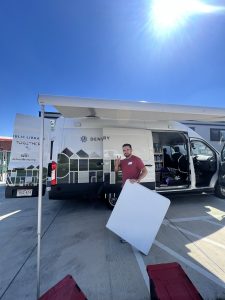
Setting up the bookmobile next to a mobile food pantry with my supervisor 

References

Ewen, L. (2018, September 4). A movable feast: Libraries use mobile kitchens to teach food literacy. American Libraries Magazine. https://americanlibrariesmagazine.org/2018/09/04/movable-feast-library-mobile-kitchens/

WCVB Channel 5 Boston. (2024, June 18). Libraries are evolving into community centers with multi-services [Video]. YouTube. https://youtu.be/tCvR7P42MKA

Reflection on Hyperlinked Environments

As someone who loves and adores the South, I was delighted to see that Tennessee was included as a case study for hyperlinked public libraries. Most times, Tennessee is known for the egregious policies being enacted on a population that does not reflect those making the governmental decisions. I was especially excited that Memphis was highlighted in a positive light, and that east Tennessee was represented with the Chattanooga Public Library.  As outlined in How Memphis Created the Nation’s Most Innovative Public Library, “Memphis, Tennessee is one of the poorest cities in the nation” (Grant, 2021). Poverty is many times correlated with violence or danger, especially in communities of color. The Memphis Safe Task Force, a multi-agency group of federal enforcement including the FBI and Homeland Security, was brought forth by the president roughly a year ago. Here, we see two very different ways to address a city. The federal attempt to address Memphis has been to increase policing funds to deploy the Tennessee National Guard, while the local city library system increases their budget to provide more buildings and services.  Most notably, MPL is the only public library system in the country with its own television and radio show, and it is a direct response to the “issue of youth hanging around”. Cloud 901 was created with state-of-the art equipment alongside the expertise of local artists (Grant, 2021). Memphis may have one of the highest rates of poverty, but it’s also the home of blues, jazz, rock-and-roll, and so many other music genres that are the foundation of many of the newer genres we have today. To see the birthplace of so much music and art be invested into in such an intentional way is beautiful, even more so knowing that it’s the library’s doing. It cost roughly two million to create Cloud 901, and I wonder how many more initiatives could be created with the 28 million monthly cost of the Memphis Safe Task Force (Congressional Budget Office, 2026). I dream of living in a state that addresses its systemic issues through opportunity and creativity at the governmental level.

Also investing into youth on the other side of the state in a similar way, the Chattanooga Public Library provides a “rock instrument library for ages 10-17 with guitars, drum kits, keyboards, and amps” (Chattanooga Public Library, n.d.). Lending libraries provide the unique opportunity for patrons to explore different items they may not otherwise get to. I am endlessly impressed by the ways libraries identify innovative ways to implement technology in their hyperlinked communities to further opportunities and skills. I can’t help but think of all the money spent on policing and how it could be spent on more state-of-the-art studios and instruments to lend out to youth. I am all for hyperlinked environments that use technology for the people instead of technology used against the people.

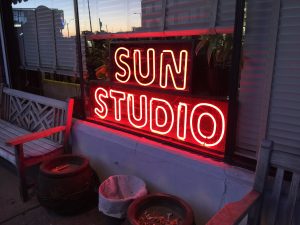
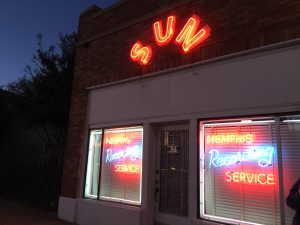
Images I took on Memphis field trip for my course Intro to Social Movements, Social Action, and Restorative Justice.

References:

Chattanooga Public Library. (n.d.). Noise closet. https://chattlibrary.org/noise-closet/

Congressional Budget Office. (2026, January 28). Estimating the costs of troop deployments to U.S. cities. https://www.cbo.gov/system/files/2026-01/61943-Troop-Deployments.pdf

Grant, R. (2021, November). How Memphis created the nation’s most innovative public library. Smithsonian Magazine.

Trump, D. J. (2025, September 15). Restoring law and order in Memphis. The White House.


Reflection on Hyperlinked Communities

I am a big fan of looking at things through the lens of community. For my information communities class, I zeroed in on the information needs of folks experiencing homelessness. I found that many people experiencing homelessness look for information regarding essential needs like food and employment. Almost equal to vital resources, folks look to meet recreational needs like catching up shows on a library computer. At the end of the day, we’re all just trying to survive and have some fun while we do it.

Looking at this module’s materials, I was most intrigued by resources provided to parents and their children. As a child who grew up spending a lot of time in laundromats, I immediately recognized the logos on the washing machines shown in the “Wash & Learn Library Pop-Up Library Program” video. I also had a visceral response to the sign on the laundromat wall emphasizing that no playing was allowed. I grew up incredibly low-income to a single, immigrant mom. For most of my life, we did not have a consistent and accessible mode of transportation. My siblings and I went everywhere with my mom, laundromat included. We spent hours upon hours at the laundromat every week without the opportunity to leave and enclosed in a tiny, enclosed space that was not play friendly. For Wash & Learn to have youth from their own community provide access to information and resources is incredibly brilliant. Not only do they understand their community best, but they are also safe and credible hyperlinks. Further, just because someone is not in the physical building of a library does not mean they could not benefit from the library’s resources. It may mean there are some barriers in place, whether it be time, awareness, etc. The youth in this program remove so many barriers and meet people where they are at. I like that this is a mutually flourishing program, youth connect and learn from one another while community members learn about resources.

As a new parent that works while in school, the initiative highlighted in the Libraries in Balance section of Wholehearted Librarianship felt like a soft balm on my tired, overworked mom head and heart. To further promote kindness in a New Zealand academic library, “student parents are allowed to bring their children because childcare is a barrier to studying” (Stephens, 2019). From New Zealand to the United States, childcare is a huge barrier. I have very limited childcare because the hourly rate is higher than my current position’s hourly rate.I currently do schoolwork only after completing a full workday followed by my child’s bedtime routine. Many times, this means I am doing schoolwork in the middle of the night, a few hours before getting up to get ready for work. If I could comfortably bring my child to a shared space and get work done, that would be a game changer. This is true for me and so many other single moms I know. So many parents want to go back to school to be able to provide more opportunities to their children, but the barriers are endless and exhausting.

To connect the Wash & Learn program and the New Zealand academic library’s kindness initiative, A Beautiful Obsession synthesizes efforts in a beautiful way. David Lankes states, “Our buildings, our books, our services, our catalogs must not be channels of assistance we provide, but part of a powerful platform that enables our communities to success” (Pewrainangi, 2014). The library community, whether in a laundromat or a physical library building, is a platform for hyperlinks connecting us to promote success. I believe that all flourishing is mutual, just like I am trying my best to provide for my nine-month-old son as a library staff member, so is the mom at the Wash & Laundromat with her one-year-old son. We are better for connecting to one another and providing essential and recreational opportunities to survive and hopefully have some fun while we do so.

My nine-month-old son, Alex, and I in the children’s area of our local library.

References:

Bibliothèques Sans Frontières. (2017, October 11). “Wash & learn” pop-up library program in the Bronx [Video]. YouTube. https://www.youtube.com/watch?v=9HM7pQiqDZY&t=2s

Pewrainangi, S. (2014). A Beautiful Obsession.

Stephens, M. (2019). Wholehearted librarianship: Finding hope, inspiration, and balance. ALA Editions.