As someone who loves and adores the South, I was delighted to see that Tennessee was included as a case study for hyperlinked public libraries. Most times, Tennessee is known for the egregious policies being enacted on a population that does not reflect those making the governmental decisions. I was especially excited that Memphis was highlighted in a positive light, and that east Tennessee was represented with the Chattanooga Public Library. As outlined in How Memphis Created the Nation’s Most Innovative Public Library, “Memphis, Tennessee is one of the poorest cities in the nation” (Grant, 2021). Poverty is many times correlated with violence or danger, especially in communities of color. The Memphis Safe Task Force, a multi-agency group of federal enforcement including the FBI and Homeland Security, was brought forth by the president roughly a year ago. Here, we see two very different ways to address a city. The federal attempt to address Memphis has been to increase policing funds to deploy the Tennessee National Guard, while the local city library system increases their budget to provide more buildings and services. Most notably, MPL is the only public library system in the country with its own television and radio show, and it is a direct response to the “issue of youth hanging around”. Cloud 901 was created with state-of-the art equipment alongside the expertise of local artists (Grant, 2021). Memphis may have one of the highest rates of poverty, but it’s also the home of blues, jazz, rock-and-roll, and so many other music genres that are the foundation of many of the newer genres we have today. To see the birthplace of so much music and art be invested into in such an intentional way is beautiful, even more so knowing that it’s the library’s doing. It cost roughly two million to create Cloud 901, and I wonder how many more initiatives could be created with the 28 million monthly cost of the Memphis Safe Task Force (Congressional Budget Office, 2026). I dream of living in a state that addresses its systemic issues through opportunity and creativity at the governmental level.
Also investing into youth on the other side of the state in a similar way, the Chattanooga Public Library provides a “rock instrument library for ages 10-17 with guitars, drum kits, keyboards, and amps” (Chattanooga Public Library, n.d.). Lending libraries provide the unique opportunity for patrons to explore different items they may not otherwise get to. I am endlessly impressed by the ways libraries identify innovative ways to implement technology in their hyperlinked communities to further opportunities and skills. I can’t help but think of all the money spent on policing and how it could be spent on more state-of-the-art studios and instruments to lend out to youth. I am all for hyperlinked environments that use technology for the people instead of technology used against the people.

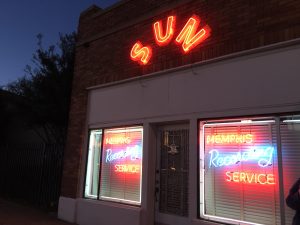
Images I took on Memphis field trip for my course Intro to Social Movements, Social Action, and Restorative Justice.
References:
Chattanooga Public Library. (n.d.). Noise closet. https://chattlibrary.org/noise-closet/
Congressional Budget Office. (2026, January 28). Estimating the costs of troop deployments to U.S. cities. https://www.cbo.gov/system/files/2026-01/61943-Troop-Deployments.pdf
Grant, R. (2021, November). How Memphis created the nation’s most innovative public library. Smithsonian Magazine. https://www.smithsonianmag.com/innovation/memphis-created-nations-innovative-public-library-180978844/?fbclid=IwAR1KhgGc_cXHfCduhqGtJ1Wi5Y2jRho1yW1Q62QjCNC5o2Qs9eLeGnzqqIM
Trump, D. J. (2025, September 15). Restoring law and order in Memphis. The White House. https://www.whitehouse.gov/presidential-actions/2025/09/restoring-law-and-order-in-memphis/