
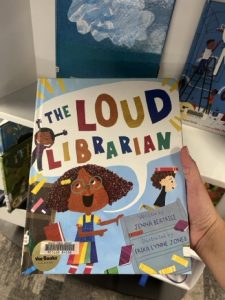
Book found on the bookmobile at an elementary school stop that I think is representative of the topic.
I was born and raised in Nashville, Tennessee. I’d like to think of Nashville like the heart of the South while also being the belly of the beast. It is where so many things are forced to confront one another: religious governing policies, systematic disinvestment of public education, prioritizing business’ profit over people, and the highest maternal mortality rate in the country. It is also where a lot of the Civil Rights Movement took place and significantly moved the country towards integration. Championed by young adults attending college in Nashville, the Civil Rights Movement developed many leaders we recognize and honor today. Among those local leaders, John Lewis is widely recognized for his rebellious, yet heart-centered approach to bettering access for all.
I currently work at the main Nashville Public Library located downtown. One of the many streets between the staff parking garage and the library building was recently renamed “Rep. John Lewis Way S”. Every day, on my morning trek from the parking garage over to the library, I get to see a vibrant mural of John Lewis alongside other activists. It notes a part of the phrase Lewis is known for “Get in good trouble, necessary trouble, and help redeem the soul of America” (Lewis, 2020)
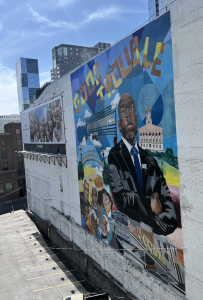
Image of John Lewis Mural located downtown Nashville
Over and over, Professor Stephens emphasizes that the Hyperlinked Library is about the heart. In his book, The Heart of Librarianship, the chapter on embracing chaos is a call to “try out a new thing without regard to the way ‘it’s always been done’” (Stephens, 2016). When I think of heart accompanied by some level of chaos, I think of John Lewis’ work, story, and legacy of “good trouble”.
Although the Civil Rights Movement and library services are very distinct, they are also similar in many ways. The Civil Rights Movement focused on access; the access of people of color to spaces, whether that be physical or more systemic. And to be frank, libraries themselves were segregated not too long ago. Today, library services are still seeking access to spaces for connection through many ways including evolving technology. As noted in “Think Like a Startup”, “what we really need right now are breakthrough, paradigm-shifting, transformative and disruptive ideas” (Matthews, 2012). I can think of a few examples in alignment with this framework at each of the library systems I have worked at.
Before working at the Nashville Public Library, I worked at the Denver Public Library and had the privilege to work with their Plaza program. Plaza translates to “an open meeting space” in Spanish and that is exactly what it is. Based on community needs, the program takes place at several branches throughout the entire system, multiple times a week. Plaza provides English classes, citizenship preparation, and resource navigation. They provide laptops and hotspots for people to take home and continue learning English at home free of cost, using their library card’ s access to a language learning platform. Plaza is chaos and like nothing I have ever seen in any other library system. It is loud, celebratory, and representative of what connection can look like with people from all over the world. Most participants are immigrants, refugees, or asylees that eventually became paid staff members that teach newcomers. It is also a program that receives a lot of pushback from branch staff for how “disruptive” the program can seem. Plaza challenges the notion of a quiet, isolated library experience. It is learning through storytelling and connecting to vital resources in a shared, hands-on, and accessible environment. I considered it the heart of the Denver Public Library, as did many other Plaza staff members and participants.
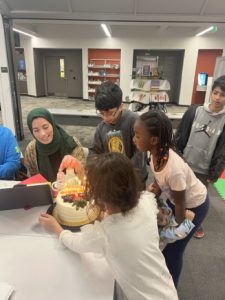
Image of our Plaza celebrating a patron’s birthday for the first time in the U.S. after setting her up with her own laptop and hotspot to take home.
The Nashville Public Library recently started a Memory Lab, helping families preserve physical materials in a digital format. Our library director, Terri Luke, introduced it as “more than technology- it’s a creative space where anyone can reconnect with their historyand all of the stories, memories, and history will be given new life” (Leyva, 2026). . The service launched in March of this year and was immediately popular. The demand was much higher than the library could supply. Staff took it upon themselves to seek community support through unused technology for further expansion to provide more access to patrons.
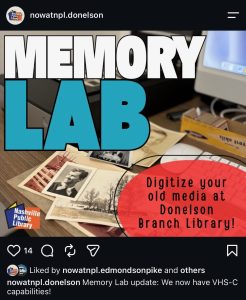
Instagram post from the Nashville Public Library Donelson Branch about the Memory Lab
Tying the concept of “good trouble” from the Civil Rights Movement to the Hyperlinked Library’s encouragement of transformative, and at times chaotic, change alongside the power of stories, I hope to be a librarian that listens to other’s experiences and readily accepts change as needed to propel us forward and provide more opportunities to continuously learn and connect.
References
Lewis, J. (2020, July 30). Together, you can redeem the soul of our nation. The New York Times. https://www.nytimes.com/2020/07/30/opinion/john-lewis-civil-rights-america.html
Leyva, D. (2026, March 18). Nashville Public Library launches Memory Lab. https://www.tennessean.com/story/news/local/davidson/2026/03/18/nashville-library-digitize-old-photos-vhs-tapes-slides/89207874007/
Matthews, B. (2012, April). Think Like a Startup. Facing the Future. https://vtechworks.lib.vt.edu/server/api/core/bitstreams/77d2cb98-ddab-4543-9e47-b011819231b3/content
Stephens, M. (2016). The heart of librarianship. ALA Editions.
Hello Gabby!
I enjoyed reading your post, especially how you connected the Civil Rights Movement and library services. As you mentioned, both of these elements seek to provide equality of access to public spaces and aim to provide resources and connection for communities. Additionally, libraries are in a transitory state where they are shifting from providing solely research and book lending, to communal spaces that provide resources to their communities. I love how the Denver Public Library has the Plaza program to service their community’s needs by providing English classes, citizenship preparations, and resource navigations. As people move to new areas, libraries seem to be one of the first community buildings that new residents visit, so being a place that provides a plethora of resources for them to utilize, especially for free is extremely helpful.
Great work and post!
Best,
Aldore