In 2006, my wife, Heather Goodwillie, and two close friends, Justin McInteer and Grant Capes, formed Echo Curio, The Echo Park Curiosity Shop & Art Gallery — a community based all-ages art gallery, performance space, and information center, during a period in Echo Park when the negative effects of gentrification were still minimal. So, we Curians, so as to be as open as possible, decided to include in our founding manifesto the idea of a radical egalitarianism. We neatly scrawled its Merriam-Webster dictionary definition where the sunlight fell through the front window on to the gallery wall. That goal was to be certain that we included the community, both from the neighborhood and from the alternative culture more broadly and internationally, so as to flatten the hierarchies of the MOR (middle of the road) pay-to-play culture and to strengthen and unify freak, weirdo, geek, and outsider communities.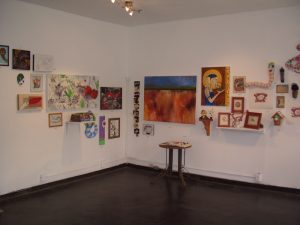
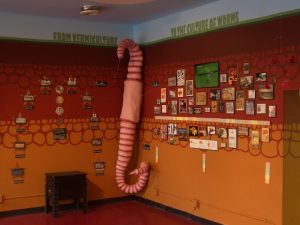
The Curio had ongoing rotating monthly thematic informational exhibitions with accompanying open calls to the community and abroad for art related to those themes. Our first installation and exhibit was on vermicomposting, centered around Mary Appelhof’s book Worms Eat My Garbage (1982). Along with the art exhibit/informational installation, and a compilation of music submitted on the theme and released for free on CDR, we provided vermicomposting demonstrations, and examples of the process at various stages.
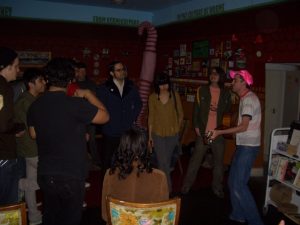 We also put out an open call for anyone or any group who wished to perform any genre of any kind of performance, lecture, or screening they desired. We did not turn a single artist away; and had performances every night and day. At the time the only all-ages venues for that level of free expression had limits: Il Corral — “no guitars, harsh noise only” and The Smell — only shows for friends of the owner. We at The Curio had everything from queer cabaret to traditional African drumming (and harsh noise too!). Echo Curio unknowingly positioned itself at the intersection of the Danish Agency for Library and Media’s Four Space Model: inspiration, learning, meeting, and performance — although without the graphic clarity of the Danish Model.
Dr. Stephens opens his lecture on Participatory Service with Henry Jenkins’ concept of hyperlink-enabled participatory culture and how the user has moved from media spectatorship of the couch-locked potato toward the low-to-zero viscosity of the contemporary web-based world, where the user is transformed not just into participant, but into a creator. This pure agency is prefigured in the historic grassroots underground outsider DIY model — displayed most popularly in jazz, the 60’s counterculture and in hip-hop, punk, and rave cultures; where academic craft expertise and the corporate high-rise has been leveled — flattened by Chris Anderson’s long tailed alternatives to mainstream market-based control. Passion and hard work are the only prerequisites for inclusion as “artist.”
Creative grassroots outsider communities are the soul grandparents of the participatory user. I propose that the all-ages alternative venue — where those artists have performed and exhibited is a ready-made model for the future of participatory service in library and archival venues. The concept of the Participatory Service Model is most clearly reduced for expansion in Dr. Stephens’ introduction to Module 3 where he describes the true core of the Hyperlinked Library as a service model that is “built on openness, participation, and the belief that libraries thrive when they foster meaningful human connections. Communication happens in a human voice. Conversations—with users, among staff, and across communities—are transparent, authentic, and ongoing.”
Libraries and archives as sponsors or venues for the outsider artist, could go a long way in preventing what happened to our Echo Curio — shut down by the negative gentrification of West LA and NYC transplants looking for bigger houses at lower prices with no regard to the communities they were destroying, which happened to also include some weird kids dancing to weird music; or most horrible, what happened in the Ghost Ship community fire, where we lost members of our alternative community. Whereeven in the ruins of that loss the mainstream society continued its othering. We need fleetfooted librarians, to keep ahead of this, to see the benefits and harms before they harm and to contribute to greater benefit, at speed. Let the outsiders in.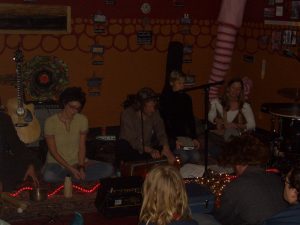
Hi, Timothy! I love that you and the rest of the team at the Curio have had such success with open calls. I supervise my library’s circ desk, where most interactions are still transactional, and your post has me wondering what our version of an open call would even look like.
@marloramirez Hey, Marlo! Thank you! I would think it would just be one-to-one word of mouth with patrons, along with classic fliers, or even some low budget bigger Colby Poster-style posters. It would be neat if the open call invites where also something that involved engagement with visual artists in their creation.