Reflecting on the Future of Hyperlinked Libraries in Virtual Environments

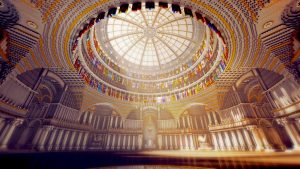
The Uncensored Library’s Dome

        I was perusing amongst the digital stacks in Module 6 for an adventure of my own choosing when my daughter walked through the back door, excited to tell me that inside Minecraft is an endangered library of banned articles, books, and reports. Then, most serendipitously, I saw at the bottom of the resource list a link to an archived post from a former Hyperlinked Library student, Martin Martinez: “The Metaverse, Minecraft, and the Uncensored Library.” This meta-library is such a profoundly beautiful and egalitarian idea that it chose me.

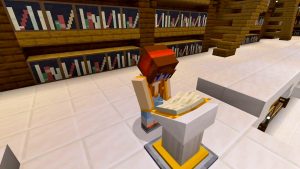
A Reader at The Uncensored Library

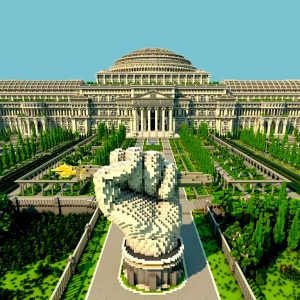
        Minecraft is not just an environment for building with virtual blocks and minerals or for game play alone. Inside of the virtual world is also a protected archive, The Uncensored Library, created in 2020 by Reporters Without Borders (RSF) with the virtual architecture group BlockWorks. The library’s virtual books contain reportage censored by illiberal and authoritarian governments, in wings of the library curated by RSF for Mexico, Russia, Belarus, Vietnam, Saudi Arabia, Egypt, Brazil, Iran, Eritrea, and — added in 2026 — the United States. The books are read-only, to protect their content from tampering. At first flush it seems in line with the spirit of the Hyperlinked Library model: meeting the users where they are, the gamification of learning, and a humanitarian focus on preservation. But the very restrictions that are necessary for user access and protection — one-way reading, top-down curation, and no librarians at hand — would seem to disqualify it as truly a Hyperlinked Library.

        Virtual spaces could also preserve, as digital objects, institutions closed for political reasons, as with the Kennedy Center ; exhibitions under forced revision, as at the Smithsonian; or historic buildings we have lost to war, terrorism, or unrestrained capitalism. These virtual objects cannot just conquer space; through metaverse archiving, the fleetfooted librarian can also defeat time and the violence of entropy, and move out, toward an allotropic Hyperlibrarianship — one core communal truth manifest in a multitude of forms.

The Uncensored Library Power Fist

Prompting Towards Pepperland: Human-Enabled AI as Community Hyperlink

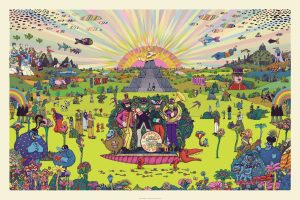
Mark Spusta .(2015). Pepperland [screen print].
        The need for hyperlinked communities, to openly interface, to draw community together in informational communion, is the very substance at the core of LIS practice: not just connecting disparate communities internally and from afar, but preserving and providing free access to the endless modes of human creation — works made for and by the very same greater human community. Terry Cook, the Canadian archivist, in his 2012 article for Archival Science, “Evidence, Memory, Identity, and Community: Four Shifting Archival Paradigms,” describes how the transformation of the archivist into a “community facilitator” has met the “digital realities” and is opening wide alternative horizons. He writes:

The archivist has been transformed, accordingly, from passive curator to active appraiser to societal mediator to community facilitator. The focus of archival thinking has moved from evidence to memory to identity and community, as the broader intellectual currents have changed from premodern to modern to postmodern to contemporary. Community archiving and digital realities offer possibilities for healing these disruptive and sometimes conflicting discourses within our profession.

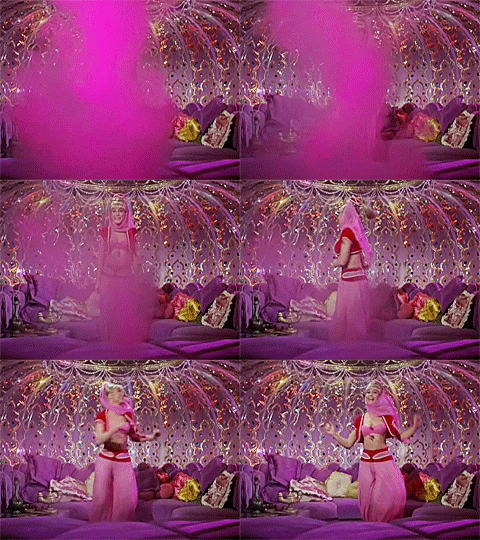
        The newest form these “digital realities” have taken is Artificial Intelligence (AI), an exacting tool that is helping to offload non-human tasks. Ideally, greater focus can be redirected toward the humanness of our communities, into leisure activities and educational forums for personal and community growth. There will be an expanding need for meaningful community experiences as free time increases through the outmoding of jobs that no longer need humans to accomplish them. This ideal is not all Pepperland; there be Blue Meanies here too. Unfortunately, the genie that is AI has already left her bottle and is granting wishes willy-nilly.

Barbara Eden as Jeannie. (1965-70). I Dream of Jeannie. [television series].
        Dr. Lili Luo’s 2025 study on the daily use of Generative AI (GAI) by library professionals showed that 66.5% of respondents use GAI and find it effective in improving efficiency and work quality. Their top three concerns were, first and foremost, the inaccuracy of the model’s outputs (41% of respondents); second, ethical risks regarding security and privacy (25.7% of respondents); and third, difficulty in composing effective prompts (21% of respondents).  Along with these daily concerns, keep in mind this new technology’s environmental footprint coupled with the inherent bias ready-built into AI models’ ground-truth training, via a lack of diverse identities among the models’ original trainers and in the data they were fed — data based on works that are the human canon and carry all the fear and beauty represented there. There also is a need for creator compensation and usage rights, for which library science already has modes of mitigation through established frameworks, like licensing, fair use, and attribution, that can help guide towards fair remedies.

        There will be a need for designing alternative, creative workflows to help in building community events and paths for individual self-improvement. In the past, self-directed community-based activities were primarily practiced by artists and artisans, farmers and contemplatives, both spiritual and philosophic, in media physical, in mediums electric. When more people are freed from the existential strictures of their day-to-day survival needs, the practice of integrating life and imagination, apart from work for work’s sake, will be crucial. With the freedom at scale that AI can enable, the influence of creative innovation won’t be restricted to the unworried wealthy and the starving artists, and that freedom will change the meaning of what is expressed. Hopefully, the proliferation of creative self- and community-based workflows can inform lifestyles that help ameliorate AI’s deleterious effects.

        As Michael Stephens said in his lecture for Hyperlinked Communities, “Everything you do should involve your users every step of the way.” AI’s shocking gains in the intelligence and fluidity of information delivery are already making it much easier to connect with current and potential users to discover their needs and move forward as a humane community that becomes its own motile third place of pure imagination.

Assignment X: Let the Outsiders In

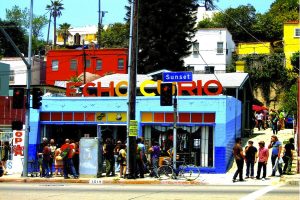
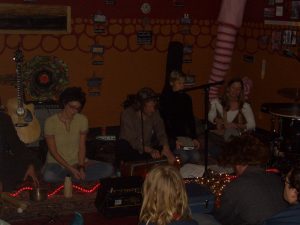
        In 2006, my wife, Heather Goodwillie, and two close friends, Justin McInteer and Grant Capes, formed Echo Curio, The Echo Park Curiosity Shop & Art Gallery — a community based all-ages art gallery, performance space, and information center, during a period in Echo Park when the negative effects of gentrification were still minimal. So, we Curians, so as to be as open as possible, decided to include in our founding manifesto the idea of a radical egalitarianism. We neatly scrawled its Merriam-Webster dictionary definition where the sunlight fell through the front window on to the gallery wall. That goal was to be certain that we included the community, both from the neighborhood and from the alternative culture more broadly and internationally, so as to flatten the hierarchies of the MOR (middle of the road) pay-to-play culture and to strengthen and unify freak, weirdo, geek, and outsider communities.
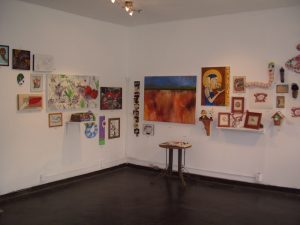
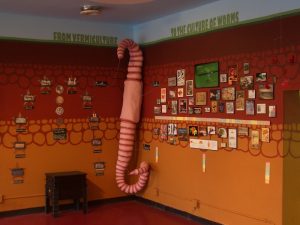
        The Curio had ongoing rotating monthly thematic informational exhibitions with accompanying open calls to the community and abroad for art related to those themes. Our first installation and exhibit was on vermicomposting, centered around Mary Appelhof’s book Worms Eat My Garbage (1982). Along with the art exhibit/informational installation, and a compilation of music submitted on the theme and released for free on CDR, we provided vermicomposting demonstrations, and examples of the process at various stages.
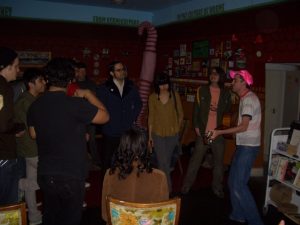
        We also put out an open call for anyone or any group who wished to perform any genre of any kind of performance, lecture, or screening they desired. We did not turn a single artist away; and had performances every night and day. At the time the only all-ages venues for that level of free expression had limits: Il Corral — “no guitars, harsh noise only” and The Smell — only shows for friends of the owner. We at The Curio had everything from queer cabaret to traditional African drumming (and harsh noise too!). Echo Curio unknowingly positioned itself at the intersection of the Danish Agency for Library and Media’s Four Space Model: inspiration, learning, meeting, and performance — although without the graphic clarity of the Danish Model.

        Dr. Stephens opens his lecture on Participatory Service with Henry Jenkins’ concept of hyperlink-enabled participatory culture and how the user has moved from media spectatorship of the couch-locked potato toward the low-to-zero viscosity of the contemporary web-based world, where the user is transformed not just into participant, but into a creator. This pure agency is prefigured in the historic grassroots underground outsider DIY model — displayed most popularly in jazz, the 60’s counterculture and in hip-hop, punk, and rave cultures; where academic craft expertise and the corporate high-rise has been leveled — flattened by Chris Anderson’s long tailed alternatives to mainstream market-based control. Passion and hard work are the only prerequisites for inclusion as “artist.”

        Creative grassroots outsider communities are the soul grandparents of the participatory user. I propose that the all-ages alternative venue — where those artists have performed and exhibited is a ready-made model for the future of participatory service in library and archival venues. The concept of the Participatory Service Model is most clearly reduced for expansion in Dr. Stephens’ introduction to Module 3 where he describes the true core of the Hyperlinked Library as a service model that is “built on openness, participation, and the belief that libraries thrive when they foster meaningful human connections. Communication happens in a human voice. Conversations—with users, among staff, and across communities—are transparent, authentic, and ongoing.”

        Libraries and archives as sponsors or venues for the outsider artist, could go a long way in preventing what happened to our Echo Curio — shut down by the negative gentrification of West LA and NYC transplants looking for bigger houses at lower prices with no regard to the communities they were destroying, which happened to also include some weird kids dancing to weird music; or most horrible, what happened in the Ghost Ship community fire, where we lost members of our alternative community. Whereeven in the ruins of that loss the mainstream society continued its othering. We need fleetfooted librarians, to keep ahead of this, to see the benefits and harms before they harm and to contribute to greater benefit, at speed. Let the outsiders in.
Welcome

Hello!
        My name is Timothy Burton Goodwillie, you are welcome to call me Tim—also cool with Timothy—or Timmy if I am being obnoxious. I am a writer and visual/audio artist originally from Kansas City. I currently live on a hill facing east at the western mouth of the San Gabriel Valley in Los Angeles. I am in my 3rd and final year of the MLIS program with an emphasis on archives and artificial intelligence. I received my BFA, with a focus on installation art, marionette-based automata, and creative writing, from the Kansas City Art Institute. It was there that the seed was planted that grew into a fiscal need—art pays not—and SJSU’s MLIS program is the hope that it will.

        I have always been a reader of weird and visionary fiction, and fascinated with the poetic and historical implications of art materials, more than the skills it takes to bend those materials to the artist’s will. These curiosities led me into the hinterlands of art-based music/sound and creative writing, all of which were not yet part of studio art curriculum at the college level. The art school’s library—and local indie record shops—were where those few other kids in that outsider art realm wound up.

        I am interested in working in an archive whose collections include all modes of visual art, creative writing, music, and performance-related objects/documents with a special emphasis on the outsider, visionary, and paranormal domains. I was a stay-at-home parent until my two kids aged out of that need. I also owned, operated, and curated a community art gallery/curiosity shop, alternative performance space, and information center called Echo Curio, until it was shut down by the city for patrons dancing to weird music without a license.