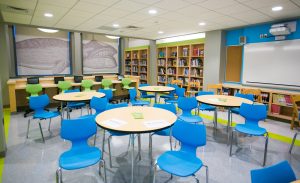
 When we talk about the library as a classroom, we usually picture patrons at workshops or makerspaces. For example, in YLibrary, Stephens urges libraries to think about “how they might offer their own large-scale, localized learning opportunities” (2014, p. 14). (Academic law libraries, I would argue, could do far more for bar takers than extend the building’s summer hours for study space. We simply have not yet discovered what that “localized learning opportunity” might be, especially for those making a second or third attempt at passing the exam.)

But some of the most consequential teaching I have done at the academic law library was informal and it happened behind the circulation desk. For several years, I supervised between twelve and fourteen student employees, almost all of them in their mid to late twenties, and only a few years away from entering a profession that demands accountability and confidence when the right answer is not immediately apparent. Over time, I came to see the library desk as a classroom and each shift as an opportunity for experiential learning. The lessons were rarely announced as lessons. They emerged through the daily work of serving patrons.
Consider who walks through our doors. Judges do not enter the library wearing their robes. Alumni who are now law partners, and potentially future employers, rarely announce themselves either. They, along with faculty, students, and self-represented litigants, are all library patrons. To a first year law student, they may be impossible to distinguish. Professionalism at the desk means extending the same attention and respect to everyone.
This, my last reflection blog for the semester, considers what becomes possible when we approach student supervision in an academic library as teaching. The library desk is the perfect practice field because the stakes are real (albeit forgiving). A student who mishandles a faculty request learns discretion; one stumped by a question learns to say “let me find out” rather than guess. As Block (2014) reminds us, “frustration leads to insights,” and learning “is not necessarily the equivalent of mastery.”
| At the Library Desk | In Practice |
| Arriving on time for a shift | Meeting court and filing deadlines |
| Saying “let me find out” | Prepared for client meetings, or before a judge |
| Handling a faculty request with discretion | Protecting client confidentiality |
| Greeting every patron with the same respect | Showing respect for all clients |
And the learning runs both ways. Connected learning is “peer-supported,” linking learners to “friends and peers, including adults,” and a shared purpose “can boost intergenerational learning and connection” (Nygren, 2014, p. 5). My students teach me new tools and fresh perspectives from areas beyond the law. They are my connection to any given class at the school, and they give me insight into a new cohort of patrons. In teaching them, I remain a learner. Or as Stephens (2016) puts it “Learn Always” (p. 142).
References
Block, J. (2014, January 7). Embracing messy learning. Edutopia. http://www.edutopia.org/blog/embracing-messy-learning-joshua-block
Nygren, A. (2014). The public library as a community hub for connected learning [Conference paper]. http://287.hyperlib.sjsu.edu/wp-content/uploads/2026/11/The-Public-Library-as-a-Community-Hub-for-Connected-Learning.pdf
Stephens, M. (2014, November 26). #YLibrary: Making the case for the library as space for infinite learning. State Library of Queensland.
Stephens, M. (2016). The heart of librarianship: Attentive, positive, and purposeful change. ALA Editions.