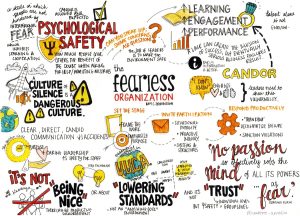
Edmondson, A. (2022). The Fearless Organization [graphic].
In The Heart of Librarianship, Michael Stephens writes that “the library is everywhere–it is not just the building or the virtual spaces (2016, p.2). Of the principles of the hyperlinked library model, this one stands out because it changes the library from a place into a relationship. The library exists wherever people encounter its staff, services, values, and networks. In my experience, this concept often gets misunderstood as “library staff need to be everywhere.” For example, staffing the reference desk at 10PM on a Sunday before a federal holiday, right after teaching advanced legal research to a class of 25 evening students. (Shannon Mattern gestures toward this very real challenge in her 2014 “Library as Infrastructure” by asking “how much more can this social infrastructure support? See p. 6).
This expansive vision of “the library is everywhere” also requires substantial internal change. Stephens connects it to organizational structures that are flatter, with services that reach beyond those who enter the building. “Everywhere” then does not simply mean making library resources and library staff available in more locations. It means giving both library workers and library users more agency in shaping what the library becomes. As The Cluetrain Manifesto puts it with striking economy, “Hyperlinks subvert hierarchy” (Levine et al./Weinberger, 2000, p.89). A genuinely hyperlinked library therefore changes both where services are delivered and how authority and knowledge circulate within the organization. Org charts are “built on sand anyways” (p.90) because influence and knowledge move through informal networks that a chart can’t fully contain.
That too is what Wendy Schultz means when she writes that the “library is everywhere, barrier-free and participatory” (Schultz, 2006, p.11). In 2006, she describes a library that lives in global catalogs and digital downloads. She imagines the library evolving through several stages, from commodity, to product, to service, and then finally, experience. Her future library combines all these forms: “a knowledge spa, . . . a luxury of ideas and thought” (p.11), which evokes an image of the library as a retreat from information overload, a space for meditation.
Shannon Mattern’s “Library as Infrastructure,” pushes the idea further into the physical world. She points to libraries like BiblioTech, where the collection itself is off-site (other libraries have followed suit), no books on the shelf, just servers, licenses, and access points (2014, p.15). The library becomes infrastructure. She asks us to think about “server stacks” (p.15) the way we used to think about book stacks, a reframing of where a library actually is. If libraries are “ubiquitous” (p.3), she argues, it is because interconnected spatial, technological, intellectual, and social systems support them. Thinking of the library as infrastructure draws attention to the often invisible structures underneath its services. It also raises a question: What happens when an organization’s internal culture doesn’t support its outward facing ideals?
The question matters to me because I have seen attempts to introduce flatter structures, radical trust, and user-focused practices meet swift backlash. Practices intended to give employees and patrons greater agency will expose how deeply some organizations depend on predictability and authority. Amy Edmondson’s image of the fearless organization offers one explanation why. Safety is not the same thing as lowering standards, but they are easily confused, and an organization can sometimes mistake candor for insubordination.
The idea that the library is everywhere is both inspiring and demanding. It asks libraries to cross physical and institutional boundaries, but it also asks them to loosen their hold on who may decide, create, speak, and even lead. An organization can hardly embrace the language of innovation without accepting the uncertainty that accompanies it. For the library to be everywhere, trust has to be everywhere too. And so to me the real question is: how do we build hyperlinked practices, like flatter structures and user focus, so that they are durable?
References:
Levine, R., Locke, C., Searls, D., & Weinberger, D. (2000). The Cluetrain manifesto: The end of business as usual. Perseus Books Group.
Mattern, S. (2014, June). Library as infrastructure. Places. https://doi.org/10.22269/140609
Schultz, W. (2006). Infinite futures: On the way to the library experience of the future. NextSpace, (2), 10–11. OCLC.
Stephens, M. (2016). The heart of librarianship: Attentive, positive, and purposeful change. ALA Editions.