Finding Strength In Stories
There are so, so many thoughts and ideas I had this week reading our articles and watching the videos on the topic of storytelling. The idea that everything is a story is foundational for me. It has impacted my entire life- how I see, interact, and walk through this world of experiences. It’s how I make sense of the people and things around me, and how I make sense of myself.
The Human Library Organization is a great example of what story can accomplish. It is a brave program, and bravery is often an attribute of what makes a story resonate. At the heart of this program is honesty and willingness to share and be heard. It encapsulates how meaningful information can become when applied with a narrative, with the idea that we all have a story to share and that is valuable and worth sharing. In “Office Hours: With a Little Twist & Power of the Pod”, Michael Stephens writes, “Story-based experiences of all kinds can increase listeners’ understanding of diverse groups, demonstrate the value of everyone’s experience, and remind listeners of their shared humanity.” The last part of the quote mentions, “listeners,” and The Human Library Organization reflects this idea: that engaged, active listening is integral to the process, when the storyteller and the listener become partners in a connectivity/information flow.
An organization that illustrates Story in terms of place, memory, food, people, and material items is the Immigration Museum NYC | Tenement Museum. This “living” museum and archive gives visitors an opportunity to experience the stories of immigrant families in tangible ways. Their Your Story, Our Story project invites people to share their personal and family histories through photographs, everyday objects, and the memories carried withe them- all the stories! The idea is to show how individual narratives connect to larger themes of immigration, identity, and history. People may submit photos of objects and the stories behind them to an online collection, creating a growing archive of experiences from different communities and generations. What I love about the project is that it takes viewers beyond traditional historical records and humanizes what may otherwise go overlooked and undocumented. It recognizes that history isn’t only about major events or well-known figures, but about people and the experiences that shape lives into stories. Here are 2 examples: one about the role that sage plays in a family’s home: Sage – Your Story, Our Story and another about a Bunny Cake – Your Story, Our Story
Seeing emojis- being the tiny little powerhouses of storytelling that they are- acknowledged in Professor Stephens’ “Whole-Hearted Librarianship,”(page 93) set me on a breathless online research path trying to find a poem that someone read in our library Poetry Club. I could not find the exact poem that I wanted to share, but I did find an emoji translation of, “Do not go gentle into that good night” by Dylan Thomas, written 1951. Emoji translation by Vincent Moody, written 2020.
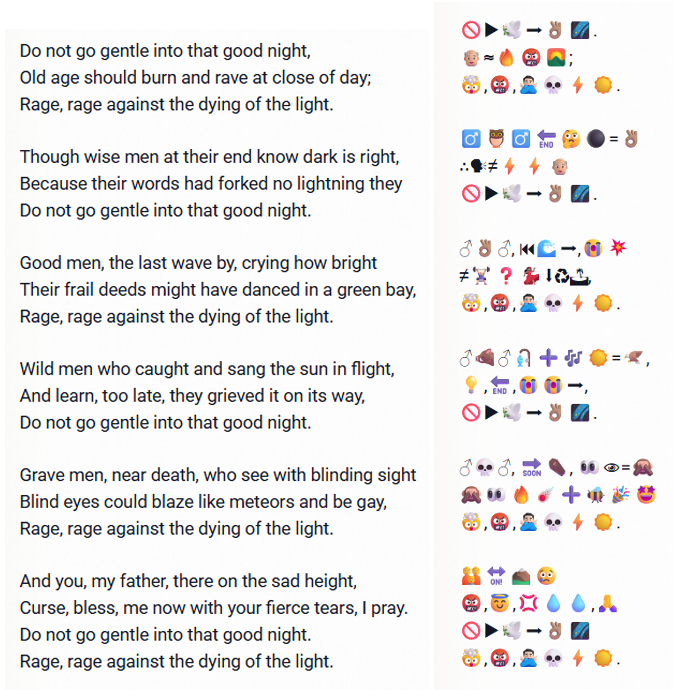
Dr. Stephens writes, “Decoding a string of emoji can be engaging, playful, and poignant” (Page 94). The symbols and patterns in the translated poem tell a story of struggle and repetition, with angry faces, skulls, blind monkeys, and tears appearing alongside A-OK hands, doves, and suns. It’s well done, and also a little unsettling (two things I look for in poetry! 🙃). It’s amazing how much meaning can be communicated through a grouping of symbols, in the form of hieroglyphs, petroglyphs, emoji, graffiti, and such.
We rely on stories in so many ways: to entertain us, help us make sense of our experiences, understand one another, and find our ways through the world. Stories give shape to things that can otherwise be difficult to explain or understand. They allow us to see familiar experiences from a different perspective and recognize parts of ourselves in the experiences of others, whether told through words, images, symbols, or emojis. 🦄🍀🐣👽🌵🎭🐦⬛⛺🎨🐒


3 Comments
Alexis Ferrari
I really enjoyed your discussion of how stories help us understand ourselves and connect with others. Your examples of the Human Library and the Tenement Museum show how personal experiences can preserve history, build empathy, and highlight the value of every person’s story. I also liked your point about emojis as a form of storytelling because they can communicate emotions and ideas in creative ways. Even simple symbols can carry powerful meanings and allow people to express experiences beyond written words. I think story telling is a fun way to connect to others and I also love that story telling is so flexible to commciuate peoples ideas and thoughts.
Caitlin Vaille
I love these reflections, Tara! The emoji rendition of “Do not go gentle into that good night” is a masterpiece, thanks for sharing haha. —Caitlin
Tara
@cvaille glad you liked it to! I want to try to emoji a haiku!😀