The Archive at the Edge of the Network
On digital equity, the discomfort of balance, and what special collections owe to the communities that made them.
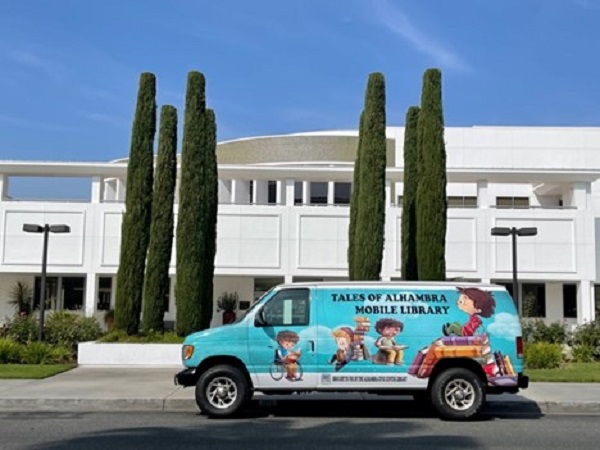
The Alhambra bookmobile parked in front of the Alhambra Library. Photo taken from Alhambra Library website.
Digital equity and community networks felt, at first glance, like the domain of public librarianship. Important and urgent work, but not quite park of my work. I work in an archive attached to a special library. I spend my days thinking about provenance, preservation, and the long slow life of primary sources. What does a bookmobile turned Wi-Fi hot spot have to do with a boxes of unprocessed board agendas from 1993?
Turns out, more than I thought. And sitting with that realization has been the productive discomfort I do not like but know is very useful and healthy.
The reading that stopped me
The article that stood out most in module 5: The Hyperlinked Library was Audra Williams’s piece for the Internet Society, “Libraries Are Bridging the Digital Divide.” On the surface, it’s a fairly straightforward case for libraries as community network hubs. Routers in windows, antennas on rooftops, bookmobiles turned into rolling hots pots. It is a practical, inspiring, well-sourced article, but one passage kept pulling me back.
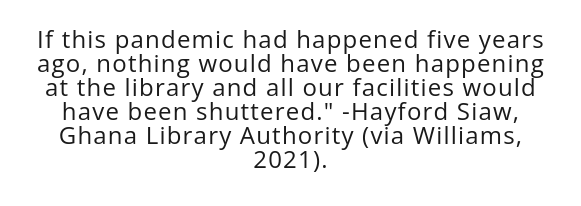
The section on Ghana is what stood out to me. Williams describes how the Ghana Library Authority developed their own app and launched a writing competition to encourage young people to document their pandemic experiences. The Executive Director, Hayford Siaw, notes that the library invested in digital content creation starting in 2018 and that without that foresight, everything would have shut down. The phrase curating and developing stories about their experiences about this period really stood out to me. What the Ghana Library Authority was doing was archival work, community archiving. The library didn’t just connect people to the internet, it became a site of primary source creation. In real time, the communities that have historically been excluded from the archive were being actively being engaged with.
This is where the digital divide and the archival divide converge. Whose stories get preserved? Whose get connectivity? The two questions are not separate.
A Question I’m Still Sitting With
What does it mean for an archive to be a node in a community network, not metaphorically but literally. Williams in their article describes libraries hosting antennas, extending Wi-Fi into parking lots, hosting a node in private off the grid radio communication in the mesh network (something I have actually discussed with a coworker as we are in a very tall building), partnering with street-light networks. Special collections repositories sit inside universities and historical societies that have infrastructure, bandwidth, and often physical buildings at the center of communities. Could an archive be part of the connectivity solution? Could the physical trust that the article identifies as a key asset of the library, a place of safety and credibility, extend to the repository?
I don’t have a confident answer. But I notice I’m asking the question differently than I would have before this module. Before, I would have framed it as: how do archives connect to the digital equity conversation? Now I’m asking: how do I make sure the communities I eventually serve can find themselves in the materials I preserve? And those are very different starting points.
From the “Reaching All Users” section from The Heart of Librarianship ends with a charge from Darien Library’s director: be leaders, be innovators, be the ones watching and planning for the future. I find that genuinely energizing and a little daunting. Especially as someone who chose a field often associated with the past., but maybe that’s exactly the point. The past belongs to everyone. Getting there requires building the infrastructure to reach everyone, too.
References
Stephens, M. (2016). Reaching All Users. In The Heart of Librarianship: Attentive, Positive, and Purposeful Change (pp. 41–43). essay, ALA Editions.
Stephens, M. (2019). Libraries in Balance. In Wholehearted Librarianship: Finding Hope, Inspiration, and Balance (pp. 78–80). essay, ALA Editions.
Wiliams, A., & Muller, C. (2021). Libraries are bridging the digital divide – internet society. Internet Society. https://www.internetsociety.org/blog/2021/03/libraries-are-bridging-the-digital-divide/
1 Comment
July 2, 2026 at 10:27 am
This: “Now I’m asking: how do I make sure the communities I eventually serve can find themselves in the materials I preserve?” This may be one of the most important questions we should be considering as we go forward.