I’m interested in many of the topics discussed in the early modules, but one theme that stood out to me was library architecture and design and the idea of the library as a third place. For context, I’m very interested in architecture and design. I read about the Bay area’s architectural heritage in my free time, and my fiancé is a graphic designer and works in museums. This interest probably stems from my fiancé constantly exposing me to design concepts coupled with the fact that I grew up in the Phoenix’s master-planned tract-home suburbs, a place devoid of context and aesthetic meaning.
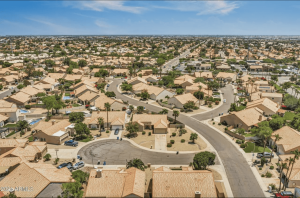
Arial view of Phoenix suburbs
The idea of third places, or places where people can spend time outside of work and home that don’t require spending money, is not new. More people are talking about this concept as inflation diminishes people’s economic security and ability to spend leisure time in a communal space. This discourse often points to public libraries as a respite in the onslaught of consumer capitalism, (Mattern, 2014).
Since the internet has provided people with remote and near instant access to a vast amount of information, library and information scholars have started to question how libraries can adapt to peoples’ evolving information needs. (An obvious answer in this course so far has been to actively seek feedback from your library’s unique community!) In addition to being a space for community events, research, technology classes and makerspaces, public libraries have increasingly asked to provide services other public agencies aren’t able to continue to provide due to budgetary constraints.
So how do libraries design and construct a physical space to meet all these needs and be an intermediary for knowledge creation in today’s social and technical landscape? For Assignment X, I delved a bit deeper into what’s happening in the realm of library architecture and design in the modern age.
I found a great article that got me thinking, (Buschman, 2022). It’s authored by John Buschman, Dean of University Libraries and Associate Provost for Research and Innovation at Seton Hall University. He conducted a simple discourse analysis of 32 articles published about library renovations, about half of which described renovation projects at public libraries. 30% included academic libraries and 18% included special libraries.
He found that the discourse describing library renovation projects tended to reflect the vision-driven master planning method used by architects rather than the design theory, iterative-based, problem solving approach often used by librarians. This reflects a top-down way of thinking about library renovation instead of one designed collectively and collaboratively by librarians and how patrons actually use the libraries’ spaces.
Recurring themes Buschman identified include framing the projects as consisting of “challenges” and “opportunities.” Challenges referred to library buildings in their previous state, which was described as being traditional, uninviting, dark, wasted or “dead” space. Opportunities were conceptually more broad and described as open up spaces, market the library, guide and control collection use and access, and bring together old and new.
Buschman writes, “with numbing regularity, the write-ups valorized access to light and, subsequently, to comely views within and without the buildings, consumer-like choice in spaces (flexibility), collaboration, and retail or consumption spaces … Technology is nearly ubiquitous as an opportunity, with the stand-in phrase ‘21st-century library’ repeated frequently,” (2022).
In short, he argues the conceptualizations of these projects in the challenge/opportunity dichotomy reflects a reimagined space for reimagined people for the imagined long term. This is the architects’, master-planned view, rather than problem-solving for actual use, the design-centered, librarians’ view.
The architects’ view, he argues, is neoliberal. It invokes the twenty-first-century library as a determined, visioned future that contrasts with an unattractive present or past. This view is an oversimplification of how cultural change happens, and it’s not grounded in the reality of libraries today and how people actually use them. Buschman also notes the majority of articles about library renovations were written by architects, and when librarians wrote the articles, they often mirrored the architects’ language.
Last week at work, while I was developing the scope of this project, I stood in and looked around at a space in the library that I personally dislike. (For context, I work at the Central public library for an urban system in the Bay area.) The space is on the ground floor, but it actually sits just below street level, so it receives almost no natural light. The walls are a putrid light gray, and black-and-white hexagon-shaped acoustic panels hang throughout the room. The temperature of the lightbulbs is so blue look like they belong in a hospital. There’s also brightly-colored modular furniture and tables and chairs. That’s really it. I hate it.

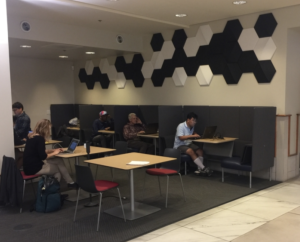
“The Commons,” a space that could be improved at the library where I work.
I turned to my colleague next to me, who was accompanying me during the library’s closing procedures. I asked, “Has this space looked like this since you started working here?” He said yes, it had. I asked, “ What was the purpose of designing the space like this?” He shrugged, said he didn’t know and reciprocated my disdain for it.
After reading Buschman’s piece, I researched the history of that space in my library. Ultimately branded as “The Commons,” it was renovated in 2018 with a $75,000 grant from the library’s foundation. A library press release and local newspaper article about the project tick many of the boxes Buschman describes: centrally featuring quotes from the architects, technosolutionist rhetoric and minimal input from library staff or patrons.
References
Buschman, J. (2022). Of architects and libraries: A simple discourse analysis. The Library Quarterly: Information, Community, Policy, 92(3). https://doi.org/10.1086/719911
Mattern, S. (2014). Library as infrastructure. Places Journal. https://placesjournal.org/article/library-as-infrastructure/
Hi Molly, thanks for introducing the 2022 article authored by Buschman. Your photos of the below-ground space also made me chuckle at how pertinent and common this conundrum is. As someone who worked on a property management team, I can understand both sides – how 75k sounds like a whole lot, but is barely enough capital to make any changes to built spaces. Closing the gap between lofty dreams and stakeholder suggestions, and dealing with the realities of not having a “blank canvas,” sounds like a painful responsibility for project managers. I wish leadership were willing to take bigger risks and lean into the characteristics they’re wrestling against. For example, what if the below-ground space didn’t try to mimic natural light and went all in on a low light ambient reading room? Or hi-fi/soundproofed, carpeted AV lounge?
Hi @jannaxzw. I had the same thought about leaning into the characteristics they’re wrestling against! If I had any input in the design of the space, I would have leaned into the low light aesthetic. People love a cozy and moody environment. Low light in combination with soft textures and durable, well-placed furniture can be conducive to reading and studying! An AV lounge could also be so cool!
Hi @djcrumbo,
My library branch is currently in the preliminary stages of exploring how we can renovate, and the company we are working with has been collaborating with our community to envision the library’s architectural future. One fun thing that they did was host a “Place It” workshop where patrons could build their own mini libraries using random found objects and toys. This inspired a lot of conversation about what the attendees want to see, their favorite memories of learning, and how the architects could use natural features around the branch to bring together the community.
The community input process has not been perfect, and staff have had some apprehensions about whether our regular patrons have been able to participate fully. However, as the project progresses, I anticipate that it will be heavily informed by the feedback we have received from the community right off the bat.
I have grown more appreciative of this approach after reading about user-centered services this semester and reading your assignment!
Hi @inasamuel. I’m glad to hear your library’s renovation project is going pretty well! It’s interesting how different architecture/design firms use different methods to seek input from communities. I’d like to learn more about best practices for library administrators to vet and assess a contractor’s work and process before hiring them.
This is a very interesting post. My library underwent a new building construction in 2011. The building itself is beautiful, but the architects and designers clearly did not really think about how the spaces would be used, especially in the children’s department. They created spaces that looked cool, but really were weird choices to have in a space for children.
Hi, @jenfredrick. This seems to be a common issue, especially in children’s spaces as you mention. Architects have slowly been renovating the children’s floor at my library system, and one of the changes was new carpeting. Many of the children’s librarians commented on how difficult it is to clean carpet after inevitable accidents and that they were not consulted in this decision.