Greenwalt’s Embracing the long game stood out to me this week. First, Greenwalt argues that real institutional change takes a long time. Rather than a one-and-done approach to implementing a new service or program, libraries should think of this work as continuous, ongoing and iterative. He encourages readers to think about significant changes to media, libraries and technologies as something that takes years to occur. He used the example of Ted Talks, a program that took decades to build an audience and materialize into what it is today.
I think this is a great reminder as libraries begin to think about how to adapt to new technologies. Our fragmented and short-form information environment can make it feel as though these technological changes are happening rapidly and overnight. But widespread adoption and disruption from these technologies is gradual, and our responses to them should be to.
Greenwalt also inspires librarians to start small rather than get bogged down in large projects. Staff don’t need a huge amount of money or resources to start making small changes. I have always acted with this in mind, but it’s a useful reminder. Don’t overthink too much and instead work in small bites on what arises naturally. Eventually, the rewards of these efforts will multiply and manifest.
Another idea that struck me in this module was the role of play in learning. First, Scandinavia’s risky and open-ended play structures are amazing and highlight the importance of intent in the built environment, (Dowdy, 2022). This prompted me to think about how the children’s areas in my library system are designed, and what type of interaction they encourage. To be honest, most kids enjoy swinging from the low-hanging trees outside on the lawn! I would love to be a part of an interior design or architecture process for a library to learn more about how these decisions get made.
Play was also mentioned in Kansas City Public Library’s report on learning in libraries, (2015). The authors noted that play can contribute to participatory learning, a type of learning that incorporates actively doing something rather than simply receiving information. Due to their focus on print materials and reading, libraries have historically not recognized this form of learning even though it’s a legitimate way to learn that can be more accessible to people with different learning styles. I hope to learn more about participatory learning programs libraries are doing. My library system, for example, hosts D&D games that are wildly popular. How can libraries begin to incorporate this style of learning while balancing the needs of the community with the priorities of their library leadership?
This week I chose to spend some time reflecting on how libraries and educational institutions are incorporating artificial intelligence into their operations and services. I was especially interested in many points included in the EDUCAUSE Horizon Report Teaching Edition, (2026). Namely, the report highlights how generative AI is reshaping how students experience trust in information and more broadly.
A key element of this issue is the fact that using an AI chatbot for information search, which is the number one reason people use AI chatbots (Goyanes, 2026), diminishes the provenance of the source. This obfuscation of where a piece of information comes from presents the need for novel information literacy skills and practices to be addressed in curricula.
Mike Caulfield is an information literacy expert who created the SIFT method, a framework used to evaluate if a source is credible or reliable. Caulfield writes extensively about how AI factors into information literacy instruction, and he argues people today operating in today’s information landscape do not necessarily have a problem with critical thinking, rather, they do not have enough information about what to do to find additional sources about a claim before they think about its reliability, (2026). Interesting argument.
AI chatbot use in the classroom more broadly presents different issues. When students use AI chatbots to do research and complete school assignments, the dynamic between the students and the teacher changes. Students less frequently go to the teacher for assistance and instead prompt AI chatbots, and teachers increasingly assume students are cheating on their work. This creates an environment of distrust, and as one teacher put it, trust is critical to learning, (Toppo, 2025). This dynamic also encourages students to focus more on “proving they did the work instead of taking learning risks,” (Robert et al., 2026).
This raises many questions for me. First, what are librarians and teachers doing to incorporate this new method of information search in their curricula? Do they have an obligation to explain the underlying mechanisms of these new technologies? How can they communicate the various accuracy levels of different generative AI models? Should these learning moments include the social and ethical implications of this technology?
For a previous course I took on AI and data ethics, I identified some public programs libraries are doing to promote learning around AI. Mt. Pleasant Public Library in Texas created a STEAM book club that prompted attendees to read any book on AI and discuss over breakfast. San Francisco Public Library partnered with Scale Up Robotics to provide a four-part beginner-level digital literacy and robotics courses in which participants remotely teleoperated a real robot and learned basic AI principles.
It’s heartening to see public programs to support learning, and it made me eager to learn more about how teachers are addressing the AI issue in the classroom. The EDUCAUSE report said some teachers are shifting assessment design to emphasize process, reasoning, collaboration, oral explanation, and critical evaluation of AI outputs. But I imagine there are many school systems who may not have the resources to overhaul curriculum. What happens to them?
In short, the New Horizons module evoked more questions for me than answers. But isn’t that a key part of the learning process?
References
Caulfield, M. (2026, March 29). A SIFT rebuild (in progress). The End(s) of Argument.
Goyanes, M., Utz, S., Gil de Zúñiga, H. (2026). Trust in AI news, AI literacy, and the mediating role of artificial intelligence attitudes: A longitudinal study across diverse societies. Computers in Human Behavior: Artificial Humans, 7. https://doi.org/10.1016/j.chbah.2026.100279
It was so fun this week to read about the variety of exciting new initiatives happening in libraries. Two themes resonated with me.
First, several public libraries have been experimenting with unstaffed spaces that can be accessed with a library card equipped with special privileges. The stories about the projects (from what I’ve read) have mostly included the voices of high-level folks like administration and city officials rather than front line library workers, (Bibliotecha, 2024; City of Mesa, 2023). I’m curious to hear about what library workers think of this service model, and I wonder if they brought up safety concerns. I also wonder how the project was planned. How did the libraries who adopted this model chose the location for the staffless site? How were permissions around access decided? I imagine this type of thinking would be quite novel in public library administration, and I’m curious how these ideas arose.
The idea of unstaffed library spaces peaks my interest because it’s been a frequent topic of discussion where I work. For context, I work at the central library of a mid-sized library in an urban area. The building has five floors, and four out of five floors have two staff members at the service desk during all open hours. The library’s administration has been considering not assigning staff people to the fifth floor service desk and turning the space into a self-service maker lab. Of course, this project has a lot of different variables than the unstaffed express library in the suburban City of Mesa, but both raise similar questions. How can library staff take every measure possible to maintain a safe and welcoming environment for patrons?
The second theme that stood out to me this week was the concept of having food served in libraries. As I mentioned, the library where I work is in the city’s downtown area. There are ample food and drink options available for people within steps of the library. Whenever the idea of serving food or drinks in the library comes up in conversation, I always think, “But there’s restaurants right outside!” Why go to the trouble of the set-up to serve food when professional food service is mere steps away.
Despite my short sided skepticism, many of my colleagues at the library have partnered with local restaurants or used mobile kitchens to serve snacks, mocktails and cultural cuisine at various events. People love it! There is clearly a value to collaborating with local food service people. First, partnering with local chefs can bring new people into the library. It also creates a mutually beneficial relationship with a small business in the town. It’s a win-win. Serving snacks can also add to the ambiance of a space. It’s simply hospitable to provide drinks to people during an hour-or-so-long event. Who doesn’t appreciate a nice cold drink after arriving at a destination? It’s a small gesture that can make a huge difference.
Brookmere Public Record: A newspaper published by the Brookmere Public Library community
The Brookmere Public Record is a community-driven newspaper led by staff at the Brookmere Public Library. It aims to fill the need for hyperlocal, accessibly-written information about the City of Brookmere’s operations. Topics include urban planning, public safety, waste management, schools, economic development, and finance and administration.
Since 2005, nearly 40% of all local newspapers in the United States have shuttered, (Metzger, 2025). This troubling trend has left countless smaller towns without journalists to explain the effects of systemic forces on communities and scrutinize the decisions of powerful institutions. The absence of local news, often referred to as “news deserts,” is alarming given local news consumptions’ association with civic engagement, (Barthel et al., 2016). Conversely, a lack of local news correlates to political polarization, increases in crime, and excessive public spending, (Haddock et al., 2026a; Haddock et al., 2026b).
Newsgathering processes require information literacy knowledge practices like the ability to assess authority, develop lines of inquiry, understand the information creation process and recognize that knowledge is produced through sustained discourse, (Association of College & Research Libraries, 2016). By educating residents of Brookmere on how to report and write a news story, library staff will bolster the community’s sense of agency and understanding of local democratic processes. The program will also fill a critical need for local news.
Mission & Institutional Context
The Brookmere Public Library’s mission is to empower, inspire and eliminate barriers with resources and experiences. Its vision is to evolve and respond to the changing needs of the community.
The widespread adoption of the internet undermined local journalism’s financial model, forcing newsrooms to merge with other newsrooms, lay off a significant portion of their staff, or close entirely. In Brookmere, a major part of the local news ecosystem has vanished. The publications that do still exist employ very few staff and are tasked with covering larger geographic areas. This has left the City of Brookmere, a mid-sized city, with a need for news produced by and for the people of Brookmere.
The Brookmere Public Library (and public libraries in general) is positioned to aid in this need because librarians are experts in information literacy. The library also provides a space for people to meet, conduct interviews and write, and provides proximity to many of the city’s public records, which are printed and kept at the main library.
The Brookmere Public Record would advance the library’s mission because the program would empower Brookmere residents with the ability to navigate today’s increasingly complex and technology-mediated information environment. By learning the newsgathering process and developing stories of interest to them, Brookmere patrons will simultaneously learn about and participate in media production and democratic processes.
Action Brief Statement
For staff:
Convincelibrary staff and administrationthat byinvesting resources into the Brookmere Public Recordtheywill help serve a critical local information need and learn about and connect with their patrons which willpromote the production of local knowledge, spark ideas for improved library services, and foster the community’s digital and information literacy skillsbecauseit aligns with the library’s mission and vision to empower and inspire.
For the public:
ConvinceBrookmere patronsthat byparticipating and investing resources into the Brookmere Public Record they will develop useful research skills and feel more connected with their communitywhich willpromote civic engagement and the production of local knowledgebecauseit aligns with the library’s mission to empower and provide resources and experiences.
Inspiration
Library Newsroom Project, Sunset Park branch, Brooklyn Public Library, New York, 2025.
At the Sunset Park branch of the Brooklyn Public Library, journalist Terry Parris Jr. led neighbors through the process of creating a hyperlocal newsletter.
A partnership between the Kansas City Star and Kansas City Public Library where reporters and librarians answer questions from the community and show their work.
NOWCastSA was a public TV news station in San Antonio, Texas that operated out of the sixth floor of the San Antonio Public Library. The two organizations shared resources and ran news literacy programs together.
A partnership between the Dallas Morning News and the Dallas Public Library. Teens worked closely for eight weeks with journalists and librarians to develop community-focused articles.
A nonprofit newsroom in Chicago that trains a network of documenters: everyday people who write about public meetings for a general audience.
The Details
Library Newsroom Project, Sunset Park branch, Brooklyn Public Library, New York, 2025.
Guidelines & Policies
Article Workflow Map
Library staff and journalists partners will create an outline of the steps required to report, write and publish an article for the Brookmere Public Record. This document will reflect the practices of professional journalists, and community reporters can refer to it as they develop their stories.
Publishing Criteria
Library staff and journalist partners will produce a guideline that details the criteria for an article to be published, including sourcing requirements, the fact-checking process, and structuring best practices.
Editing Best Practices
Library staff and journalist partners will draft a list of journalistic editing standards and best practices derived from journalism education materials. Library staff who may be new to this process can refer to this document as they work with volunteer reporters.
Brookmere Public Record Mission & Vision Statements
Library staff will establish a mission and vision statement to reflect the goals of the project and the outcomes it hopes to achieve. These statements can be revisited in collaboration with community reporters once some articles have been published and a writers’ voices are communicated.
Reporting 101 and Editing 101 Training Materials
Library staff and journalist partners will create training curricula covering reporting and editing basics (detailed in Staff Training & Readiness section)
Timeline for Implementation
Months 1-2
Identify staff equipped to help run and plan the program.
Identify local journalists willing to partner and participate.
Communicate program scope internally to library staff.
Month 3-4
Create training materials for staff and community volunteers.
Months 5-6
Train library staff on basic newsgathering practices and editing (Reporting 101 & Editing 101)
Promote the program to the public
Create online application and begin recruiting volunteer reporters
Months 7
Build website to host articles and gather feedback from the community
Months 8-9
Begin training volunteer reporters (Reporting 101)
Begin to report, edit, publish articles and revisit workflows and guidelines regularly
Months 10-11
Run internal and public campaigns to gather feedback on the program: What’s working? What could be improved? What is the public’s perception of the program?
Reproduce this campaign every six months and implement feedback as needed.
Marketing & Promotion Messaging for the Brookmere Public Record will emphasize neighborhood connection, educational opportunities, and the creation of local knowledge.
Within the Organization
System-Wide Email
Program scope, mission and purpose will be communicated to staff through a system wide email.
Departmental Meetings
The library staff program leads will communicate to staff by attending regular departmental meetings, briefing the program and explaining how it relates to each departments’ work
Quarterly All Staff Meetings
Library staff program leads will present a 5-10 minute presentation about the program’s progress at quarterly All Staff meetings
Organic Conversation
Library staff program leads will explain the program in conversation with colleagues as the topic arises, focusing on interpersonal relationships as a core component of the program.
In-Library Signage
Library staff program leads will design signage for highly visible staff areas to communicate information about the program.
External Community
Library Website
Program leads will develop a landing page on the library’s website to communicate information about the program as it progresses.
When ready, this page will direct users to the dedicated Brookmere Public Record site.
Social Media
Information about the program will be regularly shared on the library’s Facebook, Instagram and Reddit accounts
Print Campaign
Small posters will be displayed in areas with high-level pedestrian traffic around town to communicate information about the program to people who may not use social media.
Journalist Partners
Journalist partners and journalism organizations who are willing to collaborate on hosting promotional materials through their channels will share information about the program to their audiences.
Staff Training & Readiness
Library Newsroom Project, Sunset Park branch, Brooklyn Public Library, New York, 2025.
Reporting 101 – A lecture-based slide deck with speaker notes and hands-on activities developed and taught by librarians and reporting partners to cover the basics of reporting
Topics covered include public records requests, research methods (including but not limited to library resources), interview techniques, source attributions, journalistic writing principles, journalism ethics, etc.
Training materials will be created by lead library staff and journalist partners.
All staff and community reporters who participate in the program will receive this training.
Editing 101 – A lecture-based slide deck with speaker notes and hands-on activities developed by librarians and journalist partners to cover the basics of editing
Topics covered include clarity and brevity, story structure, AP style, fairness and other ethical principles.
Training materials will be created by lead library staff and journalist partners.
Evaluation & Future Expansion
Library Newsroom Project, Sunset Park branch, Brooklyn Public Library, New York, 2025.
Success of the program would include regularly publishing high quality articles written by the community to the Brookmere Public Record site at least once per week. These stories will represent the diversity of lived experiences of the Brookmere community, provide easy to understand information about city operations, and educate people about information technology, research methods and library resources through project-based and community-centered reporting experiences.
Potential stories:
Explainer on how Brookmere’s latest amendment to zoning laws will affect local businesses
Explainer on major changes to Brookmere’s annual budget
Feature celebrating local restaurants 20th year of serving the community
Investigation into illegal dumping: root causes, offenders, negative effects and government accountability
To assess usage, library staff will collect quantitative data like article page views. More importantly, every six months library staff will use public-facing surveys to gather and record qualitative information about how the public perceives and uses the library-run paper. At this same cadence, library staff will conduct internal surveys for library staff, journalist partners and community volunteers to share their feedback on the program. This internal and external feedback will inform modifications to guidelines, policies and training materials.
Service will grow and evolve over time in accordance with the wants and needs of library staff and the Brookmere community. Growth for the sake of growth should not be a goal. Rather, the program’s functioning should be responsive to the ideas of reporting volunteers, readers and staff’s capacity to contribute in addition to other job duties.
Haddock, T., Schaefer, A., Whitacre, B., Malone, T. (2026). Financing dies in darkness? The impact of newspaper closures on public finance. Journal of Financial Economics, 135(2), 445-467.
Haddock, T., Schaefer, A., Whitacre, B., Malone, T. (2026). Local news deserts and community social capital erosion. Journal of Regional Science, 66(2), 626-649.
Recognizing diversity of perspectives, the complexity of technology
For this week’s Choose Your Own Adventure format, I read some recent research from Pew on the state of technology usage and perception. I also read through Pew’s collection of thoughts from futurists on their predictions for how technology use will change and affect us in coming years. One fact that stuck with me was the huge diversity of perspectives on issues including social media’s effects on democracy and people’s awareness of artificial intelligence in everyday life, (Anderson et al., 2021; Silver & Clancy, 2022).
The questions Silver and Clancy asked focused on people’s perceptions and attitudes. This led me to wonder what recent research has been done to assess causality between technology use and real world outcomes or other social indicators. I then thought about how broad and interdisciplinary this area of research is. For example, I did a quick keyword search for articles on social media usage’s effects on mental health in SJSU’s OneSearch, and the results yielded articles from journals in communications and media, human-computer interaction, education, political communication, medicine and more.
Given the complexity of the social and political effects of emerging technologies, how can public libraries make informed decisions about how to integrate them into their services? I’m primarily referring to more consequential players in our information ecosystem like privately-owned social media sites and generative AI. This module prompted me to reflect on the feasibility of devising a completely informed strategy within the time constraints of everyday public service. (For example, the library where I work hired a consulting company to help our library system create a Technology Roadmap. Due to budget and staffing issues, very few points in the plan have been achieved.) Many of our readings for this course so far have touched on frameworks to approach this issue, like listening to the interests of the community and the expertise and lived experiences of staff at all levels of the library system.
How can public library workers balance the need to meet people where they’re at – scrolling on platforms and dialoging with AI chatbots – with the mission to teach the public about the social and political facets of information search in the internet age?
With these technology perception statistics percolating in my mind, I came across a Linkedin post by Lauren Pressley, the Dean of Z. Smith Reynold’s Library at Wake Forest University, (2026). Pressley argues the role of libraries today is no longer to provide access to information, as internet-equipped smartphones fill that need. Instead, libraries’ role today is to promote discernment, “knowing what to ask, noticing what a confident answer leaves out, and sensing when something is wrong.” She continues, “When you know something the challenge is being able to say with clarity why you think what you think.”
Though I’ve always recognized that libraries play a role as educators, Pressley frames education as libraries primary responsibility, not access. This conceptualization helped me better understand how libraries should approach emerging technology. It’s not necessarily a question of how to adopt the technology into library services. It’s a matter of how to teach people how these technologies affect our information landscape and the ability to discern. For me, thinking with education and discernment as the goal instead of centering on the technology itself can be a more useful framework for approaching library service.
This week’s readings prompted me to think about how the concept of the digital divide has evolved in recent years and how it takes shape today. Though written a decade ago, Boyd’s (2016) description of the lack of diversity in computer science education and its effects on oppressive, exploitative digital systems rang true, “If people don’t understand what these systems are doing, how do we expect people to challenge them?”
In my mind, there are two key components to the digital divide today. First, people are practicing sustained reading less than previous years (Bone et al., 2025; Iyengar, 2024). Significant disparities persist in reading achievement levels between racial groups, (National Center for Education Statistics, 2019). This is compounded by the fact that in many places, public library open hours are declining due to budget constraints, (Lauersen, 2025), and the price of living continues to rise, encroaching on people’s ability to pay for accurate or editorially-produced information.
Today’s most popular internet-connected devices support platforms that are designed to keep people scrolling for as long as possible to maximize ad revenue. App-based companies coerce people to see an onslaught of short form videos and images accompanied by brief texts. Much of this content provokes fear and anger, a stress response that can become addicting. People less frequently engage with longform print materials for sensemaking and entertainment and instead tend to reflexively turn to fragmented and sensationalized forms of information.
So I see one side of today’s digital divide as the lack of multiple literacies among the general public — digital as well as traditional information literacy — that are necessary to be critical, informed citizens. The other side of the issue, in my view, is the myriad of negative outcomes associated with our built information systems, primarily in the form of internet centralization, a term used to describe the consolidation of information dissemination and the internet’s physical infrastructure, (Internet Engineering Task Force, 2022). To echo Boyd’s sentiment, how can people fight the root of this problem without being able to understand what’s happening?
The two parts of the problem as I see it are reinforcing each other. To even frame the issue as having two parts is probably an oversimplification. It unevenly equates the agency of everyday people to improve their reading and computational comprehension with the consequences of entire economies and infrastructure systems. It’s more broad and complicated than what some scholars call “the digital divide,” and that’s why I’m skeptical to use that term.
It’s also why I’m skeptical of technosolutionist ideas for libraries like book vending machines or bookmobiles. Of course, this doesn’t mean that some good can come from these creative ideas. Similar to calls to fight the “digital divide” by lending out hotspots or teaching computer classes, these moves are probably not getting at the root of the problem.
So how can public libraries address people’s waning attention spans and the dumpster fire economy? I definitely do not know. The first step may be leaning into our uncertainties and admitting that we don’t know. Maybe we should stop talking about library services and programs as a silver bullet for our communities and instead recognize that there are real limits to the impact we have.
I really do not mean to be a downer this week! Part of my thinking around this issue stems from the dynamic in my department at my current library system. My goal in future weeks is to explore the role that workplace culture and management styles play in library services and programs. I think some inward reflection and learning in this realm will be insightful for me.
References
Bone, J., Bu, F., Sonke, J., Fancourt, D. (2025). The decline in reading for pleasure over 20 years of the American time use survey. iScience, 28(9).
I’m interested in many of the topics discussed in the early modules, but one theme that stood out to me was library architecture and design and the idea of the library as a third place. For context, I’m very interested in architecture and design. I read about the Bay area’s architectural heritage in my free time, and my fiancé is a graphic designer and works in museums. This interest probably stems from my fiancé constantly exposing me to design concepts coupled with the fact that I grew up in the Phoenix’s master-planned tract-home suburbs, a place devoid of context and aesthetic meaning.
Arial view of Phoenix suburbs
The idea of third places, or places where people can spend time outside of work and home that don’t require spending money, is not new. More people are talking about this concept as inflation diminishes people’s economic security and ability to spend leisure time in a communal space. This discourse often points to public libraries as a respite in the onslaught of consumer capitalism, (Mattern, 2014).
Since the internet has provided people with remote and near instant access to a vast amount of information, library and information scholars have started to question how libraries can adapt to peoples’ evolving information needs. (An obvious answer in this course so far has been to actively seek feedback from your library’s unique community!) In addition to being a space for community events, research, technology classes and makerspaces, public libraries have increasingly asked to provide services other public agencies aren’t able to continue to provide due to budgetary constraints.
So how do libraries design and construct a physical space to meet all these needs and be an intermediary for knowledge creation in today’s social and technical landscape? For Assignment X, I delved a bit deeper into what’s happening in the realm of library architecture and design in the modern age.
I found a great article that got me thinking, (Buschman, 2022). It’s authored by John Buschman, Dean of University Libraries and Associate Provost for Research and Innovation at Seton Hall University. He conducted a simple discourse analysis of 32 articles published about library renovations, about half of which described renovation projects at public libraries. 30% included academic libraries and 18% included special libraries.
He found that the discourse describing library renovation projects tended to reflect the vision-driven master planning method used by architects rather than the design theory, iterative-based, problem solving approach often used by librarians. This reflects a top-down way of thinking about library renovation instead of one designed collectively and collaboratively by librarians and how patrons actually use the libraries’ spaces.
Recurring themes Buschman identified include framing the projects as consisting of “challenges” and “opportunities.” Challenges referred to library buildings in their previous state, which was described as being traditional, uninviting, dark, wasted or “dead” space. Opportunities were conceptually more broad and described as open up spaces, market the library, guide and control collection use and access, and bring together old and new.
Buschman writes, “with numbing regularity, the write-ups valorized access to light and, subsequently, to comely views within and without the buildings, consumer-like choice in spaces (flexibility), collaboration, and retail or consumption spaces … Technology is nearly ubiquitous as an opportunity, with the stand-in phrase ‘21st-century library’ repeated frequently,” (2022).
In short, he argues the conceptualizations of these projects in the challenge/opportunity dichotomy reflects a reimagined space for reimagined people for the imagined long term. This is the architects’, master-planned view, rather than problem-solving for actual use, the design-centered, librarians’ view.
The architects’ view, he argues, is neoliberal. It invokes the twenty-first-century library as a determined, visioned future that contrasts with an unattractive present or past. This view is an oversimplification of how cultural change happens, and it’s not grounded in the reality of libraries today and how people actually use them. Buschman also notes the majority of articles about library renovations were written by architects, and when librarians wrote the articles, they often mirrored the architects’ language.
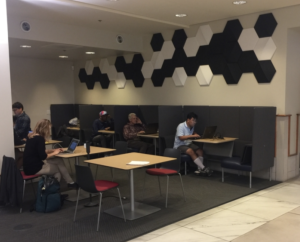
Last week at work, while I was developing the scope of this project, I stood in and looked around at a space in the library that I personally dislike. (For context, I work at the Central public library for an urban system in the Bay area.) The space is on the ground floor, but it actually sits just below street level, so it receives almost no natural light. The walls are a putrid light gray, and black-and-white hexagon-shaped acoustic panels hang throughout the room. The temperature of the lightbulbs is so blue look like they belong in a hospital. There’s also brightly-colored modular furniture and tables and chairs. That’s really it. I hate it.
“The Commons,” a space that could be improved at the library where I work.
I turned to my colleague next to me, who was accompanying me during the library’s closing procedures. I asked, “Has this space looked like this since you started working here?” He said yes, it had. I asked, “ What was the purpose of designing the space like this?” He shrugged, said he didn’t know and reciprocated my disdain for it.
After reading Buschman’s piece, I researched the history of that space in my library. Ultimately branded as “The Commons,” it was renovated in 2018 with a $75,000 grant from the library’s foundation. A library press release and local newspaper article about the project tick many of the boxes Buschman describes: centrally featuring quotes from the architects, technosolutionist rhetoric and minimal input from library staff or patrons.
References
Buschman, J. (2022). Of architects and libraries: A simple discourse analysis. The Library Quarterly: Information, Community, Policy, 92(3). https://doi.org/10.1086/719911
My name is Molly AKA DJ Crumbo and I’m a library specialist at a mid-sized urban library in the East Bay. I currently work in the adult services department, where I teach digital literacy skills and develop educational programs for the public. I run a monthly lecture series featuring research scientists from the nearby university.
I’m almost done with the MLIS program, and I’ve taken a considerable amount of courses focusing on emerging technologies. I’m interested in the social, ethical and political issues associated with implementing emerging technologies within the LIS professions and in our broader world. Prior to working in libraries, I was a journalist and wrote about national politics and education. After graduation, I hope to continue writing about how people and organizations are harnessing new technology and these changes’ many effects on society.
I chose to take this class because I’d like to continue exploring how libraries can adapt to today’s rapid technological evolution. There’s already so much that’s changed in the last decade: consolidation of major platforms and transformation of their user interfaces, continued expansion of cloud-based services, integration of AI tools into a great deal of major sites, etc. I hope to learn skills on how to manage projects and make decisions in uncharted library territory. I already appreciate this course’s emphasis on creativity and unconventional thinking.
Outside work and school, I love to hike with my dog around the Bay Area. I grew up in Phoenix, Arizona and moved to the East Bay in 2021. I’m still in shock at the greenness of the landscape, the walkability of neighborhoods, and the mild weather. I like to peruse book and vintage furniture stores, try new restaurants, read books and magazines, attend shows, bike around town, and write about my observations. I’m a very curious person, and I love chatting with people and learning new things.