When I first read about the concept of participatory service, I thought about events at public libraries such as storytimes for children, crafting or gaming hours for teens and adults, or classes for health or for anyone wanting to learn English. Rather than public libraries simply collecting and distributing information and having a variety of events, participatory service at libraries acts as a platform for collaboration, peer-to-peer learning, and shared creation.
“We have wonderful third spaces that offer our users a place where they can think and dream and experience information. Is your library a place where people can dream?” (Schneider, 2006).
Academic Libraries
North Carolina State University
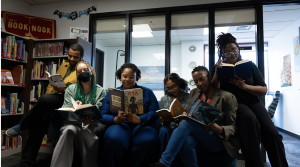
“The North Carolina State University African American Cultural Center (AACC) is home to over 6,000 books centering African American and Afro-diasporic experiences, culture, society and history” (Schnittker, 2026). During National Library Week, this library held interactive programs that was of the theme of, “Libraries as Spaces of Opportunity.” The librarian and librarian coordinator, Wynter Douglas, stated that they had many “events that showcased ways libraries are spaces of opportunity” (Schnittker, 2026). Douglas stated that libraries can provide ways for students to find out about their heritage, career possibilities, and what their future can be like. Since AACC is part of the NC State University, it is accessible to the community in addition to being available to students, staff, and faculty.
Reed College
At Reed College in Portland, Oregon, there is a permanent collection of zines that Reed students, staff, and faculty can borrow. They also have zine making kits that can be checked out for groups or individuals. The website has a Zine Library Open House listed on September 24, 2026, where they will have zine-themed snacks, a zine-making area, button making, and a show and tell of rare zines from their archives.
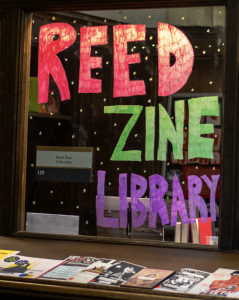
The zine library website page indicates that anyone who is not a student, or a staff or faculty member can go to the reference room where the zines are located and browse through the titles. Not only does this academic library make zines available to read and create for students, staff, and faculty, but they have also made them available for anyone in the community who is in the vicinity of the college.
Public Libraries
New York
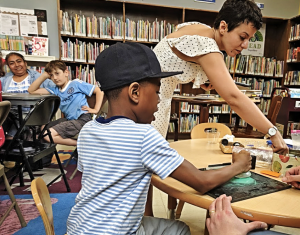
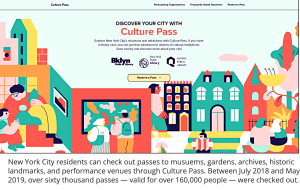
In the chapter titled “Communities of Practice” in the section, “Age of Participation” in Heart of Librarianship, it tells of a museum director having only six seconds to catch the attention of visitors. The author asks, “Could adding a social, participatory component to museum exhibitions maximize this brief window of opportunity?” (Stephens, 2016, p. 79). In the article, “Leveraging Libraries for Cultural Engagement: A Model from New York,” a group of patrons at the Brooklyn Public Library are participating in an event where an educator from The Morgan Library and Museum is leading them in a hands-on event about different ways that colors are produced and created (Giles, 2019). For anyone who does not want to leave their neighborhood, this is an excellent example of programming through the public library systems of New York called Culture Pass. Anyone with a library card from the Brooklyn Public Library, the Queens Public Library, and the New York Public Library, can reserve a daily pass that will allow them to visit over 100 cultural centers across the areas these library systems serve in New York (https://www.culturepass.nyc/). In this case, an educator from the Morgan Library and Museum went to the Brooklyn Public Library. Since museums and cultural centers are in partnership with the library systems mentioned, they can have programming and events such as this one.
The theme of participatory service stands out to me because these types of programming can affect what a person becomes interested in. A lot of people think libraries are only for books and are quiet places to do research and to study. While books, research, and studying are part of libraries, they can also be places where if a person joins an event and is able to participate in something, this might be the canon event in their lives. They may never have known of the topic before, but it can cause them to want to learn more about the topic of the event.
One initial question I had to learning about participatory service is how could this be created in small towns? New York City is a major city with five boroughs that are highly populated. There are many places there that could provide countless cultural experiences. In smaller cities, there might only be one museum, if any. Thinking about smaller cities, on how to build learning and community, I would think that the idea of partnerships with museums and other cultural centers would be important. The cultural centers in a larger city would have to be willing to be in partnership with public libraries in smaller cities, which would mean that they would have to send someone who could lead an event at that library. This idea is something I could research more in depth if I ever found myself working at a library in a smaller city rather than libraries in major cities like Los Angeles, New York, and Chicago.
Works Cited
Giles, D. (2019). “Leveraging Libraries for Cultural Engagement: A Model from New York.” https://www.giarts.org/leveraging-libraries-cultural-engagement
Reed College. (n.d.) “Zine Library.” https://library.reed.edu/zines/
Schneider, K.G. (2006). “The User Is Not Broken: A Meme Masquerading as a Manifesto.” https://freerangelibrarian.com/2006/06/03/the-user-is-not-broken-a-meme-masquerading-as-a-manifesto/
Schnittker, A. (2026). “African American Cultural Center Promotes Libraries as Spaces of Opportunity.” https://news.dasa.ncsu.edu/african-american-cultural-center-promotes-libraries-as-spaces-of-opportunity/
Stephens, M. (2016). “Age of Participation” in Heart of Librarianship.