What is the idea?
My plan is to implement an all-ages, family friendly game night at the library. Depending on staffing and schedule availability, this could be a weekly or bimonthly offering. My idea is to have it open to as many different game genres as possible, with patrons either bringing in their own or using those from the library’s collection, ranging from classic group games like bridge and mahjong to tabletop roleplaying games (TTRPGs) like Dungeons & Dragons or Pathfinder. I envision everyone from senior’s to toddlers with their parents and families taking part, each finding the game that speaks to them. We can’t forget about our teens and young adult audiences either–this service is for them, too! A game night would highlight the library’s status as a keystone of community engagement and connection.
(Full disclosure: this is a real-life program I’m trying to get started at my library in the Fall, so this assignment is a great opportunity for me to get all my ideas about it written down!)
Mission & Institutional Context
Broadview Public Library District’s Mission and Vision Statements are as follows, from our website:
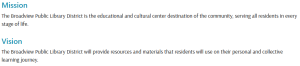
Game Night at the library will serve both cultural and education functions, fulfilling both aspects of the library’s Mission statement. Furthermore, following the Vision statement, the resources made available at the Game Night may support patrons’ personal and collective learning journeys as well.
Action Brief Statement – Label this section clearly—it’s a cornerstone of your strategy. Create an action brief of your own as part of this process focused on the user population you want to reach. For example: convince {a certain group} that by {utilizing the new or improved service or technology, etc} they will {discover a new or cool thing about the library or service} which will {create the outcome you are aiming for} because {this is what the library is about}. If part of your plan involves staff-buy in, write a second Action Brief statement for staff.
Convince Broadview residents and library patrons that by joining our Game Night, and contributing their own games and participation they will have a great time, meet new people, and learn new games which will strengthen their bonds as a community as well as their participation and engagement as library patrons because the library’s mission is to serve as both an educational and cultural hub, serving patrons at every stage of life.
Where did you find inspiration?
“The Heart of the Deernicorn“, an Olympia-based game studio that partners with library and educational institutions to present game nights and related programs, has a wealth of resources for getting a game night off the ground. Even better, they have a comprehensive list of games broken down by content, age groups, and themes that library programmers can tailor towards their audiences.
Guidelines & Policies
Of course, as with any public program, there have to be certain behavioral guidelines and policies in place. All participants would need to abide by the Library’s Code of Conduct, and games and content would need to be approved. Not everything would need to be family friendly, mind you, but library staff would need to make sure to have adult and teens separate from youth and family groups. I certainly wouldn’t want to bar the D&D group just because it includes violent themes for example–but let’s try to make it so that the toddlers can’t hear the description of the goblin’s head getting cut off…
At the same time, certain themes would be off-limits for any and all games and groups. While some degree of fantasy violence is tolerable in a library setting, anything with sexual themes or involving identity-based discrimination would be a strict no-no. A comprehensive list would be made by library staff and provided to participants; signs with this information would also be posted around the event.
Timeline for Implementation, Marketing
Ideally, this program would need a handful of months in order to be fully fledged and ready for the public. In the early stages of preparation, for example, I would reach out to local game stores and similar venues to help market the activity, while also saying that the library gratefully offers any game supplies donation and would happily post any promotional material for the donor business or organization. Basic library partnership stuff to help build our audience and game collection!
Beyond that, flyers, newsletter blurbs, and social media posts would all be mobilized to help generate interest and participation in the community.
Time would also be required to order supplies through the proper budgeting channels; perhaps I would have to make several orders out of my own programming budget over several months, though the game collection could also be bolstered by collection development budgets if approved by the Library Services department. Ideally, patrons would also bring their own games, so it wouldn’t be entirely dependent on the library’s collection, though we would want to start off with a strong enough stockpile that Game Night could run without any game contributions from the public.
Staff Training & Readiness
I would want to communicate with coworkers to gauge their own personal interest and participation in this program. Some of them maybe have always wanted to try DMing, perhaps others are experienced Magic: The Gathering or Pokemon TCG players. Or maybe we just have a dedicated poker player who’s eager to teach others the rules!
With such a fun, free-form program, I like to think it wouldn’t take much to light a fire of enthusiasm amongst my coworkers. I don’t think that actual training would be necessary; if someone wanted to try something a little more challenging, like DMing, maybe I would share some resources them and encourage them to explore actual-play TTRPG podcasts like Critical Role, Dimension 20, or Glass Cannon to get familiar with the style and format. Again, I am assuming that if they are volunteering to fill in these roles, then they have some familiarity with the game, its format, and the style assumed for running it. If not, that’s no problem: it makes for an exciting learning experience for them, and their players!
Evaluation & Future Expansion – What performance benchmarks or usage metrics will guide your evaluation? What success stories do you hope to tell? How will feedback be gathered and shared? How might the service grow or evolve over time?
Beyond the basic metric of how many participants register and show up to the program, it would be important to track the number of games brought to every session, as well as the average amount of time participants actually stay for the event; ideally we would have folks staying for the entire duration, whether that be an hour, two, or even more. We might boost registration and attendance by providing light snacks and drinks, as long as there is an understanding of cleanliness throughout the program.
“Heart of the Deernicorn” has a nice template for opening and closing circles for Game Nights which we would implement:
Introductions – 3 Things About Story Games (10 minutes):
Use these three simple principles to introduce the concept of story games. This segment is led by the host or experienced participants and is meant to demystify roleplaying games for newcomers and foster a welcoming atmosphere.
- 1) Games Are Like A Conversation:
- Emphasize that playing games involves the same skills used in conversations, such as listening, questioning, and collaboratively building on ideas. Remind participants to respect each other’s speaking turns.
- 2) Think Small:
- Encourage participants to start with simple concepts and to pay attention to the details. Not every idea needs to be grandiose to be impactful.
- 3) X Card / Safety Tools:
- Explain the purpose of safety tools and the X-Card, a simple tool allowing anyone to remove uncomfortable content without explanation, ensuring a safe and enjoyable experience for all participants.
Pitches:
- Participants eager to play a specific game will take turns introducing themselves, present the game by holding it up, provide a short description, and mention the required number of players.
- Attendees will then select their preferred game from among the pitches, forming smaller groups to play.
Note: Pitch presenters should indicate if the game requires a Game Master (GM), specifying whether they can assume this role or if they are seeking someone with the necessary experience.
Closing Circle:
- Signal a 15-minute warning before regrouping everyone into a closing circle.
- Ask participants to reflect and go around the circle one at a time, sharing from these options:
-An experience they had
-An appreciation of another player
-Something that was challenging or difficult
Games are such a low-stakes way to bring people together for something fun! I wish you all the luck bringing this to your library in the fall. People need more games right now, I think!
@nigelito Games are a fun way for people to interact and learn from one another. I held a Loteria game night at my library and received positive reviews and requests for similar programs. People enjoyed being able to learn about a new game and interact with other community members. I like that your program would also make it open to all ages, offering patrons from different generations an opportunity to interact.