Public libraries are valuable learning ecosystems that are expanding the possibilities of education and learning, implementing resources and services that support a broad range of communities. Some libraries are expanding access to knowledge by offering courses in virtual and/or physical formats, whereas others serve as hubs for self-guided exploration by lending tools and equipment for little to no cost. This brings in new curiosities on art education: How can public libraries and other GLAM institutions educate patrons on art literacy (literacies with a visual arts focus; visual literacy, object literacy, artefact literacy, etc.)? How can they help users in their self-guided learning and spark curiosity to not only experiment in artmaking, but also learn deeply about art-related topics.
This blog post reflects on rising concerns with literacy; interest in self-directed learning; innovative approaches to community education; and how public libraries (or any GLAM institutions for that matter) can support the practical and theoretical information needs of artists and curious patrons.
Rising Concerns with Literacy & the Value of Participatory Learning
Miller (2025) describes the rising concern of student disengagement with assigned readings, the common conflation of compliance with learning, and the need to explore a deeper question: “Are our students thinking, questioning, and applying ideas?” (Miller, 2025, par. 4). Dynamic learning experiences, where students can apply principles learned to other contexts and experiences, are integral to intellectual engagement (Miller, 2025, par. 6-8). Instruction must reframe reading as a tool for curiosity and deeper learning as opposed to compulsory memorization. Some suggested approaches include “(1) Connecting course concepts to the real world; (2) Giving students agency in practice; (3) Making abstract ideas urgent and actionable; and (4) Getting creative with concepts and content” (Miller, 2025). Applying these models to curricula encourages students to deeply explore their intellectual interests by developing ownership over their learning.
The Institute of Museum & Library Services similarly acknowledged the value in supporting individual learning objectives of community members, highlighting how libraries can re-imagine their services and spaces in the digital age (Hill et al., 2015). Participatory learning encourages understanding by doing rather than passive absorption (Hill et al., 2015, p. 6), expanding learning approaches for multiple literacy types. It is important that GLAM institutions recognize themselves as more than information centers, instead as hubs for curiosity and lifelong learning.
The Pursuit of Self-Directed Learning
A great number of the public is interested in deepening their knowledge as well, whether that be for the purpose of advancing their professional careers, developing life skills, or as serious leisure. The growing concern with literacy is not limited to educators. Younger generations are struggling with their relationships with technology, lacking a balance between their personal life, work, and screentime, finding themselves frequently engaged with information colloquially labeled as “brainrot,” or addictive online content that leads to perceived cognitive decline (Merriam Webster, n.d.). To resolve this, some choose self-directed learning where they are in control of the topics explored and pacing. Two approaches of note are personal curriculums and alternative virtual education.
Personal Curriculums
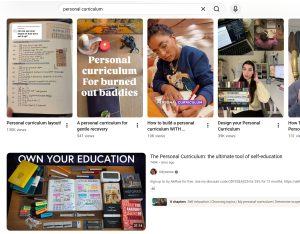
Ripari (2026) explores the concept of the “personal curriculum,” a TikTok trend where people develop and execute their own self-guided study on a particular subject. The aim is to deepen one’s understanding on a topic of interest and/or acquire new skills, which may prompt new curiosities in the process. It is also intended to prevent time theft often caused by overconsuming social media. There are no restrictions other than the pursuit of learning, meaning people can tailor the quantity of topics they learn simultaneously, the goals of the “class,” the time length spent on a topic, and the overall curriculum structure. Some people approach this similar to a college course, with detailed learning outcome goals, various academic readings and resources, assignments and projects, and intended completion within 3-4 months. Others develop personal curriculums of lesser intensity, exploring a topic for a month or less with fewer expected readings and resources. Many people share their experiences with a personal curriculum and how to make your own, expressing how it has improved their personal lives and relationships with learning.
For some interested in a personal curriculum, the time commonly allocated to ideating, developing, and participating in it may not suit the current lifestyle a person has. They may feel trapped in the former two phases without an opportunity to even begin their curriculum. Walchack (2026) expresses this concern as a full-time working mother and how she approaches learning through a curiosity notebook, journaling her questions, finding resources on it, and documenting her findings. This strays from an academic approach and allows for organic exploration, taking a question and learning more through different searching methods (e.g., online searches, browsing literature, visiting locations, asking professionals, etc.), allowing the idea to take shape as more information is retrieved. People can curate their self-guided study experience around their lifestyle rather than restrict themselves to a particular system.
Alternative Virtual Education
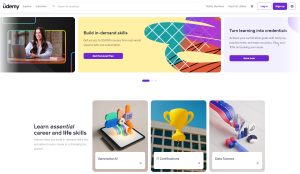
People seeking learning opportunities similarly structured to academia but cannot afford the price tag placed on college courses may utilize online learning platforms. Two commonly known platforms—that many public institutions offer for free—are Coursera and Udemy, providing users skill-building courses on various topics, including business, language, social sciences, design, health and fitness, and much more. Coursera (2024) notes over 168 million registered learners in their 2024 Impact Report, with a catalog of over 2,000 projects, 9,200 courses, 1,200 specializations, 150 certificates, and 50 degree programs. This goes beyond personal learning, extending to professional learning experiences that can support a user’s career goals.
Certain institutions, like Harvard, offer online courses that users can audit for free. Courses are in various subject areas, some examining theory and others presenting practical applications with hands-on project assignments. This expands access to learning opportunities by removing financial, scheduling, and transportation barriers for users.
Some libraries take an additional step beyond these offerings, developing their own lesson plans and providing facilities for patrons to iterate and experience learning by making.
The Library as Classroom
Stephens (2014) describes public libraries as “‘the people’s university’ – an open education resource or commons or center for lifelong learning” (par. 2). These spaces are becoming welcoming, inclusive hubs that foster creativity and experimentation through participatory education. Let’s look at a few examples of libraries transforming their presence into classrooms for the community, in the physical and/or digital sphere.
Adult School @ Montclair Public Library – Montclair, NJ
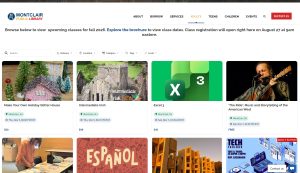
Montclair Public Library (n.d.)’s Adult School offers courses to adult patrons in various subject areas, from the arts and humanities to social sciences, to health and wellness and more. Courses may have in-person, virtual, hybrid modalities. Certain courses are more lecture-based whereas others are more active and hands-on. Some courses appear to be in collaboration with external organizations, such as their four-week indoor rock climbing course held at Gravity Vault Montclair 8 (Montclair Public Library, 2026).
The Edge @ State Library of Queensland – Queensland, Australia
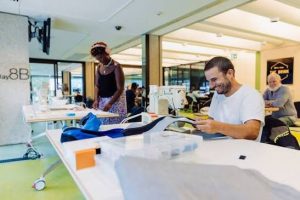
State Library Queensland (n.d.)’s The Edge is a center for experiential and instructed learning, offering users various creative tools and equipment, workshops, and opportunities for community projects and meetups. This space encourages hands-on learning and skill-building with their free and low-cost resources and services. The online resource hub appears to be a preview of workshops offered at The Edge, providing users with a workshop overview and a downloadable folder with the workshop’s slide presentation and session plan. Users can also use these materials to educate themselves on the topic if there is no opportunity to attend a workshop in-person, increasing accessibility for remote, self-paced learning. This can also serve as a resource for educators interested in creating similar materials for students.
23 Things @ Curtin University – Perth, Australia
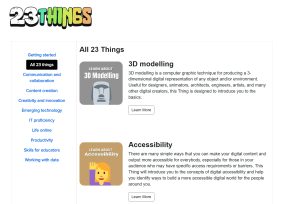
Curtin Library (n.d.a)’s 23 Things is “an online program designed to help you develop and enhance your digital skills, featuring topics like accessibility, video editing, digital security and more” (par. 1). Each topic is structured similarly to a lesson plan, with an overview on the topic, videos, interactive activities, hands-on projects. Different areas of digital literacy are covered, from personal life skills to professional learning experiences to serious leisure.
After examining people’s self-guided approaches to learning and how libraries are evolving their educational resources and services, I developed a new curiosity: How can art information centers increase free access to art education, sparking curiosity and integrating art literacy in the everyday lives of patrons?
Art Class is in Session
Here are a few ideas that GLAM institutions can integrate into their programming and resource offerings for the public that encourage artmaking, artistic research, deep learning:
Advanced, In-Depth Course Offerings
This is briefly touched on in my Assignment X post, but it must be reiterated. Information centers serving creative practitioners, art scholars, and curious audiences should offer curricula that encourage students to go beyond simply making. Courses should introduce patrons to frameworks for seeking art information, experimentation, and critical reflection, teaching them various literacy types in the process. When information centers are limited in scheduling, they can diversify their offerings that still intellectually engage patrons, such as hands-on artist talks (learning about an artist’s work and process paired with an intensive workshop), costumed figure drawing, studio critiques, lessons on research and iteration (e.g., how to retrieve information on and develop character designs) and much more. If a GLAM institution can hold longer sessions (e.g., 4-6 weeks), this opens opportunities for workshops where patrons can apply their ideas and knowledge to bigger projects with the guidance of an instructor—similar to an art & design school.
Community Showcases & Clubs
For people with personal curriculums and a preference for self-guided learning, GLAM institutions can support their interests with looser, recurring collaborative projects and community showcases, such as time-constrained events around an art theme (e.g., game jams), monthly gatherings, and quarterly group exhibitions. Time-constrained events may provide patrons an incentive to create and apply their skills to a project; oftentimes, artists need pressure like a deadline to develop new work. Monthly gatherings can serve as a themed co-working space and mixer for like-minded individuals. These exhibitions, rather than highlighting completed work, may function closer to a show-and-tell, allowing patrons to talk about their current project and process in an informal, casual setting. Rather than a traditional gallery exhibition, patrons can showcase slide presentations to an audience, removing the need for art handling and intense set up.
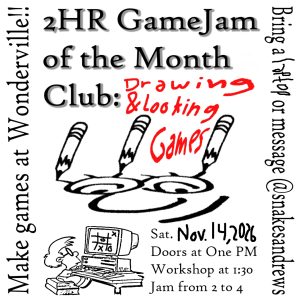
A community space that elevates this concept is Wonderville NYC (n.d.), a barcade that hosts independently made arcade games and events for game designers. Alongside their entertainment-focused events, they host monthly gatherings for indie game devs; game tournaments; performances and talks on the intersection of art and technology; gamejams and more. The arcade is, in a sense, a rotating exhibition of interactive works that experiment with content and form. For the game devs, this additionally serves as a testing ground for their projects, earning insight from players on areas that are successful or need refinement.
Collaborations with Teaching Artists & Art Organizations
Considering the growing need for specialized skills, some libraries may either seek librarians with particular expertise, or hire from outside the profession (Hill et al., 2015, p. 11). Makerspace specialists are a rising example, hiring an engineer with technical expertise in the maintenance and instruction on makerspace equipment. This may also be applicable to art instruction, hiring teaching artists to lead workshops and classes. If there are art organizations and centers in the community, one could form a partnership where instructors use the GLAM institution as an additional classroom or patrons receive free/discounted course offerings with their library card.
Online Resources Guides & Lesson Plans
Public libraries and museums can develop online resource guides and curricula that educate users on visual art subjects. These can include videos, presentation slides, collection highlights, hands-on assignments, and resources for further learning. These can be an extension to existing LibGuides that an institution may have, instead adding a focus to practical applications and specific learning targets. An example is the 23 Things page on 3D modeling, providing users with an overview of what they will learn, a general topic definition, introductory software programs and information, videos and interactive activities, a creative challenge, and additional resources (Curtin Library, n.d.b). This could be applied to other visual arts topics, such as printmaking, watercolor, pattern design, and much more. These can also integrate the books and art objects in the collection, encouraging visits and circulation for further learning.
As always, I would love to learn how others are engaging with art in their libraries, museums, and other community spaces. What free educational resources and courses have you come across that focus on art education or facilitate self-directed learning?
References
Coursera (2024). 2024 Impact report: Transforming lives through learning. https://s27.q4cdn.com/928340662/files/doc_downloads/2025/03/2024-Impact-Report_Coursera.pdf
Coursera (n.d.). [Homepage]. https://www.coursera.org/
Curtin Library (n.d.a). 23 Things. Curtin University. https://23things.library.curtin.edu.au/
Curtin Library (n.d.b). Thing – 3D modelling. Curtin University. https://23things.library.curtin.edu.au/portfolio/thing-3d-modelling/
Harvard (n.d.). Free Courses [Course catalog]. https://pll.harvard.edu/catalog/FRee
Hill, C., Proffitt, M. & Streams, S. (Eds.) (2015, May 14). Learning in Libraries. IMLS Focus. https://www.imls.gov/sites/default/files/publications/documents/imlsfocuslearninginlibrariesfinalreport.pdf
Mel [Mind Body Mel] (2026, September 26). What I’ve learned doing 1 year of personal curriculums (Video). YouTube. https://www.youtube.com/watch?v=IoyrnzIZcYg
Merriam-Webster (n.d.). Brain rot [Definition]. https://www.merriam-webster.com/dictionary/brainrots
Miller, L. N. (2025, May 22). Why we can’t get students to read. Harvard Business Impact. https://hbsp.harvard.edu/inspiring-minds/get-students-to-read-for-knowledge-transfer
Montclair Public Library (2026). Indoor rock climbing [Course description]. https://montclairlibrary.org/adults/adult-school/courses/indoor-rock-climbing/
Montclair Public Library (n.d.). Adult school: Explore classes [Course catalog]. https://montclairlibrary.org/adults/adult-school/
Queensland State Library (n.d.). The Edge. https://www.slq.qld.gov.au/visit/spaces/edge
Ripari, S. [Shawna Ripari] (2026, October 25). Is a personal curriculum the answer to brain rot, excessive social media use, and AI dependence? (Video). YouTube. https://www.youtube.com/watch?v=rjmyAvZUEII
Stephens, M. (2014). YLibrary? Making the case for the library as space for infinite learning. https://www.dropbox.com/scl/fi/4zt1yliwb2ffzr8euix2p/YLibraryInfiniteLearning.pdf?rlkey=m0v6lkd43ufilkp5aktawhlpr&e=1&dl=0
Udemy (n.d.). [Homepage]. https://www.udemy.com/
Velu, J. K. [thisstoryaintover]. How to build a personal curriculum 📓🖋️ step-by-step guide, tips & resources, notion tracker template (Video). YouTube. https://www.youtube.com/watch?v=sEx2q6WwakU
Walchack, S. [Sara in Real Life] (2026 May 25). I started a curiosity notebook (instead of a personal curriculum) (Video). YouTube. https://www.youtube.com/watch?v=yjXXWk9TsMw
Wonderville (n.d.). [Homepage]. https://www.wonderville.nyc/