Visual Artists & Participatory Service
Overview
Participatory service is an evolving framework that aims to improve community engagement efforts through the involvement of users in the ideation and evaluation of services. Each information center may offer a unique variety of services that addresses barriers or gaps specific to their community. Fostering a welcoming, explorative environment requires inclusivity and transparency, inviting patrons to open conversations where all feedback and decisions carry value and reaffirm trust. Dr. Stephens shares many examples of what this looks like, including libraries of things, community archive projects, and makerspaces. I believe participatory service and innovation is a necessary trajectory for libraries. Information centers must continuously evolve with the needs and interests of the public, otherwise whom do they successfully serve? To narrow the scope further, how does participatory service look for a community of visual artists and other creative practitioners?
Information Needs & Behaviors of Visual Artists
Chappell (2017) best describes creative art practitioners as “individuals who are actively engaged with the disciplines of visual art, architecture, design, media and craft, either through study, employment or leisure” (66). This group engages with an interdisciplinary, multi-sensory concept that calls on both the conscious and subconscious self, their needs and behaviors equally idiosyncratic and irregular. I personally noted a growth in this information community alongside the rise of self-acquired skills in arts and technology (DIY subcultures) through social media, at zine and art fairs, and when interacting with patrons.
In addition to typical, everyday information needs, artists generally seek information for inspiration, specific visual elements, additional insight on materials and techniques, professional development, and identifying trends in the arts (Kolyvas & Kostagiolas, 2024, 48); when artists seek information, it may not serve the same purposes as it does for other users. Artists consuming literature on marine biology, for instance, may not be limited to leisure or academic research, but to see how fish can be integrated into a current project, either representationally, physically, or abstractly. Artists also do not have a foundational set of resources compared to other disciplines. They retrieve information from art and non-art sources because “almost literally anything can be considered art information inspiration” (Mason & Robinson, 2011, 177). Furthermore, the forms that said information takes is not limited to print or digital, but can encompass virtually anything, including artworks, natural forms, personal experiences, smells, dreams, etc. (Mason & Robinson, 2011, 161). Art materials are also not limited to social categorizations; artists may explore their practice using anything they can acquire and transform (physically and/or conceptually), learning techniques through outside sources and physical use.
This is only a brief glimpse at how visual artists and other creative practitioners engage in artistic research, a highly intuitive process using “embodied-material-conceptual thinking that goes hand in hand with art making” and explores formats of knowledge not traditionally examined in academia (Cotter, 2024). The process itself may begin with a core question and browsing, and once something catches their attention, the creative practitioner may gradually narrow their information needs through intentional searches and experimentation. With this in mind, envisioning libraries for visual artists is not as ‘difficult to describe’ a concept as their information needs and behaviors, and some libraries are already bringing that support.
Participatory Libraries for Artists
Dedicated art libraries most commonly exist as extensions to academic libraries (colleges and universities), art & design schools, or cultural institutions (museums). These spaces often have a financial barrier to entry, requiring patrons to actively attend the school or pay admission. A town, city, or county may have an art center that holds exhibitions, events, and classes. However, some art centers still have financial barriers and do not offer research support beyond experimentation with art materials. Public libraries exemplify what accessibility and inclusivity can look like for arts education and exploration, with examples of services below:
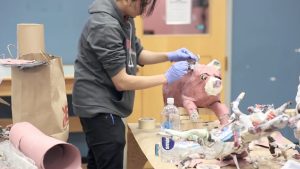
- Makerspaces: Many academic and public libraries are transitioning their spaces from wall-to-wall bookshelves to community areas and makerspaces. Stephens (2016) notes this shift and how information professionals must evolve as well. The Chicago Public Library (2018) is a great example of dedicating an entire floor to creativity and innovation. The space encourages explorative learning with a variety of technologies and equipment without barriers of cost. Many of these types of spaces are including emerging technology librarians and specialists in different equipment for education and programming.
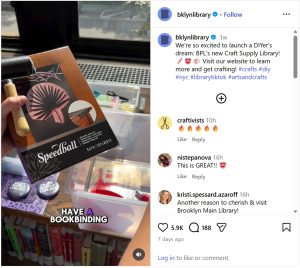
- Art Supply Collections: Libraries circulating supplies and equipment is a growingly common practice, with items like music instruments to cookware and bakeware to hiking tools, and so much more. Arts and craft equipment are occasionally sprinkled into these collections, but these are public library offerings, meaning the focus is usually to provide a variety of items to fulfill the needs of a general population. The Brooklyn Public Library (2026) recently launched a craft supply library where patrons can check out a variety of art supplies and equipment. This was announced on Instagram and received over 5,000 likes and most, if not all, the comments are positive with excitement to use them. Its success is further proven when browsing this new collection; the majority of items have a waitlist with five or more holds—some with over 20 (Brooklyn Public Library, n.d.).
- Artist Residencies: Some public libraries support artists by providing them access to space to create, educate, and exhibit; artists working in unconventional settings is not new and present potential for “fostering creativity, community engagement, and interdisciplinary collaborations” (Klotz, 2025). The Seattle Public Library (n.d.) hosts onsite artist residencies that celebrate local creative practitioners and prioritize inclusivity. They currently have four artists in residence, each with a different focus and perspective.
More Ways to Support Artists
- Dedicated Art Branches: Starting with my most idealistic—specialized library branches exist in some systems, but they are not yet the norm. O’Brien (2019) describes San Francisco Public Library’s integration of a teen-centered space in the main branch. Teens were part of the conversation, consulted about library decisions that directly involved them. I would like to expand this to the branch level, where community members, particularly artists, can discuss with leadership and architects about a dedicated art space and how it should look. It will be open to everyone, but the opinions of practicing artists is key in understanding what is needed in a space that prioritizes artistic research.
- Preservation Labs: Stephens (2016) discusses the value of increased access to community documentation and co-curation with patrons (80), and I believe this is also possible for the arts. Libraries can create multi-purpose preservation labs and highlight all the potential uses for them, not just for personal/family histories. Artists often fail to document their works since their focus is on art creation, so this would introduce an opportunity for workshops on art documentation and preservation.
- Expansive Workshops: Art programs are typically limited in depth and continuity, only offered as one to two-session introductory workshops or recurring programs without an artistic research framework (seeking information, experimentation, and critical reflection). Common programs in the visual arts may include paint and sips, mandala coloring, and simple paper or jewelry crafts. Patrons seeking longer series and advanced curricula are often limited to paid courses and self-learning. Public libraries should incorporate longer series that value the artistic process. If a library is limited to singular sessions, there should be options that vary in content; alongside simpler art programs, there can be studio critiques, costumed figure drawing, intensive art workshops, and more.
Personal Goals
I currently work in an art branch of a public library that supports artistic research and practice through a specialized collection; collaborations with local artists and organizations; literary and visual arts programming; and ongoing exhibitions throughout the year. Each staff member has a background in different arts disciplines, introducing new ideas for programs and services the space can offer and how it could be achieved. Our branch team invites participation from artists and patrons curious about the arts through explorative artmaking. I tried searching for libraries with similar art-specialized branches and they are hard to find! Art centers would mostly show up, which seems the closest in line.
One of my goals by the end of the year is to develop a zine collection that is reflective of the diverse community we serve and supports local DIY culture. We have previously held zine workshops and zinesters have shared interest in this project as well. Fortunately, there are various examples new zine librarians can reference from, the Los Angeles Public Library (n.d.)’s being one of my favorites. Alongside the physical collections, they partnered with BiblioBoard to showcase a free, open access digital zine collection. One of our new coworkers is also interested in zines and conventions/festivals, planning to host a small one in our branch after recognizing a gap in events for this demographic in our community. Since these are occurring simultaneously, the event will also serve as a zine collection launch party.
References
Brooklyn Public Library [@/bklynlibrary]. (10 September, 2026). We’re so excited to launch a DIYer’s dream: BPL’s new craft supply library! 🖌️🤩🎨 Visit our website to learn more and (video reel). Instagram. https://www.instagram.com/reel/DdHN07sh9Jk/
Brooklyn Public Library. (n.d.). Craft supplies [library catalog search]. Retrieved on September 13, 2026, from https://discover.bklynlibrary.org/?catalog=true&search=craft+supplies&materialtype=Craft+Supplies
Chicago Public Library. (2018, April 11). YOUmedia at CPL (video). YouTube. https://www.youtube.com/watch?v=v8G4nnlgKmk&t=87s
Cotter, L. (2024). Artistic research in a world on fire. In Cotter, L. (Ed.), Reclaiming artistic research: Expanded second edition (pp. 6-27). Hatje Cantz Verlag.
Duncan, C. (2017). Metaliteracies, creative practitioners and art libraries: a critical review of the literature. Art Libraries Journal, 42(2), 66-72. doi:https://doi.org/10.1017/alj.2017.5
Klotz, J. M. (2025). Promoting creativity in libraries: consider the artist residency. College & Research Libraries News, 86(1), 29. doi:https://doi.org/10.5860/crln.86.1.29
Kolyvas, S. & Kostagiolas, P. (2024). Information needs and information-seeking behavior of visual artists: a systematic review of the literature. Library Management, 45(1/2), 46-70. https://doi.org/10.1108/LM-10-2023-0110
Los Angeles Public Library. (n.d.). Zine library. https://www.lapl.org/zine-library
Mason, H. & Robinson, L. (2011). The information-related behaviour of emerging artists and designers: inspiration and guidance for new practitioners. Journal of Documentation, 67(1), 159-180. doi:https://doi.org/10.1108/00220411111105498
O’Brien, C. (2019, June 24). How San Francisco libraries are embracing their changing role. Shareable. https://www.shareable.net/how-san-francisco-public-libraries-are-embracing-their-changing-role/
Montclair Public Library. (n.d.). Library of things. https://montclairlibrary.org/borrow/things/
Houston Public Library. (n.d.). Library of things. https://houstonlibrary.org/library-of-things
Santa Clara City Library. (n.d.). Hiking Collection. https://www.sclibrary.org/books-more/library-of-things/hiking-collection
Stephens, M. (2016). “Age of participation” in The heart of librarianship, 79-82. ALA Editions.
Stephens, M. (2016). “Stuck in the past” in The heart of librarianship, 54-57. ALA Editions.
Seattle Public Library. (n.d.). Artist in residence program. https://www.spl.org/programs-and-services/arts-and-culture/artist-in-residence
One response to “Assignment X: Libraries are for Artists”
@damien Hello, love you are representing the artists! We ran an all-ages alternative a community based all-ages art gallery, performance space, and information center, in Echo Park during the mid-late oughties, called Echo Curio. My concern is how the introduction of alternative culture and its penchant for substance abuse would fit in a library setting and how thoise inevitable issues could be mitigated — not that I haven’t seen people snorting crushed pills in the children’s section of an LAPL branch, maybe then mitigation is toleration. I closed every event at our venue with Joy Division’s “Day of the Lords.” I am an undercover goth.