Hyperlinked Communities
Module 5, Hyperlinked Communities, demonstrates various engagement strategies that libraries can employ to support the public; foster equality, diversity, and inclusion; and encourage joy. Examples include alternative delivery service methods (Warner, 2024), programs on health and wellbeing (Greenwood, 2022), and inviting, inquisitive connections (DuVernay, 2024). I enjoyed learning the different ways libraries build community connections, using technology to expand outreach and services physically and virtually.
The purpose of this blog post is to explore community artmaking through a hyperlinked framework where creativity and reflection go beyond brick-and-mortar structures. I will examine three existing traveling art museums and how they support their communities with inclusive exhibitions, arts and cultural programming, and a welcoming environment.
Visual Art Hitting the Road
Laurersen (2025) shares an ode to bookmobiles, highlighting their necessity and value to areas with book deserts and few opportunities for education and cultural engagement. Similarly, access to the arts is limited for many communities, with some even lacking museums and galleries entirely. Art education equips learners with a better understanding of various literacies (visual literacy, object literacy, digital literacy, etc.); different cultures and life experiences; creative thinking and critical reflection; and so much more. Stephens (2025) shares how libraries can build connections and community, including “connecting around purpose, people, or possibility,” “leading with story” and “letting the mission shape your medium.” Art museums and galleries should also prioritize the public in these ways; art information centers need to evaluate whether they truly serve the interests of the public and must develop tools to connect with everyone, not just a select few. With that in mind, some art museums have extended beyond their buildings, sharing the power of visual art on the road!
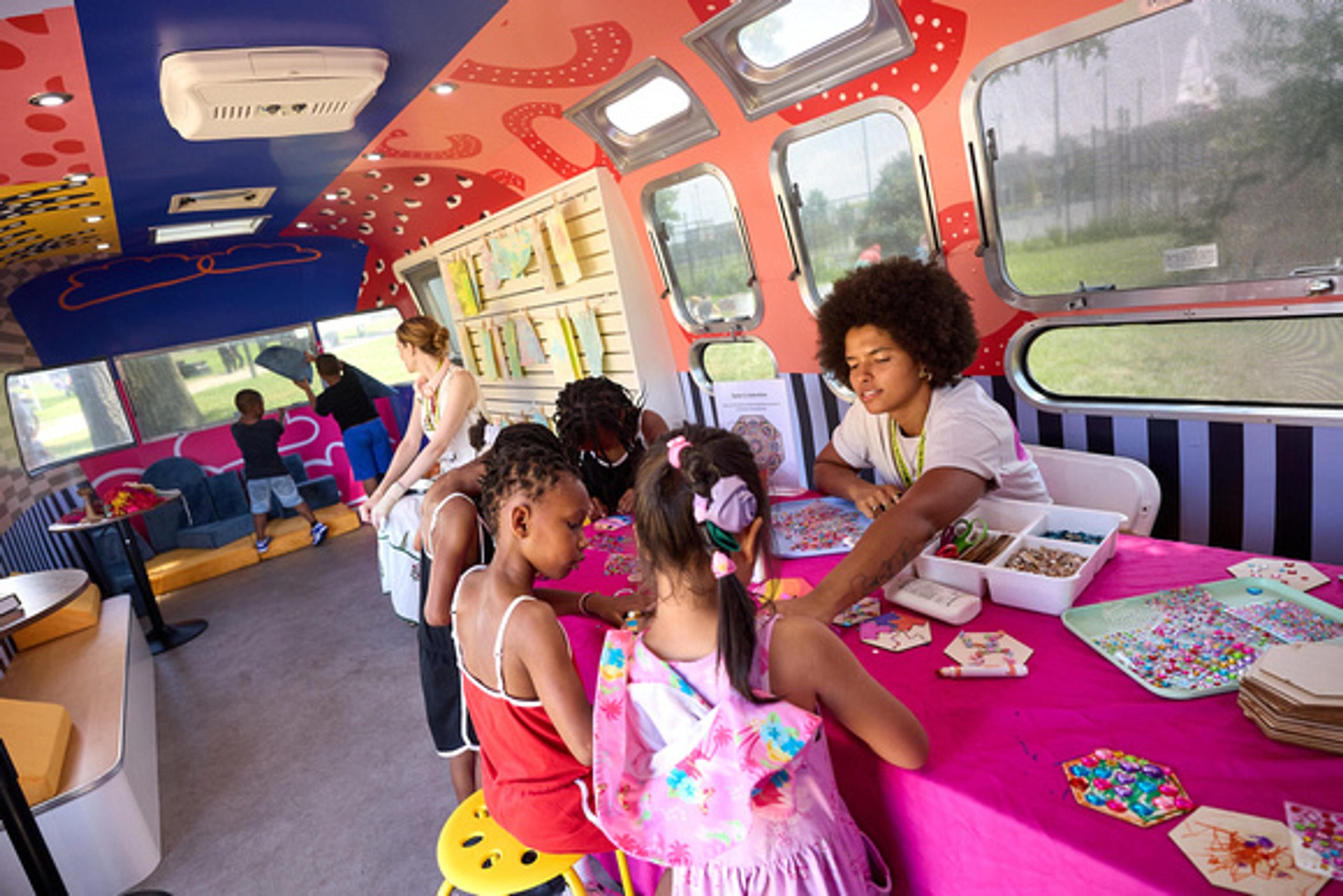
Brooklyn Museum’s Museum on Wheels (n.d.) is a notable example that meets people where they are at, offering interactive, educational art and cultural experiences at various community partner sites throughout the borough. This traveling art space expands accessibility and inclusivity to local residents who may not typically visit traditional museum settings, expanding experiential learning to a wider audience. Furthermore, their tactile approach to education enhances the experience for learners with different sensory needs.
The Citi-CSMVS Museum on Wheels is an outreach initiative in India founded in 2015, offering informative and interactive exhibitions to youth in Mumbai and remote districts in Maharashtra (CSMVS, 2020). Exhibitions and activities are free of charge, and there is an assortment of exhibition themes educators can select from to curate the experience for students (Chhatrapati Shivaji Maharaj Vastu Sangrahalaya, n.d.).
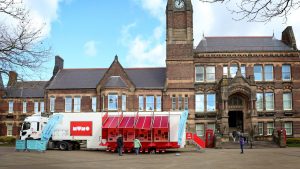
The Art Explora UK Mobile Museum (n.d.) addresses “the social, economic, and geographic barriers that prevent many people from participating in the arts” and began this initiative in 2023. This traveling museum displays works from national collections and offers educational art workshops to visitors. Compared to the former two, this one appears much larger in scale, capable of carrying larger works and bringing more attendees through the space.
Personal Reflection
Visual art carries a unique perception among the public. It is either considered a “children’s activity” that should be abandoned as one grows up, or it is a gatekept pursuit that only the elite can acquire financial success from. Art museums and galleries help support the latter notion as they are—like many entities—historical institutions that uphold white supremacy and colonialism, the British Museum being a major example (Vox, 2020). Many of these spaces steal art objects from other cultures, while charging high dollar to view said works. There are also occasions when people stumble into the world of visual art without realizing, yet the people who uphold these classist divides try to exclude them. Moses’ (2006) documentary, Who the #$&% Is Jackson Pollock?, explores this concept by following an art world outsider’s challenges in authenticating a piece that may be a Jackson Pollock painting.
Art museums have a long way to go in shifting this narrative, but many are building towards accessibility and inclusivity with initiatives like these. They are incorporating more interactive and engaging programs, offering free days to visit, and finding more ways to bring the museum to the people. In seeing the number of ways that public libraries invest in the joy and wellness of their community, I can see how these possibilities can also be implemented in art museums, with a simple change in core themes.
References
Art Explora (n.d.). The Art Explora Mobile Museum in the United Kingdom. https://www.artexplora.org/en/mobile-museum-uk
Brooklyn Museum (n.d.). Museum on Wheels. https://www.brooklynmuseum.org/community-partners/museum-wheels
Chhatrapati Shivaji Maharaj Vastu Sangrahalaya (n.d.). Museum on Wheels. https://www.csmvs.in/museum-on-wheels.html
CSMVS (2020, February 14). Introducing the Citi-CSMVS Museum on Wheels bus 2 (video). YouTube. https://www.youtube.com/watch?v=7mG9j55WFGQ&t=98s
DuVernay, J. (2024, June 12). There is joy for all: Tips for joyous library programming. Programming Librarian. https://programminglibrarian.org/articles/there-joy-all-tips-joyous-library programming
Greenwood, C. (2022). Healthy library, healthy life. inCITE: Magazine of the Australian Library and Information Association, 43(6), 24.
Laurersen, C. (2025, February 5). The necessary nearness — an ode to bookmobiles [blog post]. The Library Lab. https://christianlauersen.net/2025/02/05/the-necessary-nearness-and-ode-to-bookmobiles/
Moses, H. (2006, November 9). Who the #$&% Is Jackson Pollock? [film]. Picturehouse.
Stephens, M. (2025). Beyond buzzwords: Ten invitations to build library connection and community. https://www.dropbox.com/scl/fi/f05u6l0d50k8js28vgokz/Beyond-Buzzwords-Ten-Invitations-to-Build-Library-Connection-and-Community.pdf?rlkey=2i1b76g18h9t2qxmq3s1y7q90&st=of4tisuf&e=3&dl=0
Vox (2020, August 5). The British Museum is full of stolen artifacts.
Warner, L. (2024, January 17). Revolutionizing public libraries: Three ways that alternative service delivery strategies can meet the challenges of a booming population. Medium. https://medium.com/@lauracwarner/revolutionizing-public-libraries-ff7fed3d12c5
One response to “Hyperlinked Communities: Visual Art Hitting the Road”
Thanks for sharing this post! There is something truly charming and irreverent about a bookmobile, and I love how this method for community engagement is expanding into the arts. As an art history major, I was constantly encountering and experiencing art from an academic setting. Now that I am a parent, I have more appreciation for those who ensure that art — its creation and appreciation — more accessible and therefore more relevant for all.