At the end of April, my family and I had the pleasure of exploring a few places in Ireland, including the city of Limerick, which we adored. On a beautiful sunny day, we walked around People’s Park, and naturally my kids were drawn to the playground. In addition to the in-ground trampoline, something stood out to me—a board at children’s height covered in little pictures that could be used to indicate emotions, activities, and directions. I was intrigued and pointed it out to my family, but in the bustle of international travel, I quickly forgot about it. Then came our INFO 287 module on The Power of Stories and Kylie Carlson’s story about her sons’ autism and the ways in which the Yarra libraries are serving people like them (Library 2.0, 2020). Carlson showed a picture of a library communication board that they use for patrons who do not have speech or require more visual methods of communication.
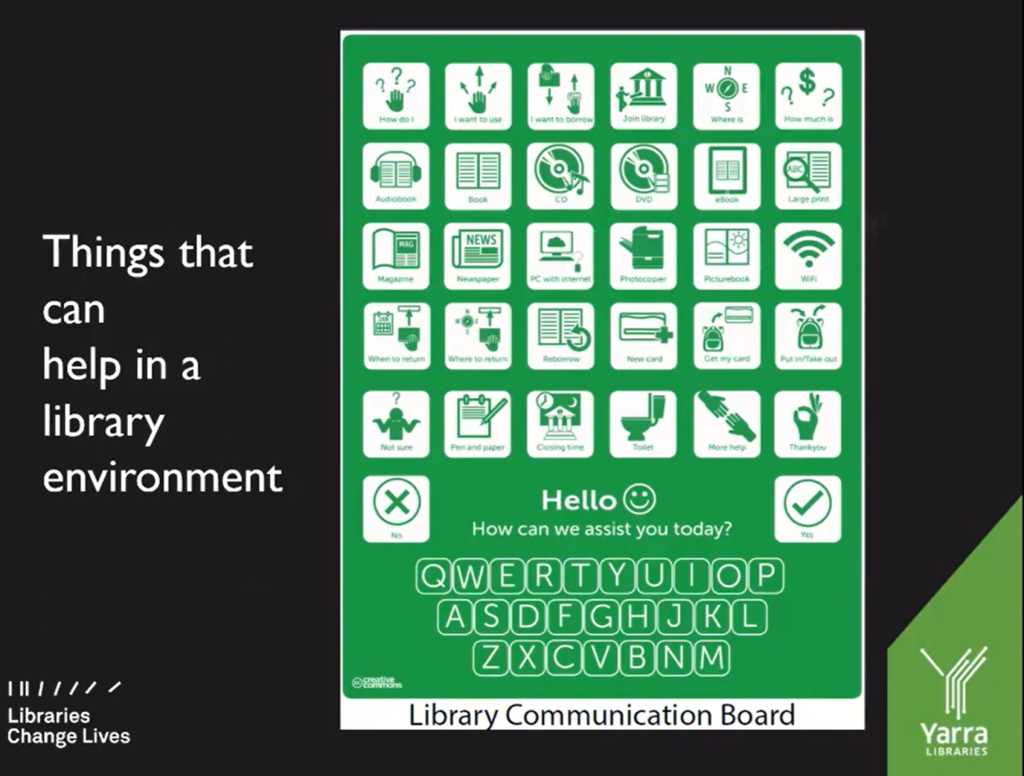
It turns out the communication board I saw in Limerick was one way that the People’s Park playground was designed to be inclusive and accessible to all children. Opened in 2023, it also features the aforementioned trampoline as well as a “fully accessible roundabout… and sand digger, while other equipment is thoughtfully designed for accessibility through transfers” (Lynch, 2023). The playground was designed “to provide children of all abilities and ages with an environment that fosters inclusive play, accessibility, and boundless imagination” (Lynch, 2023). These are all goals that this course has been emphasizing for our libraries, and I love visual communication boards as a symbol of how these ideals have been instituted in some libraries.
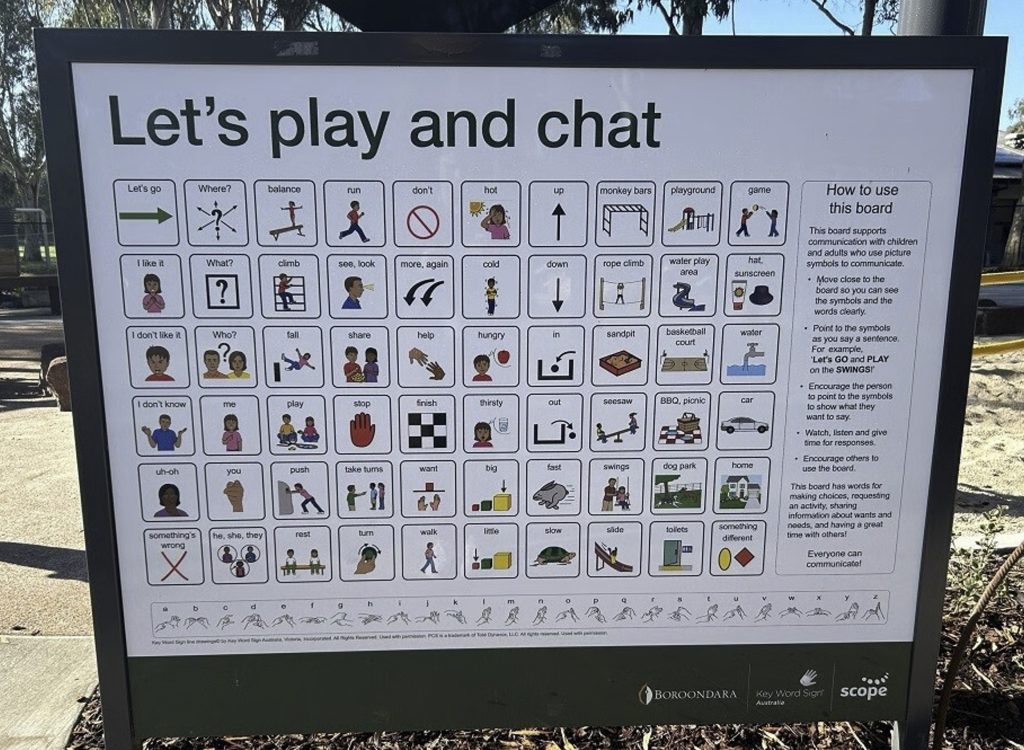
Communication board created by Scope Disability Services for Hays Paddock Playground in Boroondara, Australia, that includes instructions for how people can use the board. https://www.scopeaust.org.au/business-solutions/park-and-playground-communication-boards
As one Missouri Parks and Recreation department put it, the presence of these boards “ensures that every child has an opportunity to communicate and engage with their surroundings” while also promoting public awareness of communication barriers and encouraging learning for everyone (JC Parks, n.d.). I appreciate this approach because storytelling and story keeping are our superpowers as library professionals, but making sure that everyone is able to tell their story in their own manner is a challenge that we must continually address.
In this video, teachers from the Sumner-Bonney Lake School District in Washington talk about the communication boards and how they facilitate students’ expression of their needs on the playground. Larisa Sanchez, a speech and language pathologist, puts it this way: “everybody needs a little bit of help—you and I can get frustrated and have trouble finding our words, which I do very often, and if I had a visual of it, it’d be really helpful.” These board are such a simple way to make storytelling more accessible, and it makes me wonder—what are some other ways we can make it as easy as possible in our libraries to help our patrons tell their stories?
References
Emerald Hills Elementary School. (2025, March 30). Playground communication boards help students find a voice. https://ehe.sumnersd.org/our-school/our-school/ehe-news-details/~board/sblsd-stories/post/playground-communication-boards-help-students-find-a-voice
JC Parks. (n.d.) Enhancing play through communication boards. City of Jefferson (Missouri) Department of Parks & Recreation & Forestry. https://www.jcparks.com/inclusive-play-communication-boards/
Library 2.0. (2020, March 11). The power of stories [Video]. YouTube. https://www.youtube.com/watch?v=dvZlTRTVX10&t=617s
Lynch, Richard. (2023, September 5). Limerick City’s first fully-inclusive playground has been unveiled at the People’s Park. ILoveLimerick.com. https://www.ilovelimerick.ie/peoples-park-fully-inclusive-playground/
Sumner-Bonney Lake School Distict. (2025, March 19). Playground boards help students find a voice [Video]. YouTube. https://www.youtube.com/watch?v=DFlR-sTthak&t=66s
Great post, Laura! I have not seen these communication boards before. What an amazing way to ensure inclusion for those who may have trouble communicating. It also serves as a reminder to us as library professionals when dealing with the public or our students that communication needs and challenges vary from person to person. Something to keep mindful about! Thank you for sharing!