With library funding in the United States under continual threat, ALA President Sam Helmick warned that the public and library professionals should not underestimate the lengths that the current administration will go to undercut library funding and support (ALA, 2026). I was craving some inspiration this week, so I decided to explore the international libraries in this module. The Dokk1 Library in Aarhus, Denmark certainly delivers inspiration in spades. This library demonstrates what can be created when a city and its partners invest in meeting the evolving needs of their community. The $305 million project, which took 10 years to complete. Reenvisioned the library as both a cultural center and gathering space (Morehart, 2016). While this library is particularly striking, what stands out to me are the philosophies that guide Denmark’s public libraries.
Through a study that aimed to understand the true value of Danish public libraries, Seismonaut (a Danish innovation consultancy) and Roskilde Central Library developed a tool called the Impact Compass (Lauersen, 2021). I found this effort to shift the language around library success from quantitative measures to more qualitative impacts particularly compelling, especially as libraries expand their services and move beyond being purely book-based. The Impact Compass is explained as a tool to help guide conversations with stakeholders and administrations and a tool to help guide library programs and initiatives (Seismonaut & Roskilde Central Library, 2021). While in the past intellectual impacts may be the first thought that comes to mind when considering the value created by public libraries, the Impact Compass considers the emotional, social, and creative impacts as well. This reflects a culture that values the human needs through togetherness, emotional well-being, imagination, and shared knowledge (Seismonaut & Roskilde Central Library, 2021).
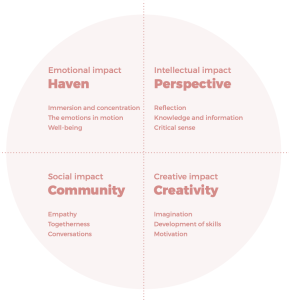
Image from: Seismonaut & Roskilde Central Library. (2021, March). A guide to the Impact Compass – The impact of public libraries in Denmark: A haven in our community. Page 6.
Dokk1 in Aarhus, Denmark is an amazing example of these philosophies in action. It was designed not just for library collections, but for the people it serves. The project manager, Marie Østergård, describes creating a “more liveable city” as one of the goals of Dokk1 (Public Libraries 2030, 2015). This human-centered mindset is evident in the building’s variety of spaces for library collections, meeting and gathering rooms, art and performance areas, playgrounds and more. One art installation that truly encapsulates the philosophy of connection is the Gong that parents at a local hospital can ring remotely to welcome their newborn into the community (Quito, 2022). While each feature is exciting on its own, together they form a clear picture of the values of the community the library serves. Dokk1 demonstrates what is possible when a community views its library not as an expense, but as an investment in its future.
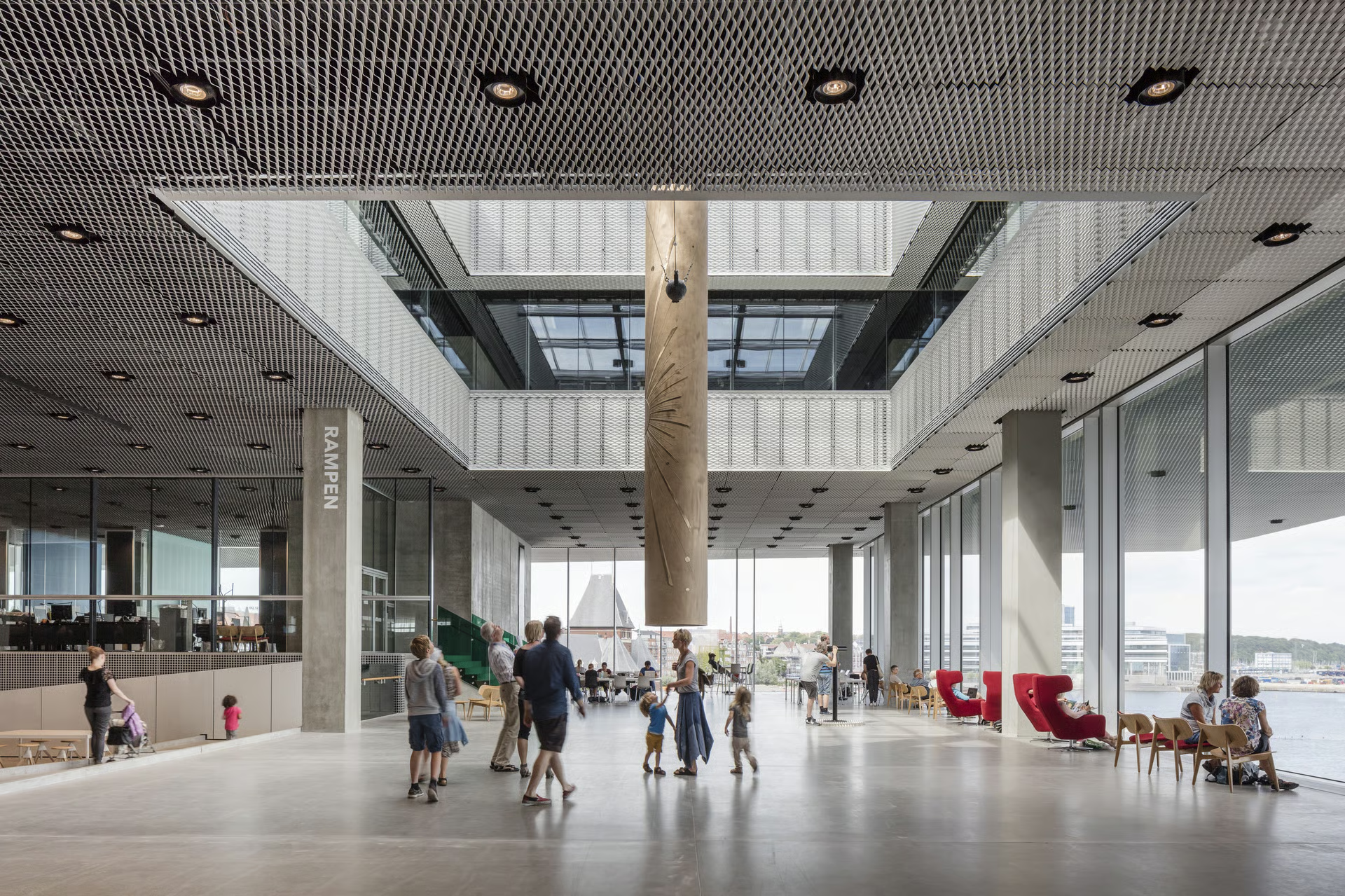
Image from: Quito, A. (2022, July 21). Denmark’s futuristic “citizen space” has been named the world’s best public library. Quartz.
Studying libraries in other countries reminds me of the expansive possibilities in public librarianship. Although the small library I work at could never replicate a $305 million facility, it can take inspiration from Dokk1 and the Impact Compass. As technology continues to change the footprint of the physical collection, we should be considering how the space we do have can be used more functionally and flexibly. Libraries can adopt a human-centered mindset that welcomes the whole person and fits into their lives and aspirations. Fostering community partnerships with other organizations can allow even small libraries to expand their reach to get resources to communities that need them most. I especially like the idea of regularly reviewing library services and programs through the categories of the Impact Compass as a means of gauging how well we’re serving our patrons and allocating energy to areas that need it. While the scale may differ, the underlying philosophy is one I hope to carry into my own career.
References
American Library Association. (2026, April 3). White House FY27 budget proposal repeats threats to eliminate IMLS. https://www.ala.org/news/2026/04/white-house-fy27-budget-proposal-repeats-threats-eliminate-imls
Lauersen, C. (2021, April 19). A haven in our community: The impact and value of public libraries. The Library Lab. https://christianlauersen.net/2021/04/19/a-haven-in-our-community-the-impact-and-value-of-public-libraries/
Morehart, P. (2016, August 17). Moving beyond the “Third Place” – IFLA forum examines library designs that embrace the community. American Libraries. https://americanlibrariesmagazine.org/blogs/the-scoop/library-design-moving-beyond-third-place/
Public Libraries 2030. (2015, April 27). PL2020 Tour – Denmark – A knowledge hub for the community [Video]. YouTube. https://www.youtube.com/watch?v=IvFfbjs8aZo
Quito, A. (2022, July 21). Denmark’s futuristic “citizen space” has been named the world’s best public library. Quartz. https://qz.com/760586/this-futuristic-citizen-space-in-denmark-was-named-the-worlds-best-public-library
Seismonaut & Roskilde Central Library. (2021, March). A guide to the Impact Compass – The impact of public libraries in Denmark: A haven in our community. https://287.hyperlib.sjsu.edu/wp-content/uploads/2022/03/en_brugsguide_06.05.21_0.pdf
Hi! This was a very uplifting post to read, I enjoyed learning about the Impact Compass. Like you said, libraries should be thinking about the people first. They were not designed to be neutral spaces, libraries are supposed to advocate for the people especially in underserved communities.
Hi @ abbietxo Thank you for the comment! I agree that libraries should advocate for underserved communities. Libraries should be for everyone, which doesn’t happen by accident. I think the Impact Compass helps give direction for how to design programs and library efforts. I find it very inspiring.
Jennifer – The initiatives coming out of Denmark, such as this and the Four Spaces model, etc., just give me so much inspiration and excitement about what libraries are doing. So glad you covered this.