The concept of the Hyperlinked Library and this course caught my attention because of my awareness of the cultural and technological shifts that libraries must adapt to. I was relieved to see the topics of transparency and organizational culture addressed in the lectures. I am currently navigating a work environment that exhibits some of the internal challenges that can slow progress. As hopeful as I am about the possibilities presented by the Hyperlinked Library model, I have come to understand how difficult it can be to maintain the enthusiasm and optimism needed to advocate for change within organizations that are resistant to it. Fortresses around roles, archaic rules, and a “something might happen” mentality not only lower staff morale but also seem to coexist with a lack of transparency that can hinder the experience offered to patrons. Understanding the role of organizational culture is imperative to making progress toward the participatory services engrained in the Hyperlinked Library model.
The cultural qualities that affect staff are the same ones that affect patrons. When there is a fear of change and an “we’ve always done it this way” mentality, staff members who are excited to share new ideas can quickly become discouraged. The stories in the “Historic” Hyperlinked Library Model lecture (Stephens, n.d.), in which two employees were described as feeling “crushed” by administrative feedback regarding their enthusiasm or approach to their work, particularly resonated with me. These anecdotes reflect a rigidity in hierarchy and rules that can squash staff spirit. The graphic below illustrates the impact of interpersonal fear and low psychological safety that can lead to apathy and anxiety among staff, while candor and environmental safety lead more positive outcomes and better experiences for both employees and organizations (Edmondson, 2022). Without embracing change and challenging outdated rules, how far can technology alone further a library’s mission?
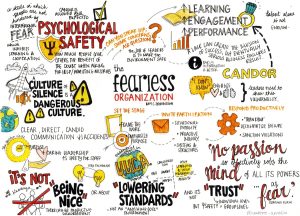
Image: Edmondson, A. [@AmyCEdmondson]. (2022, December 29). #PsychologicalSafety and my book The Fearless Organization beautifully brought to life by @ameliacrab [Graphic attached][Post]. X. https://x.com/AmyCEdmondson/status/1608475876118642690
I have witnessed and experienced these crushing experiences in a library setting and understand how they can have lasting effects on staff members. They can lead employees to keep promising ideas to themselves in anticipation that they will be unwelcomed. As Casey and Stephens explain, unnecessary roadblocks can “suck every bit of life from the inspiration” (2007, para. 3). Sadly, these barriers can stop ideas that might benefit the community from ever being seriously considered or even shared.
Scott County Library’s adoption of the Open+ system is an example of a library implementing a service that many in the field might consider intimidating or even inconceivable (Zulkey, 2019). It particularly stood out to me after an experience in which I asked to make an exception that would allow parents with overstimulated children at a library event early access to the children’s area, which is not always staffed even when open to patrons. Understanding that staff would not be available in that room for another half hour, I felt those families could still benefit from a quiet space and an alternative option for children for whom the event was not working out. The request was denied quickly without much consideration. The quick “no” that often occurs internally became a quick “no” that created a barrier to patrons’ access to library resources. Rather than waiting for the space to open, some of those families chose to leave the library empty-handed. Reading about the Open+ system, which allows patrons access to the building even when it is unstaffed, gave me hope for what the future of library service could look like.
Positive organizational culture and radical trust in the communities we serve are the foundations libraries need to remain responsive and embrace participatory services. When rigid hierarchies and egos dominate a library, not only do staff members suffer, but so do the communities we serve (Casey & Stephens, 2008). Examples such as Open+ demonstrate what is possible when libraries are willing to trust their communities and reconsider long-standing assumptions about access and service. If libraries are to be truly hyperlinked, innovation must involve not only new technologies, but also the courage to embrace change and foster collaboration with our teams and communities alike. Adopting new technologies can only take services so far if we are unwilling to cultivate the change, transparency and trust needed to fully realize the potential of the Hyperlinked Library model.
References
Edmondson, A. [@AmyCEdmondson]. (2022, December 29). #PsychologicalSafety and my book The Fearless Organization beautifully brought to life by @ameliacrab [Graphic attached][Post]. X. https://x.com/AmyCEdmondson/status/1608475876118642690
Casey, M., & Stephens, M. (2007, May 1). Turning “no” into “yes”. Tame the Web. https://tametheweb.com/2007/05/01/turning-no-into-yes/
Casey, M., & Stephens, M. (2008, July 1). Check your ego at the door. Tame the Web. https://tametheweb.com/2008/07/01/check-your-ego-at-the-door/
Stephens, M. (n.d.). “Historic” Hyperlinked Library model [lecture]. Panopto. https://sjsu-ischool.hosted.panopto.com/Panopto/Pages/Viewer.aspx?id=a0569381-4d66-4e0a-a7fa-aab3010a8f3e
Zulkey, C. (2019, September 3). Automatic for the people: Are self-service libraries a threat to the profession or an opportunity to better serve patrons? American Libraries. https://americanlibrariesmagazine.org/2019/09/03/automatic-people-self-service-libraries/