Visiting museums is one of my favorite pastimes, especially when I travel. It’s been fascinating to witness the evolution of technology integration in museums during my twenty-ish years of consciousness. I was privileged to grow up near the Discovery Cube in Santa Ana, which demonstrated to me early on the effectiveness of learning through interaction. I first visited The Broad in Los Angeles in high school and marveled at the starkly different experience a modern art museum could offer versus a traditional one. The Broad encouraged absorbing art through more than just the visual sense and making your own interpretation of the art. Additionally, I’ve watched art museums evolve from renting out MP3 players as audio guides, to advertising their app or a QR code to their website for patrons to access audio guides on their own devices.
My most recent immersive museum experience was the teamLAB Borderless museum in Tokyo, Japan. We were instructed to take our shoes and socks off and leave them in lockers prior to entering the museum. You move through the exhibits linearly. They included a room made of black, parachute-like fabric, a mirrored room with fake flowers that moved up and down based on your movement, and a knee-tall pool with projections of interactive koi fish on the surface. People had their phones out recording the experience the whole time. The videos I have are too large to attach, so here is a link to a Google Drive folder. It was certainly a unique experience, but I found it sensorily overwhelming as an autist. Still, I’m glad I went.

I’ve been delighted to see some museums build a strong presence on social media in recent years. Whether it’s frequent posts of their exhibits or funny videos of senior docents reading a script written by Gen Z interns, more and more, museums are making their mark on social media. It’s proven to be an effective strategy to draw in visitors for such popular museums as the Los Angeles County Museum of Art, The Broad, and even The Metropolitan Museum of Art (Daily Bruin Staff, 2016; Titlow, 2016). I believe that museums that embrace technology will survive our brutal attention economy while ones that reject it will eventually crumble due to lack of relevance, attendance, and funding.
Since the late 2010s, I’ve seen plenty of my friends on Instagram post profound photos of themselves looking at art, and I’ve done the same. To me, these types of posts have always projected a message of “I’m cool and intellectual”, and this belief is even backed up by psychological studies of the artistic personality (Chamorro-Premuzic, 2007). Even if it’s performative, I do think this Millennial/Gen Z association of museums with good taste has and will continue to contribute towards museum attendance. Ultimately, social media is all about curating your image, for both patrons and museums.

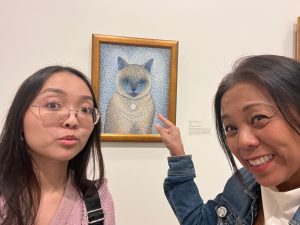
While museum curators have mixed feelings about sharing images of their collections online, I share The Met’s perspective that increasing accessibility is an ultimate good (Charr, 2020). After all, the mission of museums is to share knowledge and creativity (Charr, 2020). Personally I’ve always perceived a distinction between seeing an image of a piece online and seeing it in person. In person, you’re able to appreciate the dimensions and texture of the piece. It’s an experience rather than a still image to swipe through. I imagine that most people feel the same as me, but I don’t have any evidence to back up that belief.
I wish I knew about The Met’s mobile-friendly website and app before visiting back in 2018. I personally found The Met quite overwhelming and not enjoyable. Since that experience, when visiting a large museum I check their website first and find a few pieces I really want to see so that I have a focus. Before visiting a modern or smaller museum, I check their website to see what exhibits are currently on display to see if I’m interested in them. I see now that the increased accessibility of museums has had a positive impact on my museum-going experience.
Based on all these revelations, I believe that the growing integration of technology with museums is a positive change. People, especially younger generations, want to have experiences. The more curators are able to convince the public that museums are an experience rather than a warehouse for irrelevant artifacts, the better their chances of survival.
References
Chamorro-Premuzic, T., Furnham, A., Reimers, S. (2007, February 4). Personality and art. The British Psychological Society. https://www.bps.org.uk/psychologist/personality-and-art
Charr, M. (2020, June 17). How technology is bringing museums back to life. MuseumNext. https://www.museumnext.com/article/how-technology-is-bringing-museums-back-to-life/
Daily Bruin Staff. (2016, January 20). The impact of social media, art. Daily Bruin. https://dailybruin.com/2016/01/20/the-impact-of-social-media-on-museums-art
Titlow, J. P. (2016, February 29). How a 145-year-old art museum stays relevant in the smartphone age. Fast Company. https://www.fastcompany.com/3057236/how-a-145-year-old-art-museum-stays-relevant-in-the-smartphone-age
@isthebel I so appreciate this post. I watched all three of the videos. Very cool. I am a huge fan of museums of all kinds. And I love to see outside of the proverbial box thinking in the museum space. I remember an installation, I want to say it was in Denmark, that was a huge dark room with multiple multiple twin beds everywhere and you were invited to take off your shoes and lay down in bed and look up at the ceiling where visuals were being projected. It was fascinating. I visited the Louvre in 2014. And it was wonderful, but so crowded. And to see the Mona Lisa was like an obstacle course to get to the front for even a glimpse. I just saw a video recently of how well they’ve improved the Mona Lisa experience.
Thanks so much! I’m glad you enjoyed the videos. That museum in Denmark sounds very interesting. I still haven’t been to the Louvre but I definitely want to go one day. I hate crowds so trying to see the Mona Lisa in particular has intimidated me, but I’m glad to hear they’ve improved the experience recently. There’s a lot more pieces I want to see there, in particular sculptures.
@isthebel I am not a fan of crowds at all!
Hi Isabel, I enjoyed reading your post. As a former art museum worker, I laughed at your thoughts on “profound” museum photos. Trust that we loved all visitor photos ranging from silly to profound. Engaging audiences with art can happen online or IRL so I think social media and digital presence is as important as the exhibitions themselves. Some people will never visit the building but may still learn about an artist or artwork through the museum’s communications efforts. One of the museums I worked at once made a really silly video with Will Ferrell and Joel McHale if you’d like to watch: https://youtu.be/E7VOmgzG520?si=9drprag2CCbXaRpM