Click this link to access my report on Canva!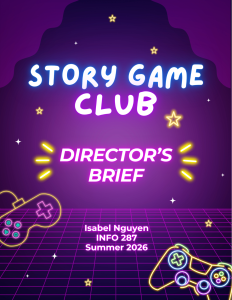
New Models: Video Games Are Not the Villain
As a gamer, the article “Video games and literacy” from the New Models module caught my eye right away. Like many people, when I hear the word “literacy” I immediately think of books and words written on a whiteboard, but literacy is much more than that. As defined by the United Kingdom’s National Literacy Trust, literacy is “the ability to read, write, speak and listen in a way that lets us communicate effectively and make sense of the world”. In other words, literacy is more than reading and writing; it’s about understanding. Knowing this, the connection between video games and literacy becomes more clear. Video games can help us make sense of the world not only through text but through storytelling and social interaction (National Literacy Trust, 2020). I am glad to hear from the National Literacy Trust (2020) that video games have a positive impact on the literacy, creative, social and mental skills of children.
When reading the findings on social and emotional development, I thought back to my own childhood. Like the children in the study, video games helped foster important social connections between myself and friends and family (National Literacy Trust, 2020). Playing video games like Spyro and Uncharted with my dad and sister was one major way I spent time with them. I also deeply bonded with friends over Pokémon and Super Smash Bros. I have core memories of sitting in a circle with my friends all playing on our Nintendo DS’s.
I’ve long advocated that video games should be considered a storytelling medium the same way books, movies and TV shows are. They’ve come a long way from their origin of two rectangles bouncing a ball between them (Pong, if that wasn’t clear). Modern video games are a uniquely immersive storytelling experience because the player has a direct impact on what happens. I believe that they are one of the best mediums to foster empathy in people. This is supported by the National Literacy Trust’s (2020) finding that 2 in 3 young people say video games help them imagine being someone else.
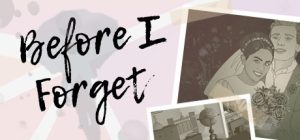
As part of a video game writing class, I was assigned to play a short game called Before I Forget. The player character has dementia and explores their house trying to piece their life together. Most areas are black and white and will fill in with color as the player recalls memories. I highly recommend it even though it is a difficult emotional experience. The interactivity of video games pulls players into the story so they often feel personal investment they may not get from other media forms.
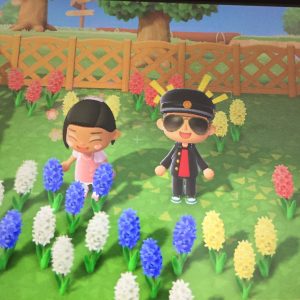
Finally, I related to the finding that supported young people’s well-being, especially during the COVID-19 lockdown (National Literacy Trust, 2020). Video games have been an escape for me throughout my life, but they were especially helpful during lockdown. I played Animal Crossing: New Horizons with my sister every single day for the first few months. My mom enjoyed watching and hearing about our adventures. I also virtually traveled to faraway friends’ islands through Animal Crossing. I would certainly say Animal Crossing helped my mental health during lockdown.
Connecting back to the library, I think librarians can use these findings from the National Literacy Trust (2020) to leverage the power of video games to encourage literacy and more in the library. Librarians could create a Minecraft server for children to play on together. They could host an in-person Super Smash Bros. tournament. Another program could be similar to a book club where there is a narrative video game of the month to play separately then come together to discuss. The possibilities are endless.
References
National Literacy Trust. What is literacy? https://literacytrust.org.uk/information/what-is-literacy/
National Literacy Trust. (2020). Video game playing and literacy: a survey of young people aged 11 to 16. https://literacytrust.org.uk/research-services/research-reports/video-game-playing-and-literacy-survey-young-people-aged-11-16/
Innovation Roadmap: Minecraft in the Library!
Here is a link to my Google Slides presentation (only accessible to SJSU accounts), I could not get the embed to work.
Hyperlinked Environments: Cool People Go to Museums
Visiting museums is one of my favorite pastimes, especially when I travel. It’s been fascinating to witness the evolution of technology integration in museums during my twenty-ish years of consciousness. I was privileged to grow up near the Discovery Cube in Santa Ana, which demonstrated to me early on the effectiveness of learning through interaction. I first visited The Broad in Los Angeles in high school and marveled at the starkly different experience a modern art museum could offer versus a traditional one. The Broad encouraged absorbing art through more than just the visual sense and making your own interpretation of the art. Additionally, I’ve watched art museums evolve from renting out MP3 players as audio guides, to advertising their app or a QR code to their website for patrons to access audio guides on their own devices.
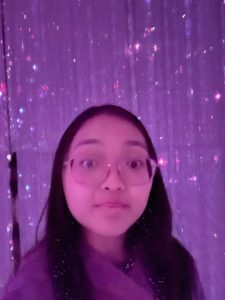
My most recent immersive museum experience was the teamLAB Borderless museum in Tokyo, Japan. We were instructed to take our shoes and socks off and leave them in lockers prior to entering the museum. You move through the exhibits linearly. They included a room made of black, parachute-like fabric, a mirrored room with fake flowers that moved up and down based on your movement, and a knee-tall pool with projections of interactive koi fish on the surface. People had their phones out recording the experience the whole time. The videos I have are too large to attach, so here is a link to a Google Drive folder. It was certainly a unique experience, but I found it sensorily overwhelming as an autist. Still, I’m glad I went.
I’ve been delighted to see some museums build a strong presence on social media in recent years. Whether it’s frequent posts of their exhibits or funny videos of senior docents reading a script written by Gen Z interns, more and more, museums are making their mark on social media. It’s proven to be an effective strategy to draw in visitors for such popular museums as the Los Angeles County Museum of Art, The Broad, and even The Metropolitan Museum of Art (Daily Bruin Staff, 2016; Titlow, 2016). I believe that museums that embrace technology will survive our brutal attention economy while ones that reject it will eventually crumble due to lack of relevance, attendance, and funding.
Since the late 2010s, I’ve seen plenty of my friends on Instagram post profound photos of themselves looking at art, and I’ve done the same. To me, these types of posts have always projected a message of “I’m cool and intellectual”, and this belief is even backed up by psychological studies of the artistic personality (Chamorro-Premuzic, 2007). Even if it’s performative, I do think this Millennial/Gen Z association of museums with good taste has and will continue to contribute towards museum attendance. Ultimately, social media is all about curating your image, for both patrons and museums.

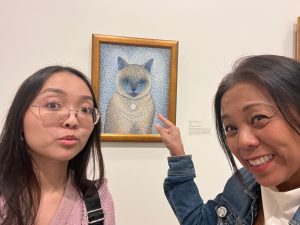
While museum curators have mixed feelings about sharing images of their collections online, I share The Met’s perspective that increasing accessibility is an ultimate good (Charr, 2020). After all, the mission of museums is to share knowledge and creativity (Charr, 2020). Personally I’ve always perceived a distinction between seeing an image of a piece online and seeing it in person. In person, you’re able to appreciate the dimensions and texture of the piece. It’s an experience rather than a still image to swipe through. I imagine that most people feel the same as me, but I don’t have any evidence to back up that belief.
I wish I knew about The Met’s mobile-friendly website and app before visiting back in 2018. I personally found The Met quite overwhelming and not enjoyable. Since that experience, when visiting a large museum I check their website first and find a few pieces I really want to see so that I have a focus. Before visiting a modern or smaller museum, I check their website to see what exhibits are currently on display to see if I’m interested in them. I see now that the increased accessibility of museums has had a positive impact on my museum-going experience.
Based on all these revelations, I believe that the growing integration of technology with museums is a positive change. People, especially younger generations, want to have experiences. The more curators are able to convince the public that museums are an experience rather than a warehouse for irrelevant artifacts, the better their chances of survival.
References
Chamorro-Premuzic, T., Furnham, A., Reimers, S. (2007, February 4). Personality and art. The British Psychological Society. https://www.bps.org.uk/psychologist/personality-and-art
Charr, M. (2020, June 17). How technology is bringing museums back to life. MuseumNext. https://www.museumnext.com/article/how-technology-is-bringing-museums-back-to-life/
Daily Bruin Staff. (2016, January 20). The impact of social media, art. Daily Bruin. https://dailybruin.com/2016/01/20/the-impact-of-social-media-on-museums-art
Titlow, J. P. (2016, February 29). How a 145-year-old art museum stays relevant in the smartphone age. Fast Company. https://www.fastcompany.com/3057236/how-a-145-year-old-art-museum-stays-relevant-in-the-smartphone-age
Hyperlinked Communities: Not-So-“Emerging” Technologies
In this module, I was particularly struck by the idea that technology is here and we need to treat it as such from Stephens’ (2019) “Libraries in Balance” passage from Wholehearted Librarianship (p. 79). I liked the assertion that digital skills are necessary, not optional, because they are. In order to function in human society now, one must have basic knowledge of how to use a computer, browser, email, applications like Adobe Acrobat, smartphones, social media, and more. This can be a hard wall to climb for digital immigrants, particularly those with mental or intellectual disabilities. Viewing digital skills as necessary can be beneficial for the learning mindset of both teachers (librarians) and students (patrons).
It is interesting to integrate my perspective as a Gen Z digital native because when I think of emerging technologies, I think of generative artificial intelligence, cryptocurrency, robots performing medical operations, and self-driving cars. In other words, I think of technology that humankind is still developing and exploring. Stephens (2019) mentions computers, smartphones and 3D printing as things that are considered “emerging technologies” to the average librarian (p. 80). Like Stephens (2019) says, thinking of the latter group of technologies as established and here to stay can help librarians and patrons accept that they need to learn how to use them (p. 79). Then we can start to approach the former group of technologies.
This passage has inspired me to potentially teach digital technology classes in my future library career. I’m on track to work in library marketing, so these classes would align with my domain. I can see myself enjoying teaching social media classes in particular. I’d want to teach both the practical sides of social media, like how to use the app, and the cultural sides of social media, like what the application is typically used for and the etiquette. Of course, I’d also like to teach about the mental health effects of social media use and learning how to set limits.
Many of my local libraries have bland social media pages made up of only event flyers and the occasional city council photo. This isn’t out of a lack of interest or desire, it’s due to a lack of budget and time. If marketing is part of my responsibilities as a future librarian, I would love to humanize the library by serving as its “face”. Also, I’d love to film fun skits or hop on social media trends like other libraries have. These types of videos can bring in audiences from within and outside the library’s community. I was so pleased when Reels from other libraries came onto my Instagram feed. I now follow libraries from all over the world simply for their creative social media posts.
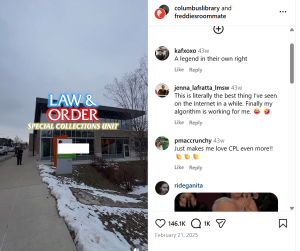
Here is a video from one of my favorite series from the Columbus Public Library. They parodize Law & Order while tracking down the culprits of damaged books. This video has over 100k likes! What a reach! (Embeds from Instagram do not seem to be allowed on this site, so please click the hyperlink to view)
References
Stephens, M. (2019). “Libraries in balance”. In Wholehearted Librarianship (pp. 78-80). ALA Editions.
Assignment X: Transform Like Ditto
- Why does this theme stand out to you?
For Assignment X, I chose to discuss the concept of the library as a startup (Mathews, 2012). This theme stood out to me because it is a model I had not yet considered for libraries. Throughout my time in the MLIS program, I have been warned that the library has undergone major changes with the digital age and rolling back of social services. Because much of the purpose of the MLIS program is to give students the foundational theories of library and information science, we don’t always get to discuss how to address these major changes. This is the first time I’ve been given a thought model to prepare myself and my library for the turbulent environment we’ll face.
- What are your initial reactions or questions? AND Can you connect it to your past experiences or future goals?
Honestly, my initial reaction to this article was “not again”. For context, I got my undergraduate degree in Business Administration and did not enjoy it for several reasons, including that I am not a very flexible person. I ruled out entrepreneurship as a career early on. I found that job postings frequently described their environments as “dynamic and fast-paced” and wanted potential applicants to match that. Business mentors will tell you that you don’t have to match 100% of the qualifications listed on the job posting and you can also “fake it ‘till you make it”, but neither of these approaches matched my internal sense of integrity.
When I decided to enter the MLIS program, I was aware of the changing role of the library, but I still hoped that it would provide a more stable environment than corporate. Reading the title and first few pages of this article gave me some dread for the potential volatility of my future career. However, as I got further into the article I saw how the thought model could be useful in my career. In fact, I realized how my background in business could help me more in my library career than I initially thought.
- How might this idea shape your perspective on libraries, learning, and community?
This idea has changed the way I think about libraries from a static institution to a constantly-evolving, amorphous, live entity. I hope this isn’t too informal, but I liken this new model of libraries to the Pokémon Ditto in the recent video game Pokémon Pokopia. Stay with me for a moment. In the game, Ditto works to rehabilitate environments so Pokémon can live in them once again. Along the way, it learns new skills and transformations from its friends but still holds onto the image of its beloved Trainer.
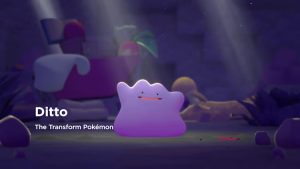

Modern libraries can be like Ditto too. Libraries can transform to serve many different purposes while still retaining their identity as institutions of information. Libraries will go through adversity, but they have their friends — in the form of patrons, supportive legislators, and more — to support them along the way. To paraphrase Mathews (2012), libraries and librarians cannot stick to what we’ve always done well; we have to look out for new opportunities to inform and support our communities (p. 2).
- Where do you see this theme showing up in practice?
I see this theme showing up in practice practically everyday at the library, but particularly during strategic meetings. During my short spring internship, I already observed some obsolescence in my library. The staff did have ideas and desires to change; what they lacked was time. They were too busy with upkeep of normal library functions like circulation and programming to implement new ideas like more social media activity. To extrapolate upon Mathews’ (2012) concept that the whole culture of a library needs to be open to change, I think the implementation of this culture needs to begin top-down (pp. 3-4). The executive suite needs to be convinced of the usefulness of the “library as a startup” model and the need to provide time and space for librarians to try out new ideas. The E-suite needs to be open to new ideas being brought up by staff members often. Then, the ideology can be spread among the staff and part of their time can go towards experimentation. I know that in practice it will not be this easy to instill the startup mentality, but I imagine myself starting in small ways whenever I have free time in my future jobs.
References
Mathews, B. (2012, April). Think like a startup. Facing the Future.
Introductory Post

Hi friends! My name is Isabel and I live in Orange County, CA. My area of interest in the LIS world has ended up being marketing and social media, much to my surprise. I liked learning about marketing strategies in my undergraduate degree, but I didn’t feel good using them for for-profit companies whose missions I didn’t believe in. Marketing for GLAMs or general non-profits has turned out to be the perfect match for me!
If I’m being honest, I chose this course because I’m afraid of how emerging technologies will affect libraries, especially generative AI. On one hand, I am a writer and proponent of the arts, so I don’t like the threat generative AI poses to creative artwork. as another thought, I am alarmed by the lack of critical thinking and original thought that has been emerging as a result of generative AI use. I personally know college students who use AI for all their assignments and people who turn to AI for decision-making before consulting other humans. My fears for library services are that people will prefer to turn to generative AI for their information needs, and that governments and other sponsors will try to replace library workers with artificial intelligence. I know I’ve only talked about AI thus far, but I am also interested in learning about other emerging technologies and their positive and negative effects on the library field. I’m probably most excited to discuss social media and its rising role in library marketing, as this applies to my career and I find social media fascinating in general.