What is the Idea?
Participatory service allows our communities to give us input about what they need. Transparency allows the library to show the community how we use that input. Both lead to new and exciting possibilities. Unfortunately, participatory service and transparency is sorely lacking in our system. Community members and the library are not in communication with each other. 
The library plans something whether that’s a program or event and then rolls it out. There is no dialog with community members, no surveys, nothing. How can we reach our mission statement and vision by not considering the needs of our community? The answer is we can’t. Let’s go ahead and tear down those walls. The idea is to make our relationship with our community participatory and transparent through a combination of a brand new program, improved outreaches, and creating a blog on our website.
- New Program – “Coffee with the Librarian” – once a month the community is invited to have coffee, donuts, and bagels with the County librarian and other community librarians. The program will start like a panel with librarians introducing themselves and sharing why they
 are there. Any pressing news/programs will be shared and then the floor is open for community members to ask questions, make comments, etc. Surveys will be available for customers to fill out. In addition, a link with the survey will be made available on our website for customers to fill out as wanted. The survey will allow community members to voice their opinions on the library. The program will be held at rotating library locations to make sure all community members have the opportunity to be heard.
-
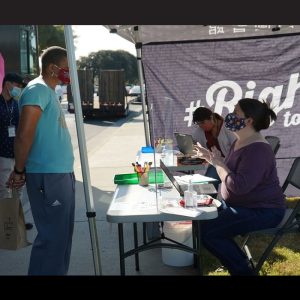
Image courtesy of San Jose Public Library
Improved Outreach – At least once a quarter the library will move outside the building and go to a community hang out (local coffee shop, grocery store, etc.) or community event (health fair, back to school night, trunk or treat, etc.). These outreaches will be designed to put a face to the library for our community who do not already use the library. Outreach will allow for community members to talk to trained library staff about why or why they aren’t visiting the library with the use of surveys and conversation. Surveys will be available just like the monthly program and can be filled out there or returned at a later time.
- Blog – Currently we do not have a blog and social media is used to promote events and programs. What we need is a place where community members and the library can have a dialog at any time. The blog will be used to inform the community about upcoming facility improvements, updates about any unique happenings at the library and community, and quarterly results from the “Coffee with the Librarian” programs, outreach events. This allows for a transparent exchange between the library and the community. Comments will be turned on in this blog with monitoring for language and any inflammatory speech. Criticism is ok and should not be suppressed. This will be a forum allowing our community to speak about what we are doing well, what we can be doing better, and how we can serve them the best.
Mission & Institutional Context:
The San Bernardino County Library system encompasses 32 branches in the United States’ largest sized County. It’s a large system that has branches stretching from Chino Hills to Twenty Nine Palms to Needles to Trona to Hesperia and all the cities in between. In our Vision Statement we state, “By utilizing the resources of SBCL’s meeting spaces, technology, materials, programs, services, and staff we envision adding to the quality of life and strengthening the community identity everywhere a branch library operates.” (San Bernardino County, 2026). Due to the size of our system, strengthening community identity can be very difficult to accomplish especially since current thought is that programs need to be consistent throughout the County. Unfortunately, this one program fits all is not a viable solution for strengthening community identity. It places the system as an authority figure that tells our communities what is good for them. Currently there is no transparent and accountable way that feedback from community members is taken into account for planning in any of our programs, events, and large scale renovation projects – “fresh voices and ideas from beyond library staff input might lead to some intriguing and popular initiatives,” (Stephens, p. 101) . The County library system is very large and though equality is a very important tenant, each branch community has different needs and because of this it’s important to make sure that those needs are being addressed in a transparent and participatory manner. It’s time to ask what our communities need.
Action Brief Statement:
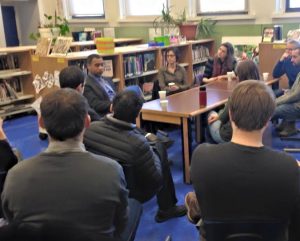
Image courtesy of Programming Librarian.
- Convince our community that by listening to their voices they will discover all the wonderful tools and resources that we offer so they will be invested in sharing their opinions to help our library change current methods of thinking which will create a transparent and participatory relationship which will give community members a feeling of ownership which will allow for deep connection between the community and the library.
- Convince library administrators that by using participatory programs, events, and blogging they will make deep connections within their unique communities across the County which will result in a hyperlinked library model because putting yourself out there and being part of the community is why the library is here and ensures that we reach all who call this County home.
Inspiration:
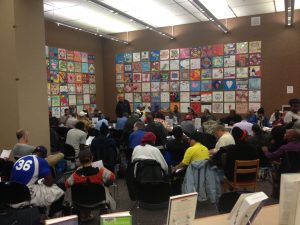
Image courtesy of Programming Librarian.
San Jose Public Library: Community Engagement: Your Voice Matters | San Jose Public Library
Coffee and Conversation at Cambridgeport School: Coffee and Conversation at Cambridgeport School | Programming Librarian
Coffee and Conversation: Coffee & Conversation | Programming Librarian
Guidelines & Policies:
Surveys – Surveys need to be anonymous; no identifying information should be included with the surveys. Questions will need to be a combination of open and closed questions. Multiple choice questions and scales would be great to gauge answers. However the survey will need to have some questions that are open ended so community members can express their answers fully. The online survey should be set-up in a way so that only residents within the community are able to participate and should include a question about which branch is closest to them. Survey questions should be reviewed by administrators once a year to ensure that questions are still relevant.
Blog – Comments should be opened however a moderator will need to review blog comments consistently to ensure that no inflammatory language is being used. There will need to be a code of conduct available to people who make comments so they ensure that what they post is appropriate. Comments with criticism should remain on the blog and should be answered by the moderator.
Outreach – Events should be planned in advance by finding major community events that already draw community interest such as health fairs, car shows, farmer’s markets, etc. If a major event is not available, outreach should be conducted at local coffee shops, grocery shops, etc. This allows the library to meet the community where they are at. These outreach events are not passive but rather a way to have conversations with our community members. The goal is to meet community members, find out if they use the library, find out why they do or don’t, and get some feedback so we can build a better library for the community by reaching their needs. Training sessions will need to be conducted to model the kind of conversations that need to happen for a successful outreach. Membership to the library is not needed to fill out surveys at events. After each outreach, there should be a debrief between staff to share what they learned and any feedback they received.
Program – Those representing the library at the “Coffee with the Librarian” should be outgoing, friendly, and approachable. They will need to be comfortable with having conversations with community members and should attend training with those that are conducting outreach. There will probably be crossover between both. After each program, there should be a debrief between staff to share what they learned and any feedback they received.
Timeline for Implementation
The system already uses 6-month out planning for current offerings so this programming should be implemented within 6 months.
Phase 1: Start building policies for the blog, start blog, and begin to create surveys (1-3 months)
Phase 2: Plan “Coffee with the Librarian” programs – where they will take place, when, who will represent the library, and ordering of coffee and food ( 2-4 months)
Phase 3: Plan new and improved outreach programs including reaching out to organizers for permission to be at events and fill out any paperwork necessary. Also, begin partnerships with local businesses to see if outreach is possible at their locations (3-5 months).
Phase 4: Begin “Coffee with the Librarian” programs and quarterly outreaches (6 months)
Phase 5: Blog about results from surveys every quarter.
Marketing & Promotion
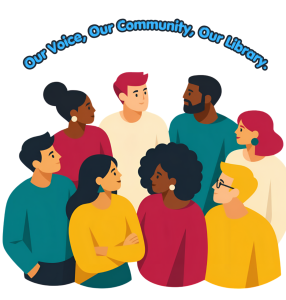
Proposed logo for initiative
Within the organization, the new model of participatory service will be revealed at the annual Staff Development Day with the reveal of its name “Our Voice, Our Community, Our Library.” This is where the whys will be explained to staff as well as what we hope to build with this kind of service. We will go over the blog, the new program, and outreach improvements. At the same time, we’ll gauge staff excitement. It’s important that dynamic staff that are excited about this are involved with this program. For the community (both users and non-users) marketing on social media about our initiative will roll out, fliers will be posted in our branches and at partnership businesses, and of course a marketing of our new blog. Email blasts will be sent out to users as well to market the upcoming programming and services. “Our Voice, Our Community, Our Library” will be the tag line attached to this initiative and can be used for all marketing purposes.
Staff Training & Readiness
Staff will need to be trained in how conversations with community members should be conducted. These are not formal conversations, this is meant to be a casual way to introduce the library to the community by giving the library a face and personality. Staff at outreaches should be personable, outgoing, friendly, and approachable. Training sessions should be mandatory for staff that will be helping with outreaches and at “Coffee with the Librarian” programs. The training sessions will go over what kind of information we are looking for as well as modeling good ways to handle conversations with the public. Meetings with staff will be conducted monthly in order to go over best practices and go over what is working and what is not working.
Staff moderating and designing the blog will meet monthly as well to go over what is working and what is not working. The county librarian will be at these meetings in order to review comments that were made in the past month.
Training in how to evaluate the survey answers will need to be held as well. In addition, there should be a running “tally” of answers so we are prepared to share our findings on our blog as well as our staff members.
Evaluation & Future Expansion
If this new participatory experience is a success, we should see an increase in activity on our blog as well as an increase of usage of our tools (digital tools, programs, physical materials, etc.), and an increase in our door counts as we become visible in our communities. Success will really be measured by how we are able to take feedback and use that to inspire our offerings so we are consistently having a dialog with our communities. Over time, our growing blog presence, stronger ties to our community organizations, and the ability to reach more people will ensure that the library remains a relevant institution. The meaning of this new participatory service model is to make connections with members of our communities and ultimately to make sure we are staying relevant by serving their unique needs. Through connections we may be able to build a larger footprint by making ourselves known. In addition, the community will have made more connections. More conversation type programs can be implemented into our libraries which can reach even more people of diverse backgrounds.
Works Cited
San Bernardino County Library (2026). Library information: About Us. https://library.sbcounty.gov/information/tion – Library
Stephens, M. (2016). The heart of librarianship: Attentive, positive, and purposeful change. ALA Editions.