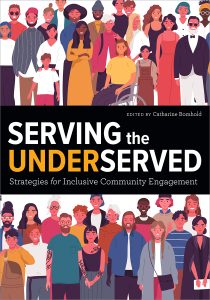
“Serving the Underserved” by Catharine Bomhold
Libraries provide a plethora of services. They not only hold a collection of materials for patrons to access, they also provide community. Peter Block’s definition of communities as “human systems given form by conversations that build relatedness” gives a new perspective to a librarian’s job. They do not just curate materials, they also curate a sense of belonging and social connections.
Underserved and Excluded Communities
Stephens’ (2016) concept of “reaching all users” stood out to me and made me think about who uses the library and what type of people our community truly contains. It’s easy to design programs for people we already know will show up, but it’s harder to serve to those who may feel like they don’t belong in libraries, including teens, immigrants navigating a language barrier, and the unhoused population. Lauersen’s (2018) article on belonging in libraries reiterates this idea. He talked about how people may have hidden biases against marginalized and underserved groups based on privilege and stereotypes. Libraries are places that, in theory, should be free from this type of mindset. As librarians, we must be aware of how our upbringing may have an effect on our services and interactions. Tareq Nurul Hasan (2022) quotes Angela Savage, CEO of Public Libraries Victoria (PLV), stating that libraries are “free, non-judgemental, trusted, and accessible to everyone”. Libraries are safe spaces where people who may face discrimination elsewhere, can feel welcome.
Libraries and Wellbeing
Having library work experience myself, the idea of the library being a safe, non-judgemental space really resonated with me, especially in the context of health and wellness. Libraries can help those struggling with mental health or addiction cope, as they provide calm environments and non-judgemental interactions with others (Hasan, 2022). Surveys conducted by PLV and State Library Victoria on 34,000 library users showed that 92% consider the library a safe place, and 60% said that the library contributed to their mental health and wellbeing. To further this study, Greenwood (2022) states that “libraries can play a critical role in improving some of the determinants of health… through programs and services that equip communities with the necessary skills, information and confidence needed to manage their own health and wellbeing.” Libraries can act as a bridge, and connect the community with health and wellbeing organizations and professionals.
Inclusive Efforts in the Library
With so many people relying on the library for various reasons, we as library professionals must serve our communities with understanding and compassion. It is important to bring qualities such as empathy, emotional intelligence, and compassion into work (Garcia-Febo, 2018). We must also be intentional in our services and interactions, make an effort to notice the excluded groups within our community and actively rethink our services and policies to be more inclusive of all community members.
References
Garcia-Febo, L. (2018, November 1). Serving with love: Embedding equality, diversity, and inclusion in all that we do. American Libraries. https://americanlibrariesmagazine.org/2018/11/01/serving-with-love/
Greenwood, C. (2022). Healthy library, healthy life.
Hasan, T. N. (2022). Free, non-judgemental, accessible. SBS. https://www.sbs.com.au/language/bangla/en/article/free-nonjudgmental-and-accessible-how-your-local-library-is-a-sanctuary-of-health-and-wellness/t15blzsi9
Lauersen, C. (2018). Do you want to dance?
https://christianlauersen.net/2018/06/07/inclusion-and-belonging-in-libraries-and-beyond/
Stephens, M. (2016). Reaching all users. In The heart of librarianship (p. 41)
Hello Vivian,
This is such an important topic, and I agree it is essential that library staff evaluate their own biases and ensure they are treating everyone fairly and free of judgment. As you mentioned, libraries should be safe spaces where everyone feels welcomed. Unfortunately, in my time working at libraries I have encountered co-workers, even mangers, who let their biases cloud their judgment and mock patrons behind their backs, which creates an awkward and tense environment. That is not the type of place a library should be and I hope that more librarians coming into this profession will work to creating safe and welcoming spaces for everyone.