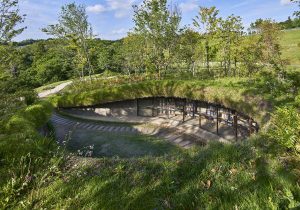
“Library in the earth” in Kisarazu City, Chiba Prefecture, Japan
Being library professionals in the U.S, we may forget that there is another world of international libraries that foster social connection and belonging based on a different set of needs and a different cultural backdrop.
Architecture in Libraries
Libraries offer a wide range of resources outside of books. Some examples of other services and materials that libraries offer include: laptops, WiFi hotspots, tax help, and citizenship test prep classes. They also serve as third spaces. To match these services, Helsinki’s central library, Oodi, has incorporated the new roles of the library into their building design (Cord, 2018). The Oodi library is organized across three floors, each with a different focus: the third floor being the “traditional library” with reading spaces and 100,000 books, the second floor acting as a space for creativity, and includes studios, music rooms, 3D printers sewing machines and other equipment, and the first floor has a café, restaurant, cinema, information points and a space curated by the EU to foster social interactions.
The Locomotive Hall (LocHal) is a library that was built inside an 80-year-old converted train shed (Schwab, 2019). It provides thousands of books, seating areas, an exhibition space, and other space for people to hold programs. The renovated space now features floor-to-ceiling windows that provide tons of natural light, creating a welcoming and comfortable space for people to learn new skills. Despite not being built from all new materials, the space still serves its purpose of meeting its community’s needs.
More than Just Books and Programs
Libraries can also be used to meet a community’s economic and agricultural needs. The Liyuan library located in Jiaojiehe, China, is essentially a steel and glass box, and the exterior is covered in fruit-tree twigs. It also doubles as a tourist attraction, bringing in tourists who then spend money for the villages’ restaurants, parking fees, and donations, contributing to the village’s economy (Perlez, 2015). The Jagodina Public Library has collaborated with the Agricultural Advisory Service of Serbia to host agricultural lectures in Glogovac Village, focusing on “Significance of agrochemical analysis of soil and lowering soil acidity” and “Potato and pepper protection” (Rajik, 2016). These lectures were helpful for the farmers of Glogovac, as well as other nearby villages. Both these libraries show that libraries don’t need to have fancy architecture or follow popular programming trends. It’s important for libraries to fulfill the community’s most basic needs.
What Makes a Library
Libraries are more than the physical materials or trendy programs provided. They are also the building itself, which provides a safe and welcoming space for people to interact, create, and learn. They don’t require expensive architecture or flashy programming to make an impact. A library doesn’t have to resemble the Oodi library to be transformational, but rather they should be intentional on how it responds to the surrounding community’s needs, people, and culture. For some communities, that may mean a new building with various technologies provided, and for others, it may be hosting agricultural workshops in a small village. As library professionals based in the U.S., it’s easy to get caught up with domestic trends, but we must remember to look beyond our borders. Doing so will allow us to learn from our neighbors, and to implement new strategies and ways of thinking into our own work.
References
Cord, D. (2018). Helsinki invests in its people with a library that reinvents the genre. This is Finland. https://finland.fi/life-society/helsinki-invests-in-its-people-with-a-library-that-reinvents-the-genre/
Perlez, J. (2015). An innovative library lifts the fortunes of a Chinese town. The New York Times. https://www.nytimes.com/2015/07/07/world/asia/enticed-by-a-library-tourists-browse-a-chinese-village.html
Rajik, J. (2016). Jagodina Public Library & AgroLib Ja project. http://jagodinalibrary.blogspot.com/
Schwab, K. (2019). The library of the future is an 80 year-old converted train shed. Fast Company. https://www.fastcompany.com/90316219/the-library-of-the-future-is-in-an-80-year-old-converted-train-shed
Leave a Reply