For this week’s reflection, I decided to go back through the modules and review resources I hadn’t seen before. During this process, I discovered the TEDxSantaCruz talk by Nina Simon (2012) entitled “Opening up the Museum.” Simon is the Executive Director of the Santa Cruz Museum of Art & History (MAH). She wrote a book, The Participatory Museum, in which she provides a guide for how cultural institutions can create a more interactive experience.
Santa Cruz Museum of Art & History offers many participatory activities, inviting guests to take an active role in their experience. I liked the example of the exhibition on giving advice. Guests were given two options for participation. One option was to write questions and solutions on Post-it notes. There were many meaningful responses on the notes. The other option was to write their questions and solutions on a mock bathroom door. In that setup, despite the same prompt, people scribbled or wrote other typical bathroom door graffiti.
Simon emphasized that the tools you give to allow participation make a difference. They need to be done with intention. She stated, “The reason they interacted differently was because of the design and the tools that were given to them.” If you give them a special tool, they will feel like their contribution is more valued, and therefore may be more inclined to have a meaningful engagement with the exhibit.
During our family vacation this summer, we visited a variety of museums in Michigan, including the University of Michigan Museum of Natural History and the Detroit Institute of Art. They had a variety of participatory activities throughout both museums.
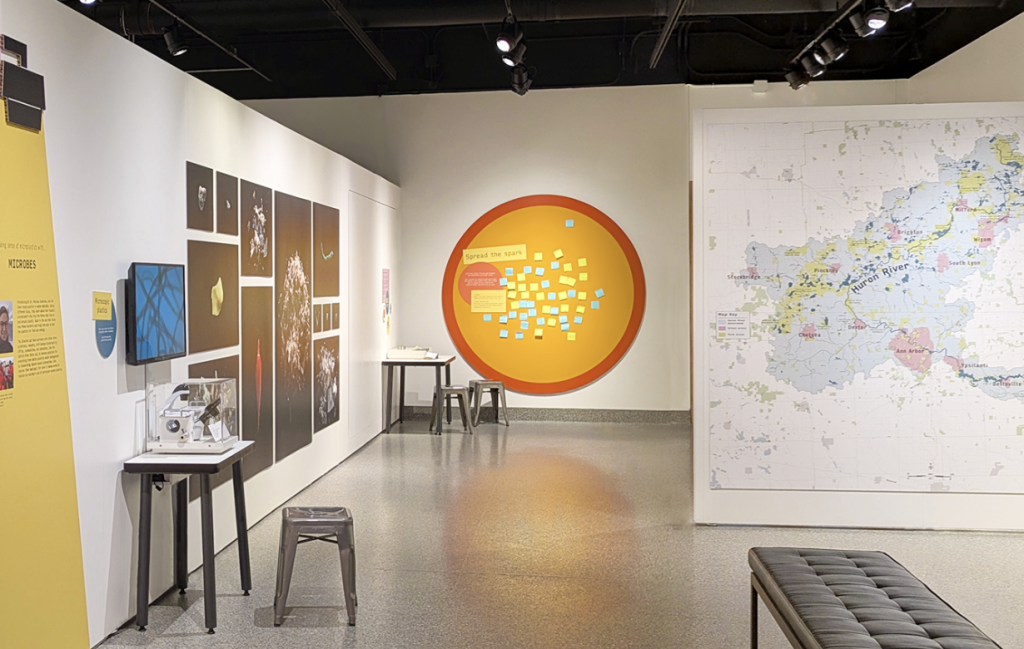
The Museum of Natural History had quite a few exhibits where they provided Post-it notes to answer a question. The image below is part of an exhibit, All the Plastic You Cannot See. The large orange circle is at the end of the exhibit and allows visitors to use Post-it notes to offer their thoughts about the exhibit and what they can do to improve the environment.
At the Detroit Institute of Arts (DIA), in the Robert & Katherine Jacobs Asian Wing, they had a Community Response Station that asked visitors to reflect on what they were seeing or to share their own stories. Many people commented about the joy of being able to connect with their cultures or being proud to share their culture with the community. Unfortunately, I did not have the foresight to take a picture of that area.
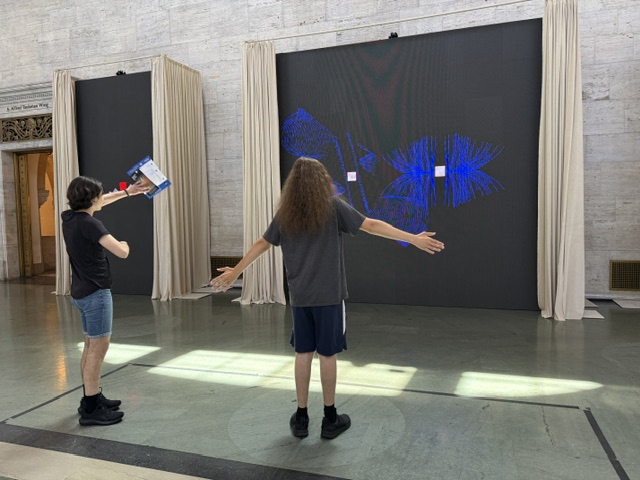
Also at DIA, FORTUNES is a large interactive installation where you can create different light designs through your movement. There were three large screens, with boxes sectioned off on the floor indicating where to stand. As you move around, the light designs on the digital screen change, getting larger or smaller depending on your movement. This was located in a large open gallery, so as you participated, you became part of the art that other visitors were able to see.
Participatory activities are more than just opportunities to engage with the museum. They allow the participant to see themselves as a creative vessel. Someone who commented about the Asian art at the Detroit Institute of Arts may be motivated to share more about their culture with their peers. A child who interacted with the Museum of Natural History exhibit may be inspired to create art from found plastic materials. An adult who played with FORTUNE may have rekindled a love of dance from when they were a child and start taking a dance class again.
The idea of the participatory museum can easily be translated to libraries. Some examples of participatory activities we have done at my library include:
-
- During elections, children can participate in a mock vote for their favorite book character and, of course, receive an “I voted” sticker.
- On the Bookmobile, patrons can use a sticker to indicate their favorite pizza topping next to a display of books about pizza.
- Teens can decorate a rubber ducky for an annual art contest. They will then be put on display for library patrons and staff to vote on their favorites.
Participatory activities help transform passive library spaces into active spaces that foster social connection and collaborative creation.
(And if you watched the entire TEDx Talk, no, I did not give my children to other museum visitors. I didn’t think anyone would want an 18- and 21-year-old.)
Reference
Simon, N. [TEDxTalks]. (2012, November 7). Opening up the Museum: Nina Simon @ TEDxSantaCruz [Video]. YouTube. https://www.youtube.com/watch?v=aIcwIH1vZ9w&t=921s
Hi Jen! I hadn’t thought as much about participatory services in the museum setting and enjoyed reading your blog post. I really appreciated your thoughts on intentionality with participatory services and providing users with tools that encourage meaningful engagement. I think that sentiment transcends the museum setting and is an important consideration whenever we’re designing these kinds of experiences. Thanks for sharing!
Hi Jen! Awesome post! I really love the idea that participatory services allow people to see themselves as creative beings. I think it’s so important to foster that because so many people think they aren’t creative, despite it being a fundamental aspect of human nature. Getting people to engage and recognize that they are indeed capable of literally anything they put their mind to is so awesome. I wrote my inspiration report on participatory services in museums, and I didn’t consider this. Thank you!
@jenfredrick @jenfredrick I am so glad you chose this topic for your wild card. And I love the fact that you came to Michigan to explore. I need to get down to Detroit and visit the museum. Also, back in 2012 at the R squared conference, I did a half-day workshop that Nina Simon led, and it was one of the most interesting things I’ve ever participated in.
@michael, we actually stayed in Toledo and were planning on going to the Toledo Museum, but that was mostly closed for renovation, and we were only able to see the Glass Pavilion. So we decided to go to the Detroit Museum, only to find that much of that museum was closed as well, although they had moved many of the well-known works to one gallery, so we were still able to see those. We also went to The Henry Ford, which I thought was fascinating. To be able to see the car where JFK was shot and actually sit on the bus where Rosa Parks sat was surreal. And then, of course, the Weinermobile. LOL.
@jenfredrick Very cool. I haven’t been to Henry Ford since eighth grade. I would really be interested in seeing the JFK vehicle and the bus.