
When thinking about library spaces in the modern world, we are often thinking more about technology and less about books. Libraries today are resources for so many different things: resume writing and job hunting, educational and recreational classes, makerspaces and art production, community services and events. Libraries are working with their communities to offer different services and features based on feedback from residents, and are changing their service models to reflect those needs. The Anythink Nature Library, for example, “invites visitors of all ages to explore their connection to nature” (Anythink, n.d.). Their collection is nature focused and tailored to support their mission of sparking “outdoor learning and adventure” (Anything, n.d.). Innovations like these are happening more and more around the world and are quickly becoming the baseline of what library spaces are shifting towards.
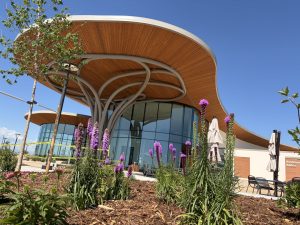 Anythink Nature Library
In Texas, the BiblioTech Public Library is the first all-digital public library. The library opened in 2013 and only lends and offers digital content. They have no physical collection other than e-readers, hotspots, computers, and Launchpads. They are the “library of the future.” Or are they? As Michael Stephens writes in his article “Taming Technolust: Ten Steps for Planning in a 2.0 World,” technology cannot and should not be “the center of your mission as an institution” (Stephens, 2008). While this might refer predominantly to the public library that strives to provide the newest technology along with its traditional physical collection, the question becomes how long can an all-digital library last? BiblioTech has been around and expanding for over 10 years now, so there is definitely something there. But I wonder how many of their patrons have to visit multiple libraries to find what they’re looking for. A 2019 article on the San Antonio Report website highlights the positive aspects of the digital library on the community, including increased access, digital equity, and the collaborative relationship between BiblioTech and the San Antonio Public Library. However, there are financial and operational challenges to such a space. Bexar County, Texas continues to invest more in BiblioTech and gradually reduce its contribution to the San Antonio Public Library, while its residents still extensively use the city’s physical library. At the time the article was written, country resident use accounted for 23% of circulation but the country’s financial contribution only accounted for about 6% of the library’s general fund (Wang, 2019). This is a significant imbalance and raises questions about whether digital libraries should replace or supplement traditional physical libraries.
This is an example of how BiblioTech’s digital-first model addresses a specific community need by bridging the digital divide, but also continuing to value ideas such as collaboration, lifelong learning, and equitable access. The partnership between BiblioTech and the San Antonio Public Library reinforces the argument that libraries strengthen communities when they work together to remove barriers to access which is highlighted in Mike Gaetani’s (2018) interview with Eric Klinenberg. In that interview the focus is on libraries as critical community infrastructures that provide equal access to information, technology, and public services. BiblioTech’s all digital model serves as a core component of social infrastructure by promoting access and equity. While this addresses a community want and need, it cannot fully replace the traditional library space. Leaders of the San Antonio Public Library note that physical libraries are necessary and continue to provide needed services such as story times, community programs, in-person assistance, and meeting spaces. And let’s not forget about the books, magazines, newspapers, DVDs, and video games that patrons are still looking for in physical form. While BiblioTech can bridge that divide, it cannot fully replace the physical collection.
This brings me to my current library. In recent years we have shrunk our physical collections to make room for meeting space, work space, and a study pod. All of these changes were made to accommodate what we thought patrons wanted. However, in 2025 the library started work on its updated Strategic Plan, and we received responses to our survey that we didn’t expect: 23% of respondents (the majority) stated that the physical collection should be the library’s top priority.
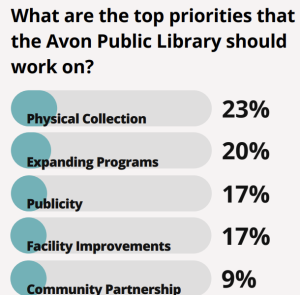 Avon Public Library Strategic Plan, 2025
Whether that was backlash due to the excessive weeding and shifting of the collection that patrons took note of, or if it was something they always wanted but we failed to see, I don’t know. I do know that it surprised us all and we are still struggling to keep up with the demand. We consistently receive comments from patrons that we don’t have enough large print books or that we don’t have enough older adult fiction. So, while library patrons are looking for innovative ways to use the physical library space, they do still want traditional library collections like books. Due to the space limitations of the library, having a big enough print collection is something that we will always find difficult to manage. We even have a consultant from the state library board coming to the library to evaluate the space and work with us on reimagining it. The best thing to come out of the strategic planning process was input from the community. Their valuable responses will shape what direction the library goes in the future both physically and digitally, this is participatory service in action.
References:
Anythink Nature Library. (n.d.). Anythink nature library. https://www.anythinklibraries.org/anythink-nature-library/?fbclid=IwAR2DgO-k8nU6kNUODo7vTlRXKiEiYSoSeQMC8Aq0QnoLMZoT3d-QKpbSl5M
Avon Public Library. (2025, October 17). Avon public library strategic plan. https://www.avon-ma.gov/DocumentCenter/View/7515/Avon-Public-Library-Strategic-Plan-FY-26-31?bidId=
BiblioTech. (n.d.). About bibliotech. https://bibliotech.org/about-us/
Gaetani, M. (2018, November 11). Q&A with Eric Klinenberg. Center for Advanced Study in the Behavioral Sciences. https://casbs.stanford.edu/news/qa-eric-klinenberg
Stephens, M. (2008). Taming technolust: Ten steps for planning in a 2.0 world. Reference and User Services Quarterly, 47, 4, 314-317.
Wang, J. (2019, July 31). City, county work to renew deal for all county residents to use SA libraries. San Antonio Report. https://sanantonioreport.org/city-county-work-to-renew-deal-for-county-residents-to-use-sa-libraries/
@robyncapone this is so interesting to read about your survey at your library. And I’m glad you have the consultant coming to maybe sort out how you can increase the collection and still have that space for the second most popular request which is expanding programs. It’s a lot to balance.