Category: Uncategorized

Reflection 2: Video Games Can Be Libraries Too

This module I was really intrigued by the Minecraft Uncensored Library. Growing up I remember spending hours and hours on the game but was never able to build anything even close to as cool as the Uncensored Project. Before this module I was unaware that something like this even existed. 

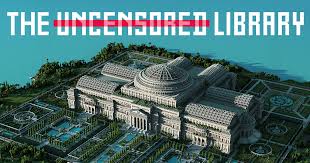
I spent quite a bit of time researching it and wanted to share about the project with you all. For those who are unaware, the Minecraft Uncensored Library is a large-scale open world library that all you need to access is a Minecraft account. Reporters Without Borders (founded in 1985) partnered with a company called BlockWorks founded in 2013 by four friends to create this and it was released to the public March 12, 2020 which is World Day Against Censorship. The goal was to be able to get uncensored and unrestricted information out to countries that lack freedom of press. So they turned to Minecraft to build a massive library building that held ‘books’ that players could come in and read allowing them access to information that would have been banned in their countries. They were able to use the platform as a loophole in oppressive countries because the content in game could not legally be censored. Players have the option to join the server that is always up and running or to locally download the map to be able to use on your own personal server. 
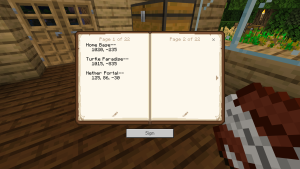
Book in Minecraft

They had 24 builders on the project and chose a neoclassical art style meant to mimic influential libraries and traditional government building design, and it used over 12.5M blocks to bring the vision to life. The building features banned works of journalism from 10 different countries around the world; The United States, Russia, Vietnam, Saudi Arabia, Egypt, Brazil, Belarus, Iran, and Eritrea. Each country has its own wing of the library full of books that can be read in both the native language and English. The interior architecture of each wing features elements that reflect the specific country.
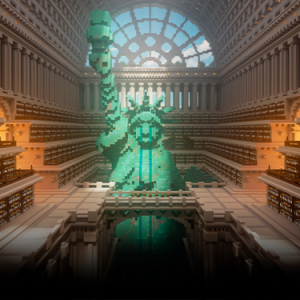
USA Room

I was so blown away by the time and the effort put into the project that allows people access to information. I would have never thought to use Minecraft in this way but it is clear that the platform is so much more than just books. It is whatever you dream up and Reporters Without Borders and BlockWorks dreamt a way to bring free uncensored information to these countries and they made it happen. If you have minecraft and want to look around the server IP address is visit.uncensoredlibrary.com 

PS. today November 18th is the anniversary of Minecraft’s release back in 2011. Happy 15th Birthday! 


The Metaverse, Minecraft, and the Uncensored Library. (n.d.). Retrieved November 18, 2026, from https://287.hyperlib.sjsu.edu/the-metaverse-minecraft-and-the-uncensored-library/

The Uncensored Library – Reporters without borders. (n.d.). Retrieved November 18, 2026, from https://www.uncensoredlibrary.com/

Wikipedia contributors. (2026a, October 11). BlockWorks. Wikipedia, The Free Encyclopedia; Wikimedia Foundation, Inc. https://en.wikipedia.org/wiki/BlockWorks

Wikipedia contributors. (2026b, November 15). Reporters Without Borders. Wikipedia, The Free Encyclopedia; Wikimedia Foundation, Inc. https://en.wikipedia.org/wiki/Reporters_Without_Borders

Wikipedia contributors. (2026c, November 15). The Uncensored Library. Wikipedia, The Free Encyclopedia; Wikimedia Foundation, Inc. https://en.wikipedia.org/wiki/The_Uncensored_Library
Reflection 1: #BookTok for Libraries

While reflecting on the hyperlinked communities module, I was looking at it through the lens of YA/Teen Librarianship and how those communities are best served. One of the things that stuck out to me was the article about BookTok. It is incredibly rare these days that someone under the age of 25 is not on social media let alone TikTok, it is an incredibly popular platform that has the ability to pull millions of views and sway opinions. The article talks about how when a book makes it big on the section of TikTok deemed BookTok, it reaches large audiences and stays popular for quite some time.

At its core social media can help foster community and it allows for easy and open discussion on these books, and reviews and recommendations from all over the world. I feel it is a very useful tool for libraries not only to stay ahead of the trends but to also promote their library and their programs. I often get videos from small libraries all around the united states, because they make a video and it goes “viral”. Using social media to drive attention to your library and highlight your local community and book recommendations is huge when trying to connect with the teens of today. I feel a lot of public libraries can tend to be behind the trend when it comes to social media, my local library has some social media like Instagram and Facebook but they are not kept up with regularly and mostly just used to show an event. I think if more libraries have the opportunity to branch out on their social media usage it can be very beneficial. 

I found an article published by the School Library Journal where a youth services assistant at a public library discusses her journey with creating a TikTok for her public library. She had some really interesting information and some helpful tips and tricks for those looking to expand their libraries social media presence. I recommend giving it a read; What Makes These Librarians TikTok teachers school social media

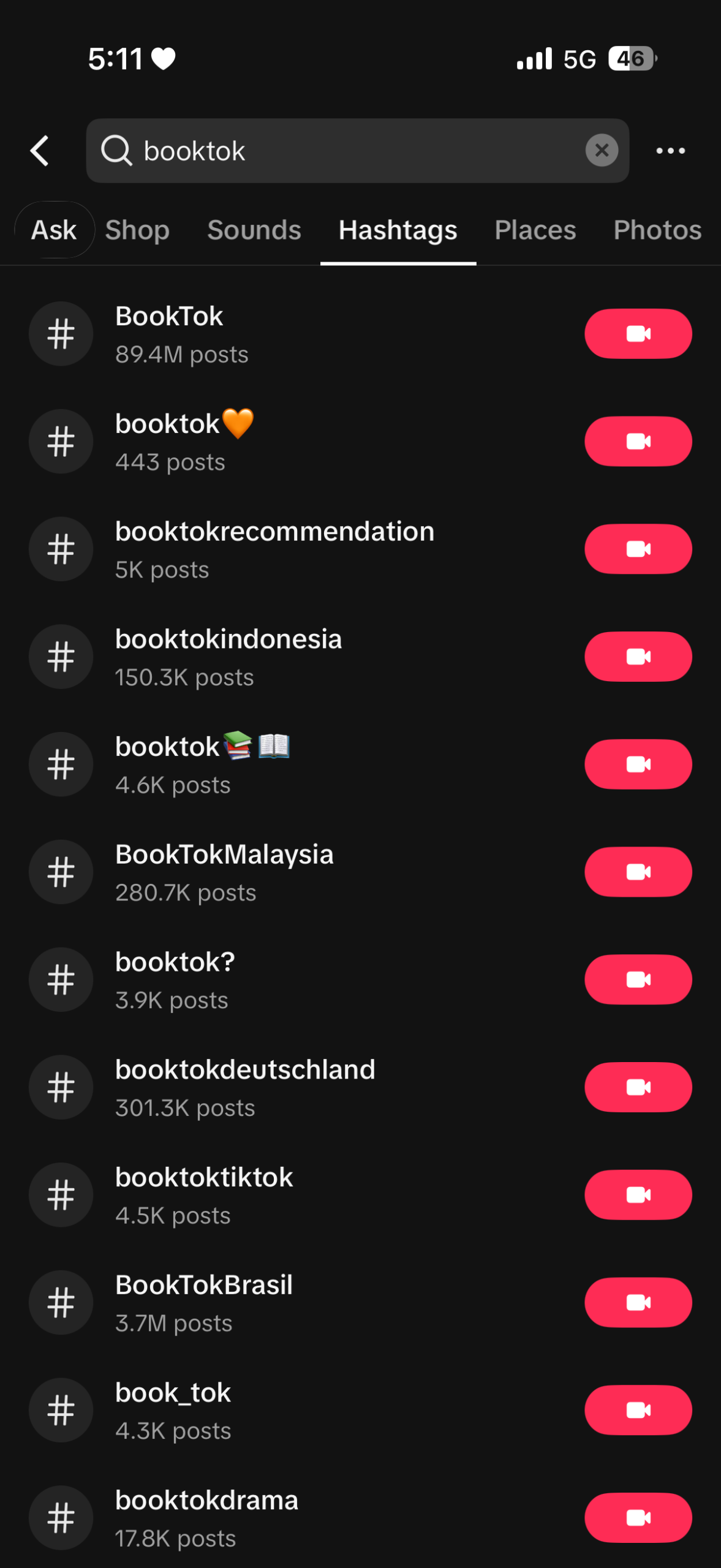
TikTok search for #BookTok showcasing 89.4M posts


References

Jensen, K. (n.d.-a). As Seen on BookTok: Inspiring Young Readers, TikTok is a Boon for Books. School Library Journal. Retrieved November 14, 2026, from https://www.slj.com/story/as-seen-on-booktok-inspiring-young-readers-tiktok-is-a-boon-for-books-libraries

Jensen, K. (n.d.-b). What Makes These Librarians TikTok? School Library Journal. Retrieved November 14, 2026, from https://www.slj.com/story/What-Makes-These-Librarians-TikTok-teachers-school-social-media


Assignment X: Get the Teens in the Library

I remember being a child and spending countless hours at the library, attending storytimes and events. However, as I got older there seemed to be less to do at the library other than to run in and grab a book and leave. Although, I think as a teenager the last thing I wanted to do was sit inside of a library and attend a class or an event. Library services for teens is a tough one to pull off sometimes and that is clear throughout our readings. 

One of the concepts I kept seeing throughout the first few modules is the lack of service for teens in the library, and it really resonated with me. I am passionate about youth services in the library because I feel like libraries are essential spaces for all kinds of different resources that can be incredibly impactful during youth. 

However, there seems to be a stigma regarding teenage patrons in the library, they are often looked at as the “problem” patron right as they walk in the door. They are judged based on things like age or appearance and not given a fair shot. The textbook Library 2.0 touches on the concerns of losing patrons when they hit their teenage years. Similar to my experience, it’s reported that “We created services for users when they were young kids, lost them as teens, got some of them back again as parents bringing their own kids in…” 

Sadly a lot of libraries have failed to make engaging programming for teenage patrons. I will not disagree that it is a hard age to make programs for, oftentimes kids are less interested in attending a class or a performance and are more interested in spending time with their peers. They can often be loud or rowdy and that is not appropriate for a library setting. The article from week 4 Embracing Service to Teens talks about how we need to be mindful that teenagers will be teenagers and may talk or be a little loud but that we should not accept inappropriate or disrespectful behavior. Sadly, many librarians seem to conflate the two.

The library I spent some time working at had a large population of teenage patrons who came in every day and many of the librarians, especially the older ones tended to turn their nose up at them when they came in. At the end of the day all anyone wants is to be treated with respect and as an equal, so librarians and staff need to be mindful of that. 

I think now there is a greater push for teen based programs and spaces to try to bring them into the libraries and create inclusive and safe 3rd spaces. Library 2.0 talks a little bit about this with the idea of a teen advisory board. “Each branch of the Gwinnett County Public Library in Lawrenceville, Georgia, formed a Teen Advisory Board made up of willing and interested teens from the surrounding community to provide input and suggestions for ways to improve service to teens and get more young adults into the library. By expressing a genuine interest in what these teens had to say, each branch was able to gain valuable feedback that they used to increase their services to this age group.” I feel advisory boards are a fantastic way to find out what this age group really needs and wants out of a library. What better way to get teens in than to ask them directly. When we allow people to have a say and a voice it makes them feel heard and then libraries are able to tailor programs that they know will bring in attendees. Places like the Harold Washington library in Chicago have done amazing things with their YOUmedia digital makers space for teens and I hope many more libraries continue to have a meaningful impact on its local teenage population.

I did also find many comments and videos from librarians on this topic of teenagers getting rowdy in the library and the mindset seemed to be “oh well we are happy you are here” and I feel that we are steps further as a community in creating that space where they want to come hangout. 

I know I would have gotten up to a lot less trouble had I spent more time in the library as a teenager.


Casey, M. E., & Savastinuk, L. C. (2007). Library 2.0: A guide to participatory library service. Medford, N.J: Information Today.

Stephens, M. (n.d.). Embracing Service to Teens. Retrieved September 18, 2026, from https://tametheweb.com/2008/05/15/embracing-service-to-teens/

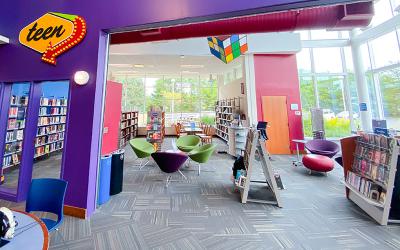
Teen room. (n.d.). Worthington Libraries. Retrieved September 18, 2026, from https://www.worthingtonlibraries.org/visit/locations/northwest-library/teen-room

The Crypt Keeper: An Introduction

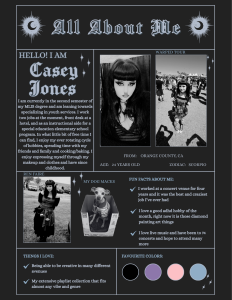
Hi everyone here is a fun little poster I made to introduce myself. 

Text from intro blurb: “I am currently in the second semester of my MLIS degree and am leaning towards specializing in youth services. I work two jobs at the moment, front desk at a hotel, and as an instructional aide for a special education elementary school program. In what little bit of free time I can find, I enjoy my ever rotating cycle of hobbies, spending time with my friends and family and cooking/baking. I enjoy expressing myself through my makeup and clothes and have since childhood.”