
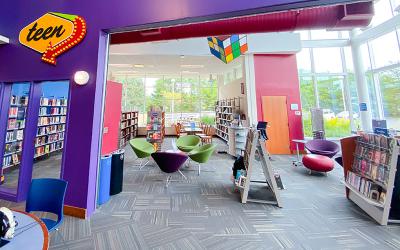
I remember being a child and spending countless hours at the library, attending storytimes and events. However, as I got older there seemed to be less to do at the library other than to run in and grab a book and leave. Although, I think as a teenager the last thing I wanted to do was sit inside of a library and attend a class or an event. Library services for teens is a tough one to pull off sometimes and that is clear throughout our readings.
One of the concepts I kept seeing throughout the first few modules is the lack of service for teens in the library, and it really resonated with me. I am passionate about youth services in the library because I feel like libraries are essential spaces for all kinds of different resources that can be incredibly impactful during youth.
However, there seems to be a stigma regarding teenage patrons in the library, they are often looked at as the “problem” patron right as they walk in the door. They are judged based on things like age or appearance and not given a fair shot. The textbook Library 2.0 touches on the concerns of losing patrons when they hit their teenage years. Similar to my experience, it’s reported that “We created services for users when they were young kids, lost them as teens, got some of them back again as parents bringing their own kids in…”
Sadly a lot of libraries have failed to make engaging programming for teenage patrons. I will not disagree that it is a hard age to make programs for, oftentimes kids are less interested in attending a class or a performance and are more interested in spending time with their peers. They can often be loud or rowdy and that is not appropriate for a library setting. The article from week 4 Embracing Service to Teens talks about how we need to be mindful that teenagers will be teenagers and may talk or be a little loud but that we should not accept inappropriate or disrespectful behavior. Sadly, many librarians seem to conflate the two.
The library I spent some time working at had a large population of teenage patrons who came in every day and many of the librarians, especially the older ones tended to turn their nose up at them when they came in. At the end of the day all anyone wants is to be treated with respect and as an equal, so librarians and staff need to be mindful of that.
I think now there is a greater push for teen based programs and spaces to try to bring them into the libraries and create inclusive and safe 3rd spaces. Library 2.0 talks a little bit about this with the idea of a teen advisory board. “Each branch of the Gwinnett County Public Library in Lawrenceville, Georgia, formed a Teen Advisory Board made up of willing and interested teens from the surrounding community to provide input and suggestions for ways to improve service to teens and get more young adults into the library. By expressing a genuine interest in what these teens had to say, each branch was able to gain valuable feedback that they used to increase their services to this age group.” I feel advisory boards are a fantastic way to find out what this age group really needs and wants out of a library. What better way to get teens in than to ask them directly. When we allow people to have a say and a voice it makes them feel heard and then libraries are able to tailor programs that they know will bring in attendees. Places like the Harold Washington library in Chicago have done amazing things with their YOUmedia digital makers space for teens and I hope many more libraries continue to have a meaningful impact on its local teenage population.
I did also find many comments and videos from librarians on this topic of teenagers getting rowdy in the library and the mindset seemed to be “oh well we are happy you are here” and I feel that we are steps further as a community in creating that space where they want to come hangout.
I know I would have gotten up to a lot less trouble had I spent more time in the library as a teenager.
Casey, M. E., & Savastinuk, L. C. (2007). Library 2.0: A guide to participatory library service. Medford, N.J: Information Today.
Stephens, M. (n.d.). Embracing Service to Teens. Retrieved September 18, 2026, from https://tametheweb.com/2008/05/15/embracing-service-to-teens/
Teen room. (n.d.). Worthington Libraries. Retrieved September 18, 2026, from https://www.worthingtonlibraries.org/visit/locations/northwest-library/teen-room
@casjones
Hi Cas,
I enjoyed reading your post! It makes me think of the libraries at the University I work at. They seem to always be coming up with different programs that appeal to a younger audience such a Virtual Reality Gaming Corner (https://www.lib.umn.edu/spaces/list/walter-toaster-vrswitch) and makerspaces with 3-D printing, sewing machines, etc. (https://www.lib.umn.edu/spaces/makerspaces). I wonder if public libraries could take more inspiration from University libraries to appeal to a younger audience.
Hello Cas!
It was a pleasure to read your blog post. I completely agree that, as librarians, we need to be mindful of the fact that teens are patrons too. People of all age groups and backgrounds want to be respected; why would we think that teens wouldn’t want the same? Although we have had teens vaping, using derogatory terms, and engaging in inappropriate behavior in the library, this isn’t something that other older patrons haven’t been guilty of as well. By having teens included in an advisory board, they feel seen and heard, which is ultimately what teens want. I would love to see an initiative like this at my local library, but as you mentioned, we still have management that sees teens as an obstacle instead of an opportunity. I am hoping that, with time and awareness, that will change.
Thank you for your post!
Hi Cas, I connected with your insights and reflections about how teens teens can be viewed by staff and also how there is opportunity for them to participate at the library. I was also really inspired by the videos about the YOUmedia maker spaces at the Chicago libraries. I’ve noticed that teens enjoy spaces where they can spend time with their peers and try out new skills or interests at the same time. A maker space is an extra special opportunity for them to develop interests into skills that they may want to pursue after high school. Allowing them the freedom to create, and give them a challenge with the guidance of a mentor is really powerful. I wish all libraries had funding for maker spaces like YOUmedia!
Hi Cas! I wrote about something similar in INFO287: User Experience. I work in Children’s, not Teens, so I used ALA resources to do some research on teens and libraries. My biggest insight was that libraries prioritize what adults think teens want–not what teens themselves need (Bolan, 2016). My biggest recommendation was to use text-based promotional and reminder services for programming.
Here are the references, should they help you with future INFO287: The Hyperlinked Library assignments:
Bolan, K. (2016). The need for teen spaces in public libraries. American Library Association. https://www.ala.org/yalsa/guidelines/whitepapers/teenspaces
Unique Library. (2026). The future of library communications: Why SMS solutions like MessageBee are essential. https://uniquelibrary.com/the-future-of-library-communications-why-sms-solutions-like-m
essagebee-are-essential/