
Many immigrants visit the library for their informational, technological, educational, reading, and entertainment needs (Shuva, 2024). However, limited English skills can create a barrier to accessing library services, especially since more than 64% of our city’s population speak a language other than English at home. Research shows that library users of color are more likely to ask reference questions when bicultural and bilingual staff are present (Asch, 1998). I have witnessed this myself at the Member Services Desk, where I have noticed that even members who speak English well often feel more comfortable and are more likely to ask follow-up questions in their native language when bicultural and bilingual staff are present. On the other hand, non-English speakers tend to avoid interacting with staff entirely. So how can we support non-English-speaking members who might feel intimidated about approaching the Member Services Desk? Even the best machine translation tools won’t be much help if people are hesitant to reach out. This brings us to an interesting question: Can robots help members feel less hesitant about asking for help?
Pepper, a social humanoid robot, first made its appearance in the San Francisco Bay Area at shopping malls in 2016 and later at the Oakland International Airport in 2017.
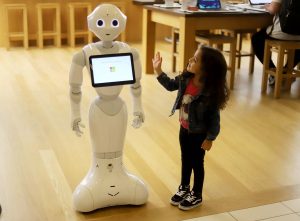
Pepper outside the Microsoft store in San Francisco’s Westfield Mall
Pepper stands just under 4 feet tall and has a cheerful, high-pitched voice and big expressive eyes, making it look less intimidating than a traditional librarian!
(I’m having trouble embedding a YouTube video of Pepper, so here it is: https://www.youtube.com/watch?v=xs0JSI3wsck&t=109s)
Developed by SoftBank in Japan, Pepper has already been used in several Japanese libraries. Pepper came to public libraries in the U.S. a few years ago: Virginia’s Roanoke County Public Library introduced Pepper in 2018 as an interactive greeter and for STEAM programs, Virginia’s Central Rappahannock Regional Library uses Pepper in their makerspace to help members explore new technology, and Hawaii’s ʻĀina Haina Public Library added Pepper in 2025 to greet visitors, answer questions, and gives users an opportunity to interact with a robot.
Pepper can communicate in nine spoken languages, greet members, answer library questions, and even offer book recommendations. It has also been used to promote library programs and storytelling, making the library experience more fun and engaging for all age groups. Robots like Pepper, with their multilingual abilities, help break down language barriers and allow English learners to obtain information without intimidation and judgment. By making information and assistance more accessible, these new technologies can help libraries become truly inclusive and safe spaces for our community members.
References
Asch, S. (1998). Urban libraries confront linguistic minorities: Programs that work. In R. Constantino (Ed.), Literacy, Access, and Libraries Among the Language Minority Population (pp. 69–87). Scarecrow Press.
Central Rappahannock Regional Library. (n.d.) Idea Space. https://www.librarypoint.org/ideaspace/
Hawaii News Now. (December 10, 2025). Pepper the robot makes Hawaii Library debut. https://www.hawaiinewsnow.com/2025/12/11/pepper-robot-makes-hawaii-library-debut/
Jones, I. (2018, August 30). Pepper the humanoid robot comes to Roanoke County Public Library. WSLS 10. https://www.wsls.com/news/2018/08/30/pepper-the-humanoid-robot-comes-to-roanoke-county-public-library/
RobotLab. (n.d.) Pepper Robot for Libraries. https://www.robotlab.com/store/pepper-robot-for-libraries/?srsltid=AfmBOoo84zfLohLlniNQR59a7jNxncp6314qwXU4nhxa4CR98NbqopDo
San Jose State University. (n.d.). Pepper. https://ischool.sjsu.edu/pepper
SF Gate. (2016, November 22). Robots greet Westfield mall shoppers in San Francisco, San Jose. https://www.sfgate.com/business/article/Robots-greet-Westfield-mall-shoppers-in-San-10631291.php
Shuva, N. Z. (2024). More than a place for social capital creation: Public library as a place for immigrants’ social integration. CUNY Academic Works. https://academicworks.cuny.edu/cgi/viewcontent.cgi?article=1701&context=qc_pubs
Tech Crunch. (2017, January 25). Pepper the robot gets a gig at the Oakland airport. https://techcrunch.com/2017/01/25/pepper-robot/
@cocoatthelibrary This is a great question: ” Can robots help members feel less hesitant about asking for help?” I think this is a good way to examine what might be possible with robots, especially as people become more accustomed to them.
Hi Coco, I enjoyed reading about both non-English-speaking library users and Pepper the robot. I’m impressed by Pepper’s ability to speak 9 languages and have brief interactions with library patrons! I’ve read about libraries that use friendly-looking robots to greet and interact with autistic children too. (https://americanlibrariesmagazine.org/2024/03/01/realizing-potential/) I agree that robots can help libraries better serve patrons who may feel reluctant or unable to interact with staff for whatever reason. I also think it’s the responsibility and privilege of libraries to introduce or familiarize patrons with technology like robots that may be otherwise cost-prohibitive to access.
Hi Nancy! Thank you for your comment. I have read about cases in Japan where Pepper is exclusively used in the Children’s Section, and I think that is very smart! I can imagine how a young child may want to approach a robot, something that they are familiar with from watching cartoons, rather than speak with a grownup!
I really enjoyed reading your post! I hadn’t thought about how a robot like Pepper could make asking for help feel less intimidating, especially for people who aren’t comfortable speaking English. It’s an interesting idea, and I can definitely see how it could make libraries feel even more welcoming.
Hi Coco, this was an excellent post! Considering robots as part of the information landscape of libraries, especially in the case of immigrants and language barriers, is an intriguing concept. A typical reference interview is already fraught with obstacles from the beginning (trying to decode what a patron is really asking for versus what they are saying), and to add a language barrier on top of that makes it more daunting and awkward for everyone involved. There can be something slightly reassuring with robots; there is the “no judgment” aspect that you mentioned. Having a positive experience with a robot like Pepper at a library can boost a new patron’s confidence and increase return visits. As you said, this will make the library more welcoming and inclusive. (On a side note, your post automatically made me think of the Waymos in my neighborhood. When I’m walking in the area, I dread the drivers accelerating to a stop at intersections (if they do at all), but I feel safer when I see a Waymo approaching. Robots are reliable!) Thanks for the great post!
Hi Yolanda! Thank you for your comment! From my experience working with English learners, I’ve noticed that they can feel frustrated when their questions aren’t understood (and this is entirely understandable). In these situations, robots can be a helpful alternative, allowing questions to be repeated as often as needed without fear of judgment. That reassurance can make a real difference and increase return visits.
I really appreciate your analogy of humanoid robots to Waymos, they truly are more reliable and predictable, and, they don’t drink and drive! 🙂