https://canva.link/lyzf36esk611mg6
Inspiration Report: Staying-type Libraries – Libraries as Third Spaces in Japan
For the Inspiration Report, I have chosen to build upon an earlier blog post and explore library trends in Japan to offer a broader global perspective. I hope you enjoy finding out more about “staying-type libraries” in Japan.
Posted in Uncategorized
1 Comment
Reflection Blogging 5: Infinite Learning Modules
Modern libraries serve as dynamic centers for education, connection, and community support. To promote lifelong learning, modern libraries provide educational opportunities both within their physical spaces and through a growing range of virtual offerings. This week, I want to spotlight how my library actively addresses food insecurity to prepare members with the knowledge and resources to help fight this important issue.
The onset of the COVID-19 pandemic prompted libraries to reimagine how they could serve their communities. Recognizing the importance of staying connected and continuing to offer learning opportunities, many libraries, including ours, began offering virtual programs on platforms like YouTube at a time when members could not visit the library. One of our staff members, a former professional chef with a passion for sharing his expertise, stepped up to lead a series of virtual cooking classes for children during this time. These sessions not only taught kids valuable culinary skills, but also encouraged them to explore healthy eating habits at home. Building on this success, we are now developing an in-person cooking program, aiming to foster hands-on learning, confidence, and community around the shared experience of preparing food while tackling food insecurity in the community.
Our commitment to community well-being also includes partnerships with local educational nonprofits dedicated to sustainable farming and gardening. Through a collaboration with Fremont LEAF (Local Ecology and Agriculture Fremont), we offer hands-on gardening classes both within our library and at LEAF’s urban garden. These classes provide members the chance to discover how cultivating healthy soil supports nutritious food, promotes climate resilience, and supports community wellness.
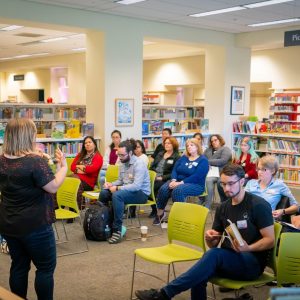
“Talkin’ Dirt: Learn All About Container Gardening” workshop at Fremont Main Library
Additionally, the library works with Our Water Our World, a partnership between water pollution prevention agencies, garden centers, and hardware stores, to provide workshops on gardening practices that attract beneficial insects and minimize harmful pesticide use. These programs not only support ecological stewardship but also give our members the tools to make informed, positive changes in their own gardens and neighborhoods.
.png)
Gardening class with Our Water Our World
As our world evolves, modern libraries have transformed into centers for lifelong learning, adapting creatively to meet the diverse needs of their communities. From online classes and digital resources to workshops and outreach events, libraries strive to meet learners wherever they are. By fostering curiosity, supporting skill-building, and nurturing a sense of belonging, libraries empower individuals to grow, pursue their passions, and contribute meaningfully to their communities.
Posted in Uncategorized
Leave a comment
Reflection Blogging 4: New Horizons Part 2
Many immigrants visit the library for their informational, technological, educational, reading, and entertainment needs (Shuva, 2024). However, limited English skills can create a barrier to accessing library services, especially since more than 64% of our city’s population speak a language other than English at home. Research shows that library users of color are more likely to ask reference questions when bicultural and bilingual staff are present (Asch, 1998). I have witnessed this myself at the Member Services Desk, where I have noticed that even members who speak English well often feel more comfortable and are more likely to ask follow-up questions in their native language when bicultural and bilingual staff are present. On the other hand, non-English speakers tend to avoid interacting with staff entirely. So how can we support non-English-speaking members who might feel intimidated about approaching the Member Services Desk? Even the best machine translation tools won’t be much help if people are hesitant to reach out. This brings us to an interesting question: Can robots help members feel less hesitant about asking for help?
Pepper, a social humanoid robot, first made its appearance in the San Francisco Bay Area at shopping malls in 2016 and later at the Oakland International Airport in 2017.
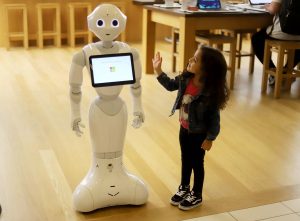
Pepper outside the Microsoft store in San Francisco’s Westfield Mall
Pepper stands just under 4 feet tall and has a cheerful, high-pitched voice and big expressive eyes, making it look less intimidating than a traditional librarian!
(I’m having trouble embedding a YouTube video of Pepper, so here it is: https://www.youtube.com/watch?v=xs0JSI3wsck&t=109s)
Developed by SoftBank in Japan, Pepper has already been used in several Japanese libraries. Pepper came to public libraries in the U.S. a few years ago: Virginia’s Roanoke County Public Library introduced Pepper in 2018 as an interactive greeter and for STEAM programs, Virginia’s Central Rappahannock Regional Library uses Pepper in their makerspace to help members explore new technology, and Hawaii’s ʻĀina Haina Public Library added Pepper in 2025 to greet visitors, answer questions, and gives users an opportunity to interact with a robot.
Pepper can communicate in nine spoken languages, greet members, answer library questions, and even offer book recommendations. It has also been used to promote library programs and storytelling, making the library experience more fun and engaging for all age groups. Robots like Pepper, with their multilingual abilities, help break down language barriers and allow English learners to obtain information without intimidation and judgment. By making information and assistance more accessible, these new technologies can help libraries become truly inclusive and safe spaces for our community members.
References
Asch, S. (1998). Urban libraries confront linguistic minorities: Programs that work. In R. Constantino (Ed.), Literacy, Access, and Libraries Among the Language Minority Population (pp. 69–87). Scarecrow Press.
Central Rappahannock Regional Library. (n.d.) Idea Space. https://www.librarypoint.org/ideaspace/
Hawaii News Now. (December 10, 2025). Pepper the robot makes Hawaii Library debut. https://www.hawaiinewsnow.com/2025/12/11/pepper-robot-makes-hawaii-library-debut/
Jones, I. (2018, August 30). Pepper the humanoid robot comes to Roanoke County Public Library. WSLS 10. https://www.wsls.com/news/2018/08/30/pepper-the-humanoid-robot-comes-to-roanoke-county-public-library/
RobotLab. (n.d.) Pepper Robot for Libraries. https://www.robotlab.com/store/pepper-robot-for-libraries/?srsltid=AfmBOoo84zfLohLlniNQR59a7jNxncp6314qwXU4nhxa4CR98NbqopDo
San Jose State University. (n.d.). Pepper. https://ischool.sjsu.edu/pepper
SF Gate. (2016, November 22). Robots greet Westfield mall shoppers in San Francisco, San Jose. https://www.sfgate.com/business/article/Robots-greet-Westfield-mall-shoppers-in-San-10631291.php
Shuva, N. Z. (2024). More than a place for social capital creation: Public library as a place for immigrants’ social integration. CUNY Academic Works. https://academicworks.cuny.edu/cgi/viewcontent.cgi?article=1701&context=qc_pubs
Tech Crunch. (2017, January 25). Pepper the robot gets a gig at the Oakland airport. https://techcrunch.com/2017/01/25/pepper-robot/
Posted in Uncategorized
6 Comments
Reflection Blogging 3: New Horizons
To provide better services to our diverse community, my library proactively hires staff who speak different languages and offers a monthly subsidy for those who can demonstrate their language proficiency by passing a language test. At the Member Services and Reference Desks, we have one Cantonese/Mandarin/Japanese speaker (that’s me!), one Mandarin speaker, one Spanish speaker, one Tamil speaker, and two Tagalog speakers. Still, there are times when we encounter members who speak languages that we are not familiar with, and technology can come to our rescue.
Real-time Machine Translation
- Mobile apps such as Google Translate and Apple Translate offer convenient camera and voice translation for quick transactions in the library.
- ChatGPT and other AI chatbots are great tools for translating written text into other languages.
- Use case 1: A reference librarian uses Google Translate’s camera feature to translate a flyer about our summer reading program.
- Use case 2: A staff member uses Apple Translate’s voice feature to help a worried mother who has lost her child in the library.
- Use case 3: I used ChatGPT to translate our Summer Reading program materials from English to Traditional Chinese, and only needed to make minimal changes.

Machine Transcription
- AI transcription services such as JotMe can help with translation, transcription, chatbot support, and meeting notes in over 200 languages.
- Use case: Library staff use JotMe to turn speech into text when community members share their stories via Zoom and other video formats.
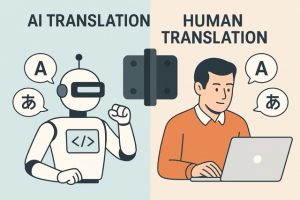
Real-time ASL translation
- Sign Language AI allows users to translate, compose, and search for ASL in real time on their website. Sorenson Communications is also developing an AI-driven sign language translation support tool that will translate a deaf individual’s signs into English text, and then turn the hearing person’s spoken response into text for the deaf user.
- Use case: Our Library is located very close to the California School for the Deaf, so we often welcome members of the deaf community. Using real-time ASL translation, library staff at the Member Services Desk help deaf users search for and check out materials.

References
Apple. (n.d.). Translate text and voice for conversations across languages using iPhone. https://support.apple.com/guide/iphone/translate-text-voice-and-conversations-iphd74cb450f/ios
ChatGPT. (n.d.). Home. https://www.chatgpt.com
Google. (n.d.). Home. https://translate.google.com
JotMe. (n.d.). Home. https://www.jotme.io/
Sign Language AI. (n.d.). Home. https://www.signlanguageai.com/
Sorensen OmniBridge. (n.d.). Soreson Omnibridge. https://omnibridge.ai/
Posted in Uncategorized
5 Comments
Innovation Roadmap: Storytelling through Technology
Storytelling through Technology is a community-driven storytelling initiative that I developed for the Fremont Main Library in Fremont, CA. Its goal is to strengthen community bonds by inviting members to share their stories using innovative technologies that break down traditional barriers. The slide-based visual plan for the initiative can be accessed here:
Posted in Uncategorized
2 Comments
Reflection Blogging 2: Hyperlinked Environments and Issues
In my previous blog, I touched upon the growing loneliness epidemic among immigrants. In 2023, Dr. Vivek Murthy, the former U.S. Surgeon General, highlighted the serious effects of loneliness and social isolation, as well as the benefits of more connected communities (Office of the U.S. Surgeon General, 2023). Libraries can help nurture a sense of community and belonging by providing a third space where people can connect and feel at home, all without the pressure to spend money. Emma Wood, Associate Librarian at UMass Law Library, describes a third space as “space that is separate from home and work where we seek conversation, neutral ground, and comfort in feeling connected” (Wood, n.d.). In many Asian countries, where collectivist values are stronger, there is greater emphasis on fostering human connections. Information professionals in the United States can learn from our colleagues from these cultures to make libraries more deliberately social spaces.
Modern Japanese libraries are intentionally designed as third spaces (often referred to as “destination libraries”). These vibrant, community-centered hubs feature experimental and adaptive architecture, shared work areas, technology centers, and even cafés that actively invite public engagement. For example, the Ota Library in Gunma Prefecture, Japan, was developed with its growing population in mind, blending the functions of an art museum and a library to foster curiosity and creativity. Citizen feedback was integrated throughout every phase of the planning process to reflect the true needs of the community. The library curates local art, crafts, and historical materials, and its café offers food and beverages made from local ingredients, demonstrating how thoughtful design and programming can successfully fulfill the third-space mission.
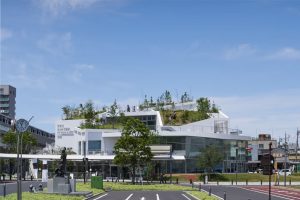
Art Museum & Library, Ota
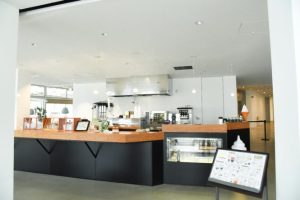
Cafe at Art Museum & Library, Ota
On the other hand, Minna no Mori Gifu Media Cosmos in Gifu, Japan serves as a multi-purpose cultural facility that embodies the third-space vision. It houses the Municipal Central Library (“center of knowledge”), the Citizens’ Activity Exchange Center (“center of community bonds”), and the Multicultural Exchange Plaza and exhibition galleries (“center of culture”). Designed as a true “destination library,” it encourages people of all ages to form connections with each other and with the broader community. Its Community Activity Exchange Center even operates a “Foreign Resident Consultation Counter,” offering daily assistance in six languages to support non-Japanese speakers, further strengthening the library’s role as a community connector.
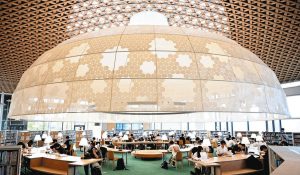
‘Minna no Mori’ Gifu Media Cosmos
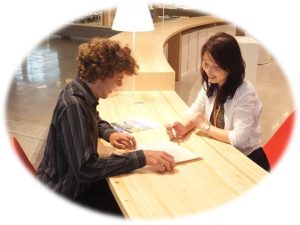
Foreign Resident Consultation Counter
These examples remind us that reimagining our libraries as intentional third spaces cannot be a second thought, but true inclusivity and connection-building often begin in the planning phase.
References
Art Museum & Library, Ota. (n.d.). Facilities. https://www.artmuseumlibraryota.jp/eng/facilities-eng/#id03
Gifu Media Cosmos. (2026). Home. https://g-mediacosmos.jp/
Office of the Surgeon General. (2023). Our epidemic of loneliness and isolation: The U.S. Surgeon General’s advisory on the healing effects of social connection and community. US Department of Health and Human Services. https://www.hhs.gov/sites/default/files/surgeon-general-social-connection-advisory.pdf
Wood, E. (n.d.). The rise of third place and open access amidst the pandemic. American Library Association Office for Diversity, Literacy & Outreach Services. https://www.ala.org/advocacy/diversity/odlos-blog/rise-third-place
Posted in Uncategorized
6 Comments
Reflection Blogging: Hyperlinked Communities
For Assignment X, I wrote about how libraries offer creative storytelling and community story sharing opportunities to help members actively participate in our services and foster a sense of belonging. As I finish the readings in Module 5, I am once again encouraged by librarians around the world who are fostering diversity, inclusion, and human connection in libraries. I live in the San Francisco Bay Area, one of the most ethnically and culturally diverse areas in the country. The library where I work serves a community where People of Color have become the majority (I am still struggling with the term “People of Color,” but that is a blog post for another day), where 64% of our residents claim to be “Asian alone” in the Decennial Census in 2020. Nearly 60% of these Asian immigrants were born overseas, with 15.5% noting that they come from households where limited English is spoken. That is a striking 15,000 people. How are they managing their lives here if they do not speak or understand English? Is my library reaching out to them and helping them and access information essential for day-to-day life? Do they feel that they belong?

Holi celebration at my library
I hope this is where I can step in.
While I only speak selected Asian languages and mostly help Chinese- and Japanese-speaking members, I wholeheartedly agree with Victoria Angela Savage, CEO of Public Libraries Victoria, whose vision of the public library is that “Libraries are free, non-judgemental, trusted, and accessible to everyone. There’s no stigma involved in coming into a library and we feel that we can offer safe and welcoming spaces for people who might otherwise experience discrimination” (Hasan, 2023). That was what the Port Moody Public Library was to me when I first emigrated to Canada at the age of 13, and that is the library that I want to work at and create for all members of the community. Having lived in five countries and being an immigrant myself, I understand that moving to a new country and re-establishing oneself is a lonely and daunting experience. Making friends with the locals is also extremely difficult due to language barriers, different cultural backgrounds, and quite frankly, people’s lack of interest in foreign cultures and immigrant experiences. Just as Savage believes that there is an epidemic of loneliness in Australia, I believe that there is an epidemic of loneliness among the immigrant population, where few, if any, free and public spaces are created for them to learn, grow, and connect. But today’s libraries, serving more as community centers, are uniquely positioned to fill this gap. With new technologies and especially AI, we have plenty of tools to break down language barriers and offer resources, programs, and services in people’s native languages. Even more important is that we now have the tools to collect feedback from these communities, listen to their needs, and foster genuine connections. Using Lauersen’s analogy, diversity is inviting others to the party, and inclusion is asking them to dance (Lauersen, 2018). By actively listening to our members’ needs and involving them in conversations and decision-making, we invite them to dance with us and, together, create a safe space where everyone feels they belong.
References
Hasan, T. N. (2023, June 27). ‘Free, non-judgemental, accessible’: How your local library is a sanctuary of health and wellness. SBS. https://www.sbs.com.au/language/bangla/en/article/free-nonjudgmental-and-accessible-how-your-local-library-is-a-sanctuary-of-health-and-wellness/t15blzsi9
Lauersen, C. (2018, June 7). Do you want to dance? Inclusion and belonging in libraries and beyond. The Library Lab. https://christianlauersen.net/2018/06/07/inclusion-and-belonging-in-libraries-and-beyond/
Posted in Uncategorized
2 Comments
Assignment X — Participatory Service: Storytelling in the Community
For this assignment, I want to explore how libraries offer participatory services to members in the form of storytelling and community story sharing. Since their inception, libraries have preserved human-made stories and served as depositories of these stories. Some libraries, including the one where I work, are fortunate enough to have an archive that collects and curates stories of local and state history. However, an interview with our reference librarians reveals that few library members visit the archives. Among whom, most are white seniors searching for their high school yearbooks or students researching for school projects. The librarian also indicated that the archives are underutilized by people of color, largely because their histories are not represented in the artifacts. This makes me wonder: how can our archives become more inclusive and serve all members in our community?
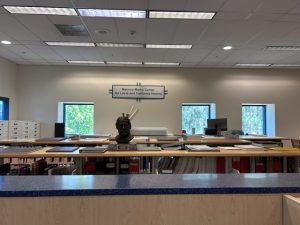
Maurice Marks Center for Local and California History
Dr. Stephens presents the Hyperlinked Library model in his books Wholehearted Librarianship and Heart of Librarianship, arguing that, in this ever-changing socio-technological landscape, modern libraries must use new technologies and offer user-centered services both in person and online. In contrast to the past, when library directors and librarians dictated which services and programs to offer, library users today are seeking ways to participate and build a sense of belonging in their libraries. Across the country, community members are helping shape libraries by providing input on library space use, programming, and collection development. Among the participatory services offered by libraries, storytelling may be the most important one. In “Telling Stories” in Wholehearted Librarianship, Dr. Stephens explores the ideas of keeping, sharing, and making stories, and discusses storytelling initiatives such as that at the Kraemer Family Library at the University of Colorado, Colorado Springs, The Naked Truth: Connect, Create, Contribute (NT:CCC) initiative from the Mill Valley Public Library, and StoryCorps. These are all examples in which community members actively participate in the programs and connect with each other through stories. Dr. Stephens believes that, through facilitating storytelling with diverse members of the community, “libraries can provide the space and training for people of color, LGBTQ folks, and the disabled to share their stories, many of whom don’t make it into mainstream media” (Stephens, 2019).
Libraries are supporting storytelling in many creative ways. For example, to support their storytelling, The Naked Truth equipped their speakers with the necessary tools and knowledge beforehand and created an online platform in addition to their live events to share the stories with a wider audience. Similarly, DOK, the Delft Library in the Netherlands, facilitates the Living Library, where members can have live conversations with a “Living Book,” a real-life person, to gain new perspectives and challenge prejudice or stigma. The Westmount Public Library in Quebec, Canada, uses an interactive multitouch table where members can view and interact with a collection of more than 40,000 postcards and other artifacts collected from the local community. The collection is made available in both French and English and removes barriers that once prohibited access.

Bibliothèque publique de Westmount Public Library, 2016
As for my library, I have some ideas for improving our services and making our archives more inclusive. I believe it is especially important to encourage participation and collaboration from people of color and other marginalized groups, who often have to work extra hard to be heard. New technologies, such as AI-powered translation apps, can leverage speech-to-text, generative AI, and real-time inference to overcome language barriers and provide English translations at storytelling sessions. Offering both in-person and virtual storytelling sessions also breaks down barriers for those who cannot easily visit the library. Furthermore, we can utilize our equipment at our Memory Lab, and invite members to share their memories with us after digitizing them using our flatbed and book scanners and VHS digitizing tools, to support future storytelling. This can be done on an interactive multitouch table like the one at the Westmount Public Library, or through a photo sharing website such as Flickr and Instagram, if the budget is tight.

Artifacts from the Memory Lab
Community storytelling enriches people’s lives and challenge stereotypes and prejudices through open dialogue. With the San Francisco Bay Area being one of the nation’s most ethnically and culturally diverse regions, it becomes the responsibility of our libraries to not only preserve local history but also foster stronger connections among members through storytelling.
References
Baiocco, L. (2016, June 19). Labor of love: Opening up archival gems for community engagement. Information Today. https://www.infotoday.com/cilmag/may16/Baiocco–Labor-of-Love–Opening-Up-Archival-Gems-for-Community-Engagement.shtml
Bibliothèque publique de Westmount Public Library. (2016). 2016 – La Semaine des bibliothèques publiques – Public Library Week [Photograph]. https://www.flickr.com/photos/bibliowestmount/30325561161/in/album-72157675285586746
DOK. (n.d.). Living Library. Retrieved June 18, 2026, from https://www-dok-info.translate.goog/volwassenen/livinglibrary.html?_x_tr_sl=nl&_x_tr_tl=en&_x_tr_hl=nl
Stephens, M. (2019). Wholehearted Librarianship: Finding hope, inspiration, and balance. American Library Association.
Van de Geer, J. (2015, December 6). Local Stories [Video]. YouTube. https://www.youtube.com/watch?v=WAfw2logFJM&t=9s
Posted in Uncategorized
5 Comments
Introduction
My name is Coco Yu, and I am a Chinese-Canadian living in the San Francisco Bay Area. My background is in PR and project management for non-profits, and I began the MLIS program at SJSU in early 2024 as a career change. I currently work as a Clerk at the Alameda County Library and enjoy every aspect of my job. I get especially excited when I can use my language skills to help members who speak little to no English to find what they need. I even made two buttons at our Makerspace that says “I speak Cantonese” and “I speak Mandarin” in the respective languages, and I wear them at all times during work. I am also interested in learning ASL because our library is visited by many members of the deaf community, and there is a need that is currently not being met.
This is my final class and semester in the program (yay!). I look forward to graduating, taking on more responsibilities at the library, and planning and leading programs in the near future.
When I am not at the library, I sew clothes for my two children or am busy driving them to gymnastics meets and soccer games. I also enjoy playing the guitar, learning languages, and hanging out with our cats. Cat tax below:
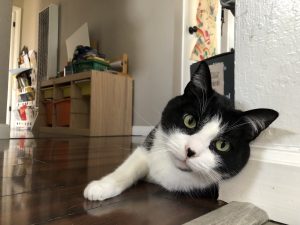
Chuckles
Posted in Uncategorized
4 Comments