Reflection on Hyperlinked Environments: Global Libraries
What should a library look like? Besides books, what should libraries be providing for their communities? These are the questions I’ve been considering this semester so far as I have been learning more about the concept of hyperlinked libraries. For most of my life, I had certain expectations of what a library should look like based on my experiences with the local branches in my community. Basically I saw them as buildings housing books, DVDs, VHS tapes (until they were no longer popular), CDs, and magazines. To me, one of the coolest features a library could have was a duck pond just right outside, as is the case for one of my local branches just ten minutes from my house. But that was before I started exploring libraries from other systems in southern California with my husband in our quest to collect library cards and expand our access to Libby. In this quest, we have made some cool discoveries. For instance, the Carlsbad Dove Library has a makers’ space (the first I’d ever seen in person), a cafe, a gallery, and even an auditorium. And the Cerritos Library features what I believe is one of the coolest-looking children’s sections, as it includes a fish tank and a T-Rex skeleton.
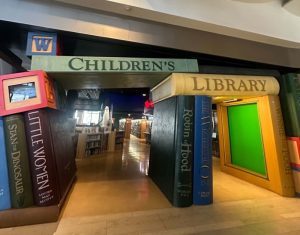
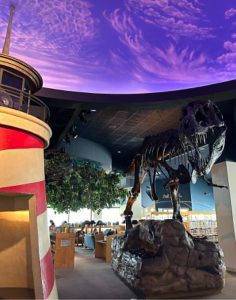
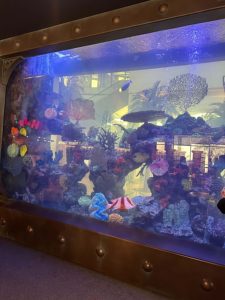
Pictured above: The Cerritos Library children’s section
But this week I found myself in awe once again as I explored (virtually) global libraries.
The Look
Though the saying goes to never judge a book by its cover, one cannot help but appreciate the aesthetics and features of a library. Perhaps a great example of this is the Woollahra Library, which incorporates nature into its design. Filled with hanging gardens and organic shapes (McGarry, 2019), this library provides a naturally soothing environment in which to enjoy the materials held within. Other notable library designs include the Forum Groningen in the Netherlands, which includes “a cinema, exhibition halls, a museum for comics, animation and games, a media lab, restaurant and rooftop terrace” (The Guardian, 2021); and the Ningbo New Library in Ningbo, China, which includes lecture halls and even a library specifically for the visually impaired. Notably, the Dokk1 features the largest tubular bell in the world, which new parents can ring every time a baby is born (Zorthian, 2016). The best libraries don’t just look cool. Their design features are meant to cater to, and in some cases like Dokk1’s bell, even celebrate, the community.
The Services
A library can stand out not just by its looks but also by what it provides. I was especially excited to see some of the services at Australian libraries like the State Library of Queensland. One such service is the Great & Grand Rumpus, which was an art installation brought together by the talents of over 1000 community members (State Library of Queensland, n.d.). How incredible is it that an entire community can come together to build whimsical creatures straight from kids’ imaginations using materials like cardboard?
Another thing I appreciated is how Australian libraries have been making efforts to include indigenous communities. For far too long, voices of indigenous peoples around the world had been left out of the greater conversation. Their stories were being told not by themselves but by outsiders who had encountered them. Luckily, this is starting to change, especially as institutions like libraries are helping to lead the charge in embracing equity. One way some Australian libraries have been doing that is by reevaluating their book classification system so local communities like the Yolngu can find what they’re looking for easier (Thompson & Trevaskis, 2018). In addition, the State Library of Queensland’s Indigenous Knowledge Centre has brought digital equipment workshops to indigenous communities (State Library of Queensland, 2025). And libraries have been working directly with indigenous communities to update their collections and provide programming celebrating indigenous culture in a respectful and culturally safe manner (National and State Libraries of Australasia, n.d.). Efforts such as these prove that libraries can do more than talk the talk. They truly can build a welcoming environment for everyone, no matter a person’s background.
Overall, this digital exploration has been rather illuminating, as the more I learn about global libraries, the more I grow to appreciate the library world and what it has to offer its communities.
Resources
The Guardian. (2021, July 6). ‘A cultural masterpiece’: the world’s best new public libraries – in pictures. https://www.theguardian.com/books/gallery/2021/jul/07/a-cultural-masterpiece-the-worlds-best-new-public-libraries-in-pictures
McGarry, M. (2019, April 7). Bookworms rejoice – The best libraries in Australia. The Design Files. https://thedesignfiles.net/2019/04/architecture-best-libraries-australia
National and State Libraries Australasia. (n.d.). Culturally safe libraries: Working with indigenous collections. https://www.nsla.org.au/resources/cslp-collections/
State Library of Queensland. (2025, March 24). Digital skills spark new creative ideas in Arkai (Kubin) on Mua Island. https://www.slq.qld.gov.au/blog/digital-skills-spark-new-creative-ideas-arkai-kubin-mua-island
State Library of Queensland. (n.d.). The making of the great & grand rumpus. https://www.slq.qld.gov.au/greatgrandrumpus/makinggreatgrandrumpus
Thompson, J., & Trevaskis, L. (2018, August 21). Galiwin’ku library closes book on the Dewey Decimal System to prioritise Yolngu culture. ABC. https://www.abc.net.au/news/2018-08-22/remote-galiwinku-library-closes-book-on-dewey-decimal/10147024
Zorthian, J. (2016, August 19). Look inside the most cutting-edge public library in the world. TIME. https://time.com/4458185/denmark-library-cutting-edge-dokk1/
5 Comments
Laura Skorczeski
The Cerritos Library children’s section is so dreamy!!! 😍
Rachel Leverenz
Thanks for sharing the picutres of the Cerritos Library. That children’s area is awesome! It reminds me of a theme park–like Universal or Disney. That is such an amazing space for kids!
Jennifer K
@litwrit I love that you went on a mission to collect library cards in SoCal! I l also enjoy exploring the different libraries here, and I was so impressed with the Cerritos Library when I visited. The environment in the children’s area creates an atmosphere of exploration and fun. It can create a spark of curiosity that makes the library and the stories children find there magical. Especially in a world where we’re competing with constant visual and digital stimulation, creating an exciting children’s room can capture young readers’ attention and help them see the library as a place for discovery. The atmosphere created in library spaces shouldn’t be underestimated. Another great SoCal library spot is the Octavia Lab at the LA Central Library. The space and all the different equipment creates a sense that the possibilities for what patrons can make there are endless.
Sarah Morse
I’ll have to check out the Octavia Lab someday! My group actually did a strategic plan for the LA Central Library in INFO 204 and since then I’ve been wanting to check it out.
Michael Stephens
@litwrit The T-Rex is amazing! I appreciate all the global libraries you highlighted in this post. This will be a good artifact for your ePortfolio.