Assignment X: Libraries – The Answer to Life, the Universe, and Everything?
Whenever I tell most people I work in a library, the most common response I get is, “Oh, so you just read all day? That must be the easiest job ever.” Gosh, I sure wish that was the case. I’m a bookwyrm surrounded by books, and unfortunately, I cannot just read every second I am at work. (Though I do sneak in some chapters whenever I have some downtime.) I cannot blame them for thinking this way though. I used to think similarly. If someone had asked me when I was younger how I felt about working in a library, I, struck with the fantasy of the splendor of books and of the places that hold vast collections of them, probably would have said something along the lines of, “It must be the most magical job in the world.” If you ask me now, I’d still say working in a library is magical, but not just because of the books.
As I have come to realize since actually working in a library, libraries are about a whole lot more than the books, DVDs, CDs, and magazines displayed on the shelves. The library is centered around the people. Sure, plenty of people come in to check out these items, as even in this digital age where attention spans appear to be shorter, everyone could use a good story. But there are also plenty of people who come, not for books, but for the space and/or the community.
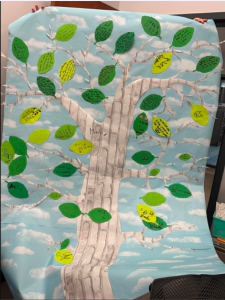
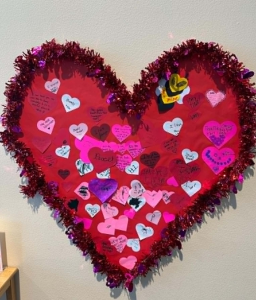
I think one of my favorite things about libraries is the various communities they can build. Whether families come in for storytimes, or groups come in to play Mahjong or Bridge, or teens come in for activities like video games, crafts, or purely hanging out with their friends, the library creates opportunities for people to explore, learn, and connect. Some of my personal favorite activities my library has offered allowed the community to contribute to the library itself, including writing poems on paper leaves to add to our “Poet-Tree,” painting small canvases which now adorn the children’s section, and writing what they love about the library on post-it notes which were added to our large paper heart during the month of February. It’s always incredible seeing everyone’s creativity and their appreciation for what the library gives to them.
But lately, especially after reading the assigned readings, I started to consider what exactly a library should be providing its customers. At the very least, libraries should continue to provide books, as they are still something people want, if not to check out, at least for the atmosphere (Leferink, 2018), and they should have tables and chairs of some sort for a welcoming environment. But what else should libraries offer? What services or spaces? We can turn to other libraries as a model. For instance, the San Francisco Public Library offers a teen space known as “The Mix,” where teens can hang out and take advantage of the available music studio, makerspace, and other activities and tools (O’Brien, 2019). The San Francisco Public Library system also provides access to resources for family and genealogy research and for jobs and careers. The main library also contains a history center (Ferrell, 2022). The Chicago Public Library created a teen area similar to “The Mix” called “YouMedia” where teens can hang out and create their own music, art, podcasts, and more (Chicago Public Library, 2018). And the Oodi in Helsinki, Finland acts like a community center as well as a library as it offers the space and tools for several hobbies which people can choose to pursue and even comes with a fully equipped kitchen (TheRuudy, 2022).
There is much that libraries can and do provide for their communities, but as Shannon Mattern (2014) points out, libraries have also turned into “opportunity centers,” where the focus has been less on fostering intellectual development and more on providing social services for the disenfranchised. And while of course it’s important for people to get access to these services, this can create stress on library workers who have been forced to take on more and more responsibilities. The key, then, is to find balance. As Mattern suggests, one solution is to form partnerships with those whose main responsibilities address bodily needs so libraries can focus more on the needs of the mind.
The library is for everyone, but what does everyone need from their library? That’s what I aim to find out this semester.
References
Chicago Public Library. (2018, April 11). YOUmedia at CPL [Video]. https://www.youtube.com/watch?v=v8G4nnlgKmk
Ferrell, J. (2022, September 15). 13 awesome free things you can do with an SF public library card. Secret San Francisco. https://secretsanfrancisco.com/sf-public-library-card/
Leferink, S. (2018, January 24). To keep people happy…keep some books. OCLC. https://blog.oclc.org/next/to-keep-people-happy-keep-some-books/
Mattern, S. (2014, June). Library as infrastructure. Places Journal. https://placesjournal.org/article/library-as-infrastructure/?cn-reloaded=1
O’Brian, C. (2019, June 24). How San Francisco libraries are embracing their changing role. Shareable. https://www.shareable.net/how-san-francisco-public-libraries-are-embracing-their-changing-role/
TheRuudy. (2022, December 13). Is this the world’s best library? [YouTube]. https://www.youtube.com/watch?v=wvyXjAI5_VI
2 Comments
Anita Chen
Hi Sarah, you bring up an excellent point. (I apologize for the length of this comment because this is a topic I care a lot about!) I feel like many things that libraries offer now are examples of scope creep, since many of these are meant to fill gaps left by a failing government. The housing crisis is why libraries are now cooling or warming centers offering overnight shelter. The mishandling of COVID-19 is why we go to libraries for COVID tests and PPE. The broken healthcare system and pharmaceutical industry are why one library in Philadelphia started administering Narcan to its patrons, and soon federal grants were being awarded to libraries specifically for Narcan rescue kits. If we as library professionals keep ourselves open to adding any and all kinds of services that our community needs, do we ever draw a line, and, if so, where?
And why does all of this fall on libraries, specifically, and not other government buildings or entities? In picking up every ball that the government drops, are we not just allowing the government to continue not-doing what it should be doing? When libraries are already fighting threats to both funding and intellectual freedom, what will happen when library workers are burnt out or when funding is further slashed? And most importantly, what will happen to the community?
People seem to have the tendency to glorify librarianship, both within and outside of the field. In thinking about what role libraries and librarians should play in society, I often think back to the Fobazi Ettarh paper “Vocational Awe and Librarianship: The Lies We Tell Ourselves” (https://www.inthelibrarywiththeleadpipe.org/2018/vocational-awe), as I think it’s a good reminder for those of us who feel the pressure to act like selfless heroes or martyrs. Treating librarianship like some altruistic ideal can quickly lead to burnout while dissuading librarians from advocating for themselves. Currently, less than one-third of library workers are unionized (https://www.ala.org/tools/atoz/unions), but I hope that number grows. In the meantime, I think we as individuals can also engage more with our neighbors and participate in mutual aid so we can lessen the burden on libraries.
Zoe Parker
Hi Sarah!
I also wrote in my assignment that many people do not understand all that libraries and librarians do! Our childhood experiences with the library also seem super similar because while it was the love of reading that drew me to librarianship, I feel so fulfilled to be working towards a career that centers on inclusivity, social service, and supporting our local communities through accessing information.
I love the examples that you provided about different creative programs and spaces that different libraries offer, especially for teens. I believe that teens are super underserved in libraries because so many of their natural behaviors are often prohibited (no talking, restrictive seating, etc.). Creating safe spaces where teens can be themselves is so important because it is an access point for a lifetime of learning.
You brought up so many excellent points in your post!