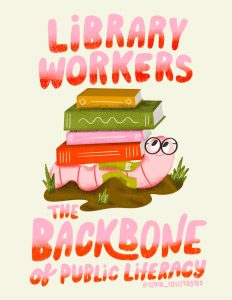
This module’s materials had me thinking about the devastating literacy crisis that we are currently facing across the globe. Also, while technology is a great tool that the hyperlinked library model supports, technology has been proven to negatively affect mental health and attention spans (Small et al., 2020). It is important for libraries to still implement new technologies but simultaneously promote a healthy use of them. The hyperlinked library model supports the fight against this crisis by creating communities that are welcoming, technologically relevant and healthy, and breaking barriers that may prevent patrons from partaking in services.
Salt Lake City Public Library’s (SLCPL) Strategic Roadmap reminded me that the term literacy does not solely refer to reading comprehension, it is talking about the ability to listen, write, and communicate with others too. In their roadmap, the SLCPL has a section on “Critical Literacies” that discusses how they want their library to help foster Early Literacy and Digital Literacy (SLCPL, 2018). There are certain literacies, like digital literacy, that are vital to being part of a community in the 21st century. Digital literacy does just mean that someone is able to communicate and understand information using technology, but this also includes reading. Ebooks and audiobooks count as reading, just like a physical book. Grant’s article mentioned the rise of technology in the 1990s and how there was fear from the library community that libraries would become obsolete (Grant, 2021). I think the fear was understandable at that time, but, to me, technology seems to only strengthen and change libraries’ role in the world. If libraries create a positive attitude surrounding technology instead of rejecting it, patrons may be more willing to trust librarians in other areas too.
There is the issue of barriers or assumed barriers that may prevent patrons from using public library services too. For example, public libraries used to have late fees issued on checkouts, but now most libraries have stopped issuing late fees (including mine!) to encourage patrons to utilize the collection more. Many patrons have expressed publicly that late fees were a major restraining point and that going fine free is a great modification (The City Library, 2018). Lots of community members don’t know about most libraries being fine free now, so they just don’t come back to the library. To solve this, libraries should promote this more, maybe on social media, to let patrons know. The public library is one of the only places community members can go after being in school to find free information, but we need to let the public know what they can do in the library.
References
The City Library. (2018, August 10). The fine free library: One year later. Medium. https://slcpl.medium.com/the-fine-free-library-one-year-later-d28c69743c15
Grant, R. (2021, November). How Memphis created the nation’s most innovative public library. Smithsonian Magazine. https://www.smithsonianmag.com/innovation/memphis-created-nations-innovative-public-library-180978844/?fbclid=IwAR1KhgGc_cXHfCduhqGtJ1Wi5Y2jRho1yW1Q62QjCNC5o2Qs9eLeGnzqqIM
Salt Lake City Public Library (SLCPL). (2018). Strategic roadmap. https://static.libnet.info/images/pdfs/slcpl/StrategicRoadmap.pdf
Small, G. W., Lee, J., Kaufman, A., Jalil, J., Siddarth, P., Gaddipati, H., Moody, T. D., & Bookheimer, S. Y. (2020). Brain health consequences of digital technology use . Dialogues in clinical neuroscience, 22(2), 179–187. https://doi.org/10.31887/DCNS.2020.22.2/gsmall
5 responses to “Hyperlinked Environments Reflection Blog: Public Libraries Addressing the Literacy Crisis”
Hi @abbietxo, I appreciate your focus the literacy crisis! It’s very worrisome to see some of the data. Your point about libraries needing to resist the urge to reject certain technologies in order to be trusted literacy and information sources was well made. It made me think specifically about AI and media literacy. There are so many valid reasons to resist AI, but it is here and it complicates literacy issues dramatically. Librarians really do need to have an understanding of it in order to effectively help our patrons.
I was signing a new patron up for a library card at work last week and they were shocked to learn that we didn’t have any fees. I also still get asked how much fines are for books someone is returning late regularly. We haven’t had fines at our library in many years, so I agree that the idea of late fees is so engrained in peoples’ mind that it could still be an underestimated deterrent.
Hi again! Yeah, the conversation surrounding AI is definitely tense right now, but I think you’re right. It’s best for us to be informed about it despite personal opinion on AI use.
I get that comment a lot too. I’m glad we are able to offer these free services to people, especially with the higher cost of living right now in the U.S.
@abbietxo I appreciated your exploration of what Salt Lake City is doing as well as your reflections on how technology could potentially impact libraries over the decades. It does my heart good to see Salt Lake’s plan for helping their public with digital literacy of the 21st-century.
Hello Abbie,
I enjoyed reading your blog. I especially liked your point about how many patrons are unaware that the library has eliminated late fees. I’ve had several patrons apologize for returning their library books long after the due date, and I’ve had to let them know that we no longer charge late fines.
Hi Nimaliny! Yes, I feel like I get at least one patron everyday that is shocked about us getting rid of late fees.