When we study international libraries, we tend to look up: at Dokk1 in Aarhus, at Oodi in Helsinki, and the buildings that win IFLA’s Public Library of the Year award. They certainly deserve the attention. But global librarianship is not made only of landmark architecture and large grants. It is also made of small rural libraries run by a single staff member.
This post is about one of them. In Todorovo, a village of about 400 in the Pleven municipality of northern Bulgaria, the library occupies two rooms and an auditorium. It was founded in 1927 and named Бъдеще (Budeshte), which means “Future.” Like much of rural Bulgaria, Todorovo’s year-round population is mostly elderly. In summer and over the winter holidays, it grows to around 600, as school-aged children arrive from the big cities and from abroad to stay with their grandparents. I’m not a neutral observer here: my child is one of those visitors, and I too spend summers in Todorovo. The library serves both groups: the elderly who stay year-round, and the children who come and go.

Budeshte Chitalishte, Todorovo, 2024. Photo: Galya Ninova
To understand “Budeshte,” you need another Bulgarian word: “chitalishte,” literally a “reading place.” Since the mid-1800s, Bulgarian towns and villages have built these community houses, which combine a library with a stage, folk-dance and choir groups, and classes. In 2017, UNESCO recognized the “chitalishte” as a good practice for safeguarding intangible cultural heritage. “Budeshte” then is not a library that happens to host community events. It is a community center that happens to lend books too.
The Todorovo “chitalishte” is run by Galya Ninova.
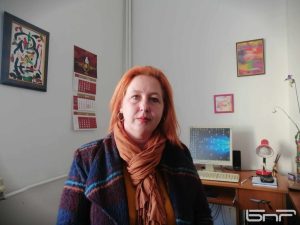
Galya Ninova, director of Budeshte chitalishte, 2024. Photo: Latinka Svetozarova for Bulgarian National Radio (BNR)
Galya is the director, the bookkeeper, the marketing manager, the collections librarian, and the only staff member. She does not hold a library degree. What she has is a stubborn commitment to her community. The library has no website, only a Facebook page, which she updates relentlessly with photos of every event, every visitor, and every child holding a paintbrush. Most of the photos in this post come from that page, which serves as the library’s digital archive as well as its publicity.
Michael Stephens describes this kind of library as one “woven with experience, involvement and empowerment” (Stephens, 2019, p. 60). “Woven” suggests something made by hand over time, and that is what Galya has built. “Budeshte” does have a collection: the classics of Bulgarian literature, chapter books and picture books, and a small but meaningful shelf of children’s books in English, Spanish, and German, the languages of the children who visit from abroad. But Galya will be the first to tell you that people come for the community, not the books. Here is a small sampling of her community work, using Stephen’s three categories.
Experience
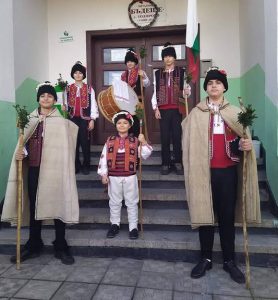
“Koledari” on the chitalishte steps, Todorovo, December 2022. Photo: Galya Ninova
Before Christmas, boys dressed as “koledari” gather on the chitalishte steps in embroidered vests, fur hats, and wool cloaks, carrying decorated staffs and a drum. They go from house to house singing blessings for health and a good year. The library is where they rehearse, dress, and set out from.
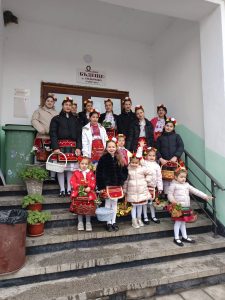
Chitalishte steps, Todorovo, April 2023. Photo: Galya Ninova
In the spring, the girls take their turn. Wearing flower crowns and embroidered aprons, each carrying a basket, they go from house to house to announce the coming of spring. Neighbors fill the baskets with eggs and coins.
Involvement
.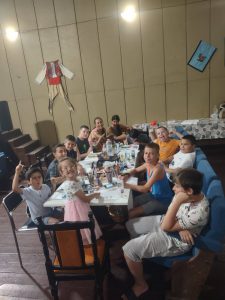
Arts and Crafts club, “Budeshte” auditorium, Todorovo, April 2026. Photo: Galya Ninova.
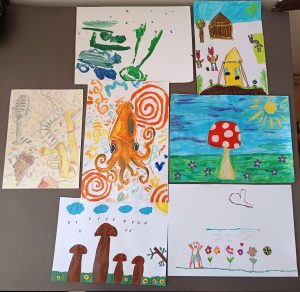
During school breaks, the auditorium becomes an arts and crafts studio. In the photo above about a dozen children of all ages crowd a long table covered with paints and colored pencils. My nephew is second from left, hand in the air in excitement. Their paintings, from a bright red mushroom to a swirling orange octopus, are then displayed together in the reading room. See the image below.
Empowerment
In early summer, Galya recruits the older children to help her clean up the village green. It is a small job but it asks visiting children to treat Todorovo as theirs to care for.
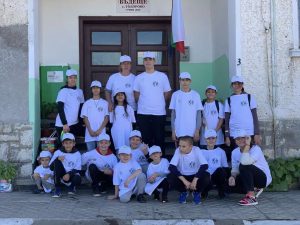
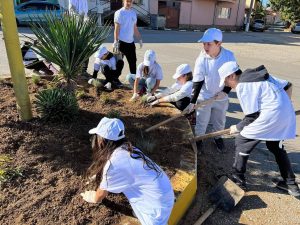
Village green clean-up, Todorovo, summer 2023. Photos: Galya Ninova
Galya tries to reach well beyond the village. When the building’s roof needed replacing, she went on national radio and television with the goal of raising 15,000 euros.
Stephens also argues that libraries should be designed “for people, not books” (p. 61). In much of library thinking, this is a reform, something libraries move toward by opening up floor space and adding makerspaces. The “chitalishte” was built as a place for people from the start; it was meant to be a stage and a meeting hall with a library inside, and Bulgarian rural libraries have run that model since the 1850s.
Not every initiative is a success and not every event works. In 2024, Galya invited Nidal Algafari, a well-known Bulgarian political commentator and journalist, to speak in Todorovo. When we talked this summer, she told me only three people came. (G. Ninova, personal communication, August 2026). You won’t see that poster on the Facebook page. A library that experiments will sometimes miss; and Galya was not discouraged. But her miss shows what designing “for people” demands, which is knowing who your people are at any given moment.
“Budeshte” will never appear on an IFLA shortlist. It’s roof depends on a radio appeal and its website is a Facebook page. Yet it does what Dokk1 and Oodi set out to do, and that is, give its community a place and a reason to gather. If we want to understand global librarianship, we have to look across as well as up.
References:
International Federation of Library Associations and Institutions. (n.d.). IFLA/Baker & Taylor Public Library of the Year Award. https://ifla.org/?p=106685
Mladzhova, B. (2024, March 19). Chitalishte v plevensko selo se nuzhdae speshno ot 30 000 lv. za remont [A village chitalishte in the Pleven region urgently needs 30,000 leva for repairs]. Bulgaria ON AIR. https://www.bgonair.bg/a/36-sutreshen-blok/338822-chitalishte-v-plevensko-selo-se-nuzhdae-speshno-ot-30-000-lv-za-remont
Narodno chitalishte “Badeshte – 1927.” (n.d.). Home [Facebook page]. Facebook. Retrieved October 19, 2026, from [URL]
Stephens, M. (2019). Wholehearted librarianship: Finding hope, inspiration, and balance. ALA Editions.
Svetozarova, L. (2023, December 24). V plevenskoto s. Todorovo ochakvat koledarskata druzhina [In the village of Todorovo, Pleven region, the koledari are expected]. Bulgarian National Radio, Programa Horizont. https://bnrnews.bg/horizont/post/270518/v-plevenskoto-s-todorovo-ochakvat-koledarskata-drujina
UNESCO. (2017). Bulgarian chitalishte (community cultural centre): Practical experience in safeguarding the vitality of the intangible cultural heritage. Intangible Cultural Heritage. https://ich.unesco.org/en/BSP/bulgarian-chitalishte-community-cultural-centre-practical-experience-in-safeguarding-the-vitality-of-the-intangible-cultural-heritage-00969